

Live in Minnesota? You’re in a sweet spot. The state lets you claim its 529 tax credit or deduction no matter which plan you fund—Utah, Illinois, New York, or any of the 80-plus options nationwide. That freedom means you can chase the lowest fees and highest ratings and still pocket up to a $500 state credit or a tidy deduction at tax time.
But choice overload is real. Which plans truly outperform our silver-rated MNSaves, and which tax perk—credit or deduction—puts more cash back in your wallet?
This guide answers both. We’ll clarify the credit-vs-deduction math, then rank six out-of-state plans that beat MNSaves on cost, flexibility, or both. A comparison table and quick flowchart will get you to a decision in minutes—not weeks of searching.
Grab a fresh cup of coffee; let’s make your college dollars stretch further.
Quick guide: credit or deduction? Grab the bigger win
Minnesota gives you two ways to trim your state tax bill when you put dollars into any 529 (no residency strings attached). The choice is simple once you know the math.
The credit is the star. It wipes out 50 percent of your annual contribution, up to $500. Households with Minnesota AGI of $96,220 or less get the full amount; it phases out to zero at roughly $146,220 for joint filers. Think of it as a straight rebate: put in $1,000, get $500 back on your return.
The deduction is the fallback. If your income is too high for the credit, you can still knock up to $3,000 (married) or $1,500 (single) off taxable income. At the top 9.85 percent state bracket, that’s a $295 saver—solid, just smaller than the full credit.
Here’s the cheat sheet:
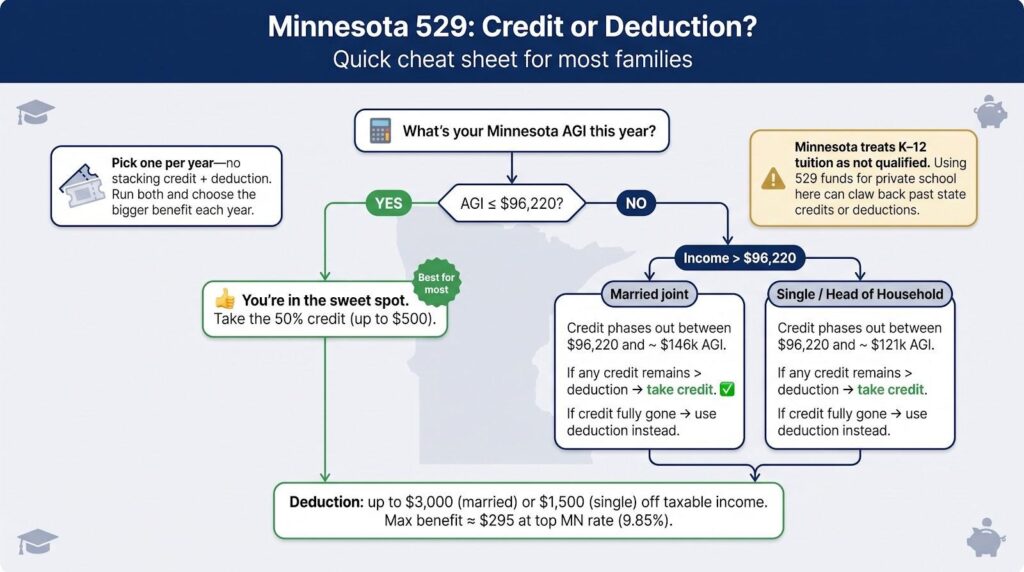
| Filing status | Income sweet spot for the $500 credit | When you pivot to the deduction |
| Married joint | ≤ $96,220 AGI | Credit gone by ~ $146k AGI |
| Single / HOH | ≤ $96,220 AGI | Credit gone by ~ $121k AGI |
Pick one benefit each year. You can’t stack them, and the plan you fund doesn’t matter—Utah, Illinois, even Minnesota’s own all qualify. Run your numbers: if the full or partial credit beats the tax saved with the deduction, take it; otherwise, claim the deduction and keep saving.
One last rule of the road: Minnesota treats K-12 tuition as not qualified, so using 529 money for private school can claw back any state benefit you claimed earlier. Stick to college costs (or the new Roth rollover option later) to keep every penny.
How we picked the winners
Choosing a 529 plan is like booking a long-haul flight. Cost matters most, but you also care about safety records, legroom, and whether the airline keeps modernizing its fleet. We built our shortlist the same way.
First, we filtered every direct-sold 529 in the country for one non-negotiable metric: an all-in expense ratio of 0.25 percent or lower on the cheapest age-based track. Anything pricier left the list.
Next, we leaned on independent quality stamps. Morningstar’s 2024 medalist ratings showed which plans pair smart oversight with investor-friendly pricing. We kept Gold and Silver plans, plus a few Bronze programs with clear strengths. Recent upgrades (Illinois and Massachusetts up to Gold, Nevada down to Bronze) signaled where momentum sits.
After cost and quality, we scored three tie-breakers:
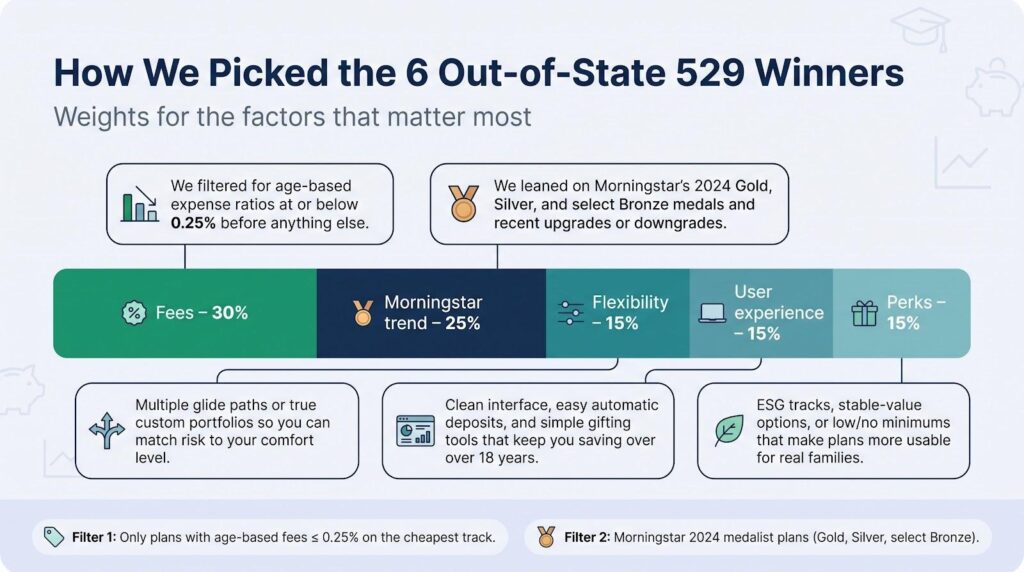
- Flexibility. Multiple glide paths or true custom builds earn points because risk tolerance is personal.
- User experience. Over an 18-year journey, a clean dashboard and easy automatic deposits keep you saving.
- Unique perks. ESG tracks, stable-value options, or zero-dollar minimums can tip the scales.
We weighted the factors as follows: fees 30 percent, Morningstar trend 25 percent, flexibility 15 percent, user experience 15 percent, perks 15 percent. The math surfaced six clear front-runners that outclass Minnesota’s plan on at least one major axis.
In short, we looked for what you would look for: low drag on returns, proven stewardship, and tools that make saving simple.
1. Illinois Bright Start 529: low fees, gold-standard oversight
Bright Start earned Gold status from Morningstar last year after a broad fee cut and tighter manager controls. That upgrade signals a plan that keeps trimming costs, refreshing its lineup, and protecting investors’ returns.
Open an account and the first thing you notice is the price tag (or lack of one). The index age-based track costs about 0.15 percent all in—on par with New York’s ultracheap option and even a touch below Minnesota’s home plan. Illinois also adds range: three glide paths from conservative to aggressive plus roughly twenty static portfolios built with Vanguard, BlackRock, and Dimensional funds. Unsure how much to feed those portfolios each month? Bright Start’s college savings calculator lets you plug in your child’s age, tuition target, and preferred cadence, then maps out the monthly contribution that will keep you on pace. Stay pure index, mix in active managers, or tilt toward ESG without leaving the platform.
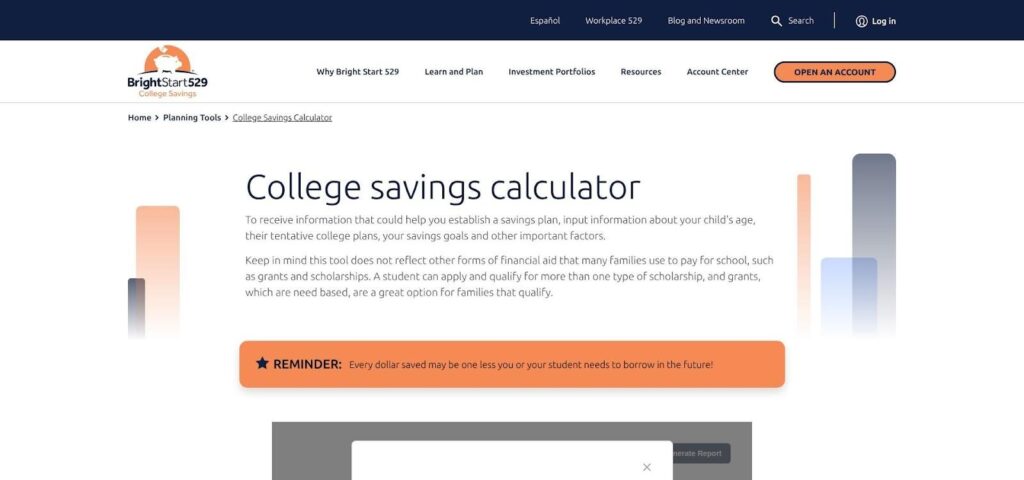
Illinois Bright Start 529 plan College Savings Calculator screenshot
Accessibility scores high. Bright Start lets you begin with zero dollars. Link a bank account, set up a recurring draft, and you’re set—ideal if you’re starting small or lining up gifts from relatives.
What’s the catch? Very little. The plan’s old high-fee era is gone, and reviews of Union Bank & Trust’s interface lean positive. If you want rock-bottom costs plus flexibility, Bright Start is a strong first pick.
2. Utah my529: customization for detail-oriented investors
Utah’s my529 has held Morningstar’s Gold badge longer than most plans have been around. Its edge is steady improvement; every fee cut, fund swap, or glide-path tweak often starts here, then moves across the industry.
The main feature is full DIY control. You can pick a prebuilt age-based track and stop there; costs hover near 0.18 percent. If you want precision, my529 lets you build a glide path from scratch. Set 70 percent stocks until freshman year, then dial risk down each month. A built-in tool forecasts volatility so you can test the mix before locking it in.

Utah my529 homepage showcasing customizable 529 investment options
Choice extends to fund families. Vanguard index funds anchor most portfolios, while Dimensional offers factor-based options. ESG-minded savers can assemble a green-tilted lineup with Dimensional sustainability funds inside the plan.
Flexibility matters only if the gates are open, and they are. Minimum to open: zero. Interface: clean and quick. Customer service: in-house specialists who focus solely on 529 questions.
Possible drawback: the many settings can overwhelm casual investors. If you prefer set-and-forget, choose a default track and still enjoy the same low pricing and stewardship.
Bottom line: my529 suits investors who manage college savings with the same care they give a 401(k). It blends freedom, small fees, and a long record of putting families first.
3. New York 529 Direct: ultra-cheap, set-and-forget simplicity
If you think investing should feel like watching paint dry, New York’s Direct Plan fits the bill. It charges a rock-bottom 0.13 percent on every portfolio, sticks to plain Vanguard index funds, and lets you start with pocket change.
The age-based track follows a single glide path, moving from all-stock at birth to mostly bonds by freshman year. No knobs to twist, no second-guessing. For many busy parents, that restraint is a welcome form of minimalism.
Low cost is more than a bragging point; it keeps real dollars in your future student’s pocket. Shaving 0.07 percent a year off fees versus Minnesota’s plan can grow into a four-figure difference over 18 years. Add Minnesota’s tax break and you layer two advantages.
What you won’t find: active funds, ESG flavors, or exotic asset classes. The menu stays all-index, all the time. If you need tactical tweaks or multiple risk tracks, head to Utah or Ohio. But if you want to automate contributions, leave them alone, and trust a global market portfolio to do the work, New York covers every base at almost no cost.
4. Ohio CollegeAdvantage: balanced menu, friendly dashboard
Ohio’s CollegeAdvantage plan sits in a useful middle zone. Fees stay low at about 0.20 percent on its index age-based tracks, yet you still get extras that ultracheap rivals skip.
Three glide paths let you raise or lower risk with one click. Prefer hands-on control? Mix and match from seventeen static portfolios covering Vanguard index funds, Dimensional factor funds, and a principal-protected stable-value option that earns interest daily. Few plans pair growth potential and guaranteed safety under one roof.
The digital experience feels more fintech than state office. Clean graphs track progress toward a cost target, automatic contribution nudges appear at milestones, and a gifting portal makes it simple for relatives to chip in. Over nearly two decades of saving, that usability keeps you engaged; engaged savers contribute more.
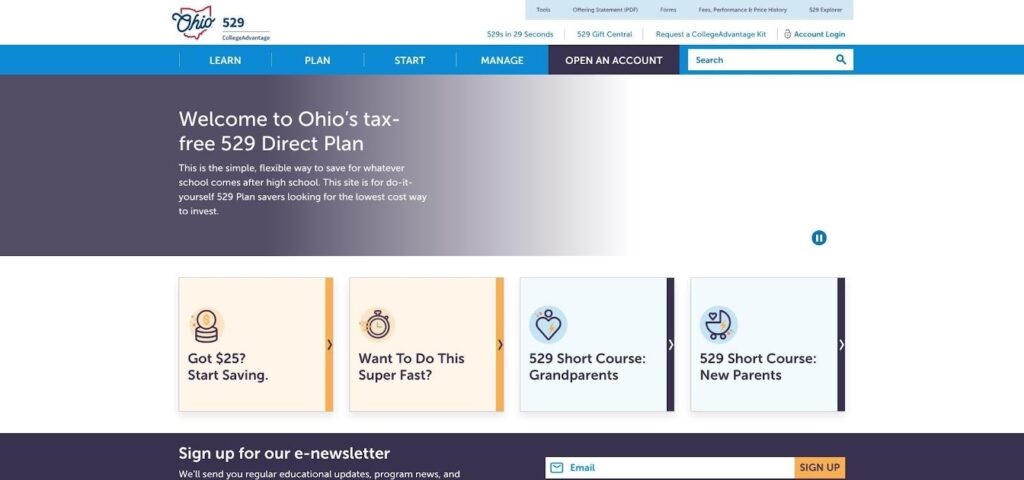
Ohio CollegeAdvantage 529 dashboard and digital experience screenshot
Minimums stay low at $25, so you can open an account while the baby is still in diapers and scale up when pay increases arrive. Skip Ohio only if you want the absolute lowest fee (New York wins by a few basis points) or need full custom glide paths (Utah leads there). For everyone else, CollegeAdvantage offers solid value with room to grow.
5. Michigan MESP: cheapest ticket on the market
Michigan’s Education Savings Program skips flash and instead posts 0.11 percent fees, letting the numbers speak. In many portfolios, costs fall into single-digit basis points, giving it a strong claim as the lowest-priced 529 in the country.
The lineup stays straightforward. One age-based track glides from equities to bonds, backed by broad-market index funds from Vanguard, Schwab, and TIAA. Six multi-fund static mixes cover the classic 100/0 down to 20/80 risk spectrum. Need pinpoint control? Five single-fund options let you park everything in an S&P 500 index, an international fund, or a short-term bond sleeve.
That spartan design is intentional. Extra features raise costs, so MESP removes them so more of your contribution compounds. The trade-off is variety: no ESG track, no aggressive versus conservative glide-path dial, and customer service is competent but not concierge level.
Minimums sit at $25. Open the account, set up autopay, and rest easy knowing you pay Wall Street little more than pocket change. For fee hawks who believe time in the market beats tinkering, MESP delivers pure keep-it-simple success.
6. Nevada Vanguard 529: brand trust, but mind the minimum
For many investors, “Vanguard” signals peace of mind. Nevada’s Vanguard 529 leans on that trust by offering a familiar suite of index funds in a simple age-based package.
Pick your risk level—aggressive, moderate, or conservative—and the portfolio shifts from stocks to bonds as college nears. The fee on these target-enrollment tracks stays near 0.14 percent, below the national average and only slightly above New York’s low-cost plan. Prefer ESG? Vanguard also offers a socially responsible glide path few competitors match.
The trade-off appears on day one: opening this account takes $1,000. Once funded, later contributions can be smaller, but the high entry price steers many first-time savers toward lower-barrier options like Illinois or Ohio.
Morningstar recently moved the plan to Bronze, noting that other states have cut fees faster and strengthened oversight. Nevada is still solid; the gap between “Vanguard quality” and rivals has just narrowed.
Choose this plan if brand loyalty and an ESG track under the Vanguard banner top your list and you have the opening deposit ready. Otherwise, equally low-cost plans without the large minimum may serve Minnesota savers better.
How the six stack up and where MNSaves lands
Numbers seal the deal, so let’s line the plans up side by side. Fees, minimums, and ratings tell a clear story: Minnesota residents can keep the state tax break and still cut costs.
| Plan | Morningstar 2024 | Age-based fee* | Minimum to open | Notable edge |
| Illinois Bright Start | Gold | 0.15 % | $0 | Low fee plus broad menu |
| Utah my529 | Gold | 0.18 % | $0 | Build-your-own glide path |
| New York Direct | Silver | 0.13 % | $0 | Absolute cheapest turnkey |
| Ohio CollegeAdvantage | Silver | 0.20 % | $25 | Stable-value + strong UX |
| Michigan MESP | Silver | 0.11 % | $25 | Lowest cost nationwide |
| Nevada Vanguard | Bronze | 0.14 % | $1,000 | Vanguard brand + ESG track |
| Minnesota MNSaves** | Silver | 0.20 % | $25 | Solid, but fewer options |
*Fee shown is the total expense ratio for the lowest-cost age-based track.
**Our home plan is included for context only.
Key takeaways:
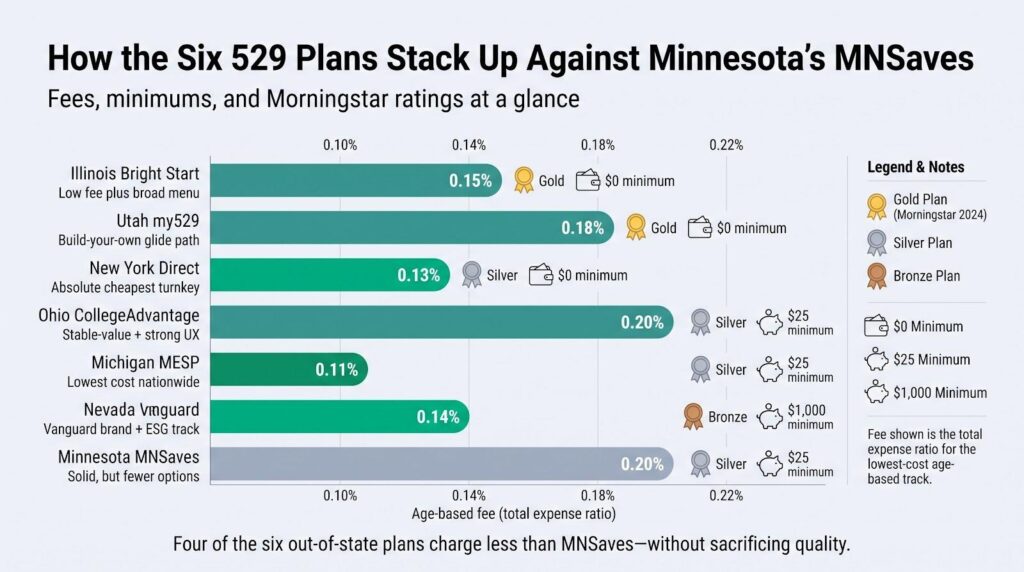
- Cost gap is real. Four of the six plans charge less than MNSaves. Over 18 years, trimming just 0.07 percentage points on a $25,000 contribution can leave roughly $2,000 extra in your student’s account.
- Entry hurdles vary. Most plans open the door for $0–$25. Nevada’s $1,000 minimum is the main reason many Minnesotans skip the Vanguard label.
- Ratings track price. Every sub-0.20 percent plan carries at least a Silver rating; Bright Start and my529 earn Gold by pairing low cost with strong governance.
- Flexibility differs. Utah excels at customization, Ohio blends index and active choices, while New York and Michigan keep things simple.
Bottom line: MNSaves is respectable, but if your goal is to squeeze every basis point or gain more investment levers, any of the six out-of-state options can pull ahead without costing you Minnesota’s tax perk.
Which plan fits you? A quick decision framework
We’ve laid out six strong options. Now match them to your style, balance, and values.
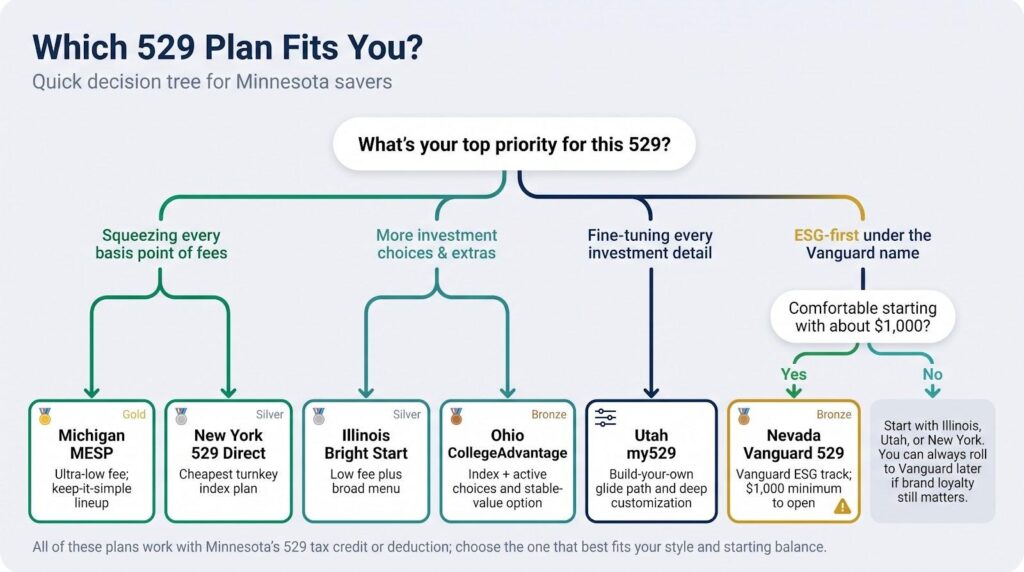
Start with your fee philosophy. If every basis point feels like a win, pick Michigan or New York. Their costs beat many index ETFs you may already own.
Prefer a broader menu without paying more? Illinois and Ohio keep expenses low while adding active funds, ESG choices, and multiple glide paths.
Want to customize every detail? Utah stands alone; its build-your-own glide-path tool lets data-driven parents set the dial.
Need an ESG-first option under a brand you trust? Nevada’s socially responsible track delivers, as long as the $1,000 minimum fits your budget.
Check your starting balance. Launching with only a few hundred dollars? Skip Nevada for now and open Illinois, Utah, or New York. You can always roll assets later if brand loyalty calls.
Across all scenarios, any of these plans plus Minnesota’s tax credit or deduction beats a high-cost default. Pick the one that matches your priorities, open the account, and let compound growth do the heavy lifting.
FAQs Minnesotans ask about 529 plans
Do I need to use MNSaves to claim Minnesota’s tax break?
No. The state says contributions to any state-sponsored 529 qualify for the credit or deduction, so it pays to shop nationwide.
Credit or deduction: can I take both?
Pick one per tax year. Most families under the phase-out thresholds choose the credit because it can cut up to $500 straight off the bill. Higher earners usually take the deduction.
What if my child earns a full scholarship?
Leftover 529 money is not stranded. You can change the beneficiary, use up to $10,000 for student loans, or roll as much as $35,000 into the beneficiary’s Roth IRA once the account is 15 years old. Non-qualified withdrawals face tax on earnings plus a 10 percent federal penalty, and Minnesota will claw back any state benefit.
Are K-12 tuition payments safe for state taxes?
Federally, yes—up to $10,000 per year. Minnesota disagrees. Use 529 funds for private school here and you’ll owe back the state credit or deduction you claimed on those contributions.
Can I hold more than one 529 plan?
Yes. You might keep an in-state MNSaves account for local seminars and open Utah my529 for its custom glide path. Remember, the credit or deduction cap applies to total annual contributions across all plans.
Will switching plans later trigger taxes?
A direct rollover between 529s is tax-free once every 12 months per beneficiary. Minnesota does not recapture past deductions or credits on outbound rollovers, so you can move if a better plan appears.
Next steps: turn insight into dollars
You’ve picked your front-runner, so let’s get money growing.
Open the account today. Each plan’s site walks you through a five-minute form that asks for Social Security numbers, birthdays, and a funding source. Keep a blank check or your bank’s routing number handy and you’re set.
Set up automatic transfers before you close the browser tab. A monthly draft—even fifty dollars—builds disciplined momentum and removes decision fatigue. Most plans let you sync pay-day deposits, so raises and bonuses scale your savings without extra clicks.
Choose the default age-based portfolio unless you have a strong reason to customize. The glide path takes more risk when you have time and protects principal as college nears. You can always tweak once or twice a year if your tolerance changes.
Bookmark the plan’s contribution history page. At tax time you’ll copy that number into Minnesota Schedule M1529 to claim the credit or deduction. No hunting through statements, no math errors.
Repeat an annual check-in each January. Confirm contributions, update college-cost projections, and, if income has moved past the credit’s phase-out, switch to the deduction. That five-minute ritual keeps you aligned with market conditions and tax rules.
Tell grandparents. Each plan offers a shareable gift link or printable coupon. Relatives can send birthday cash straight into the account, boosting balances without adding clutter to the toy shelf.
A small setup now gives compound growth eighteen years to work. Future you (or better yet, future graduate you) will be glad you started today.