
Choosing the right bariatric BMI calculator isn’t trivial. One click can influence insurance approval, surgical scheduling, and post-op nutrition. Yet many hospital tools still reflect the 1991 NIH cut-offs, even though the 2022 ASMBS/IFSO guidelines recommend surgery at BMI 35, and at BMI 30 for adults with type 2 diabetes. We tested 20 popular calculators to identify the best options, rating them on calculation integrity, bariatric guidance, BMR output, evidence, and privacy. Below you’ll meet our seven standouts, so you can capture the right number and walk into your consult prepared.
At a glance: the seven stand-out tools
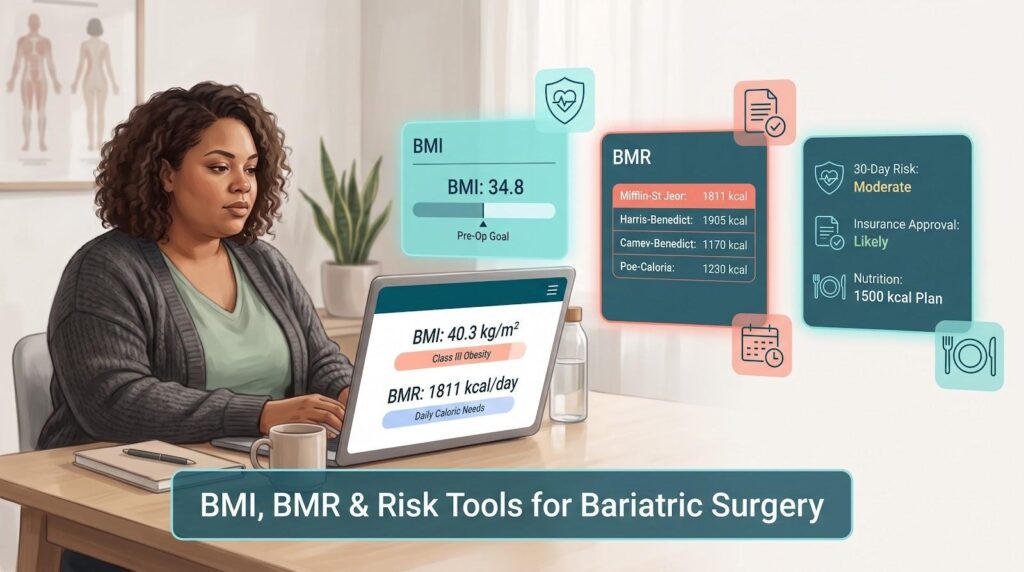
Want the quick answer? The table below lists our top bariatric BMI calculators, why each earned its rank, and whether it also estimates resting calories (BMR). Scores come from hands-on tests performed September 2, 2026, using the eight weighted criteria in the next section.
| Rank | Calculator | Best for | BMI? | BMR? | Platform | Cost (Sept 2026) | Score |
| 1 | BMCC weight loss calculators | All-in-one bariatric BMI + BMR suite | ✔︎ | ✔︎ | Web | Free | 82 |
| 2 | ACS / MBSAQIP Risk & Benefit | One-year BMI and complication risk | ✔︎ | No | Web | Free | 76 |
| 3 | Duke Health | Fresh, medically reviewed eligibility explainer | ✔︎ | No | Web | Free | 74 |
| 4 | Baritastic* | Mobile tracking from day one | ✔︎ | No | iOS and Android | Free | 74 |
| 5 | Bariatric Bluebook | Fast comorbidity screen | ✔︎ | No | Web | Free | 73 |
| 6 | CDC Adult BMI | Official baseline check | ✔︎ | No | Web | Free | 72 |
| 7 | Calculator.net | Formula-transparent BMR companion | ✔︎ | ✔︎ | Web | Free | 69 |
*Baritastic charts BMI from your entries but doesn’t show a dedicated calculator screen.
Why the range? Higher scores reward transparent formulas, bariatric-specific guidance, named medical reviewers, and clear privacy language. In short, a great calculator does more than crunch numbers; it sets the stage for your clinical conversation.
BMI, BMR, and risk: three numbers, three jobs
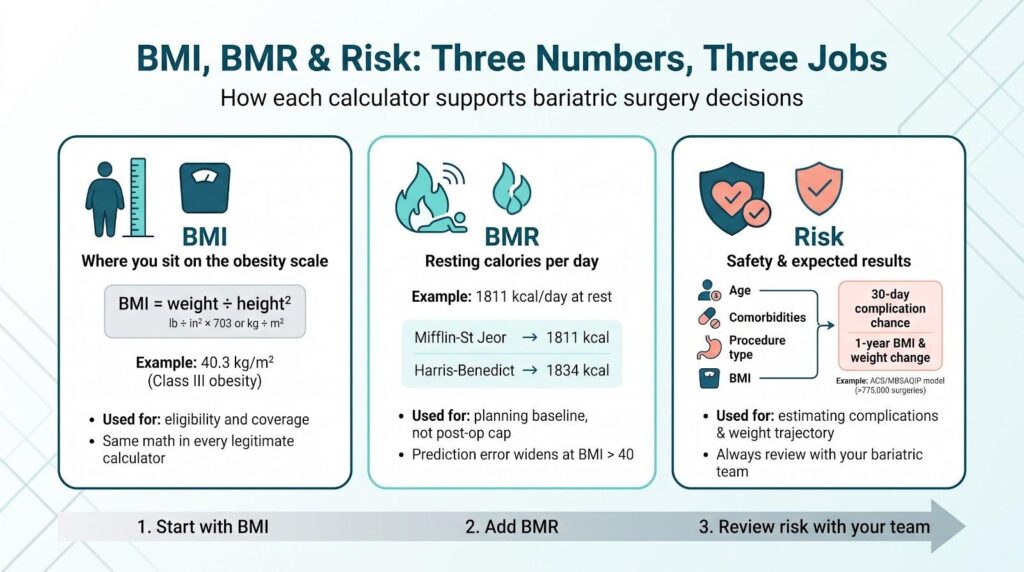
BMI is weight divided by height squared (lb ÷ in² × 703 in U.S. units, or kg ÷ m² in metric). Every legitimate tool runs the same math, so the best calculator is the one that explains what the figure means for surgery and coverage.
BMR answers a different question: how many calories your body burns at rest. Quality tools cite an equation, most often Mifflin-St Jeor or Harris-Benedict, and remind you that prediction error widens once BMI climbs above 40. Treat the number as a planning baseline, not a post-op calorie cap.
Risk calculators such as the ACS/MBSAQIP model, built from more than 775,000 surgeries, layer BMI with age, comorbidities, and procedure choice to estimate 30-day complications and one-year weight change. Use them with your bariatric team, never as a solo decision-maker.
How to put the trio to work:
- Start with BMI to confirm where you sit on the obesity scale.
- Add BMR if you need a ballpark energy target while you wait for surgery.
- Review a risk tool with your surgeon when discussing procedure options and safety.
Current ASMBS/IFSO guidelines (2022) suggest evaluating adults for metabolic or bariatric surgery at BMI 35 or higher, and at BMI 30 to 34.9 when type 2 diabetes or another serious metabolic disease is present. Numbers launch the conversation; only a qualified bariatric team can tailor them to you.
How we ranked the seven calculators
Every tool went through the same eight-point scorecard during hands-on testing on September 2, 2026. Here’s the breakdown:
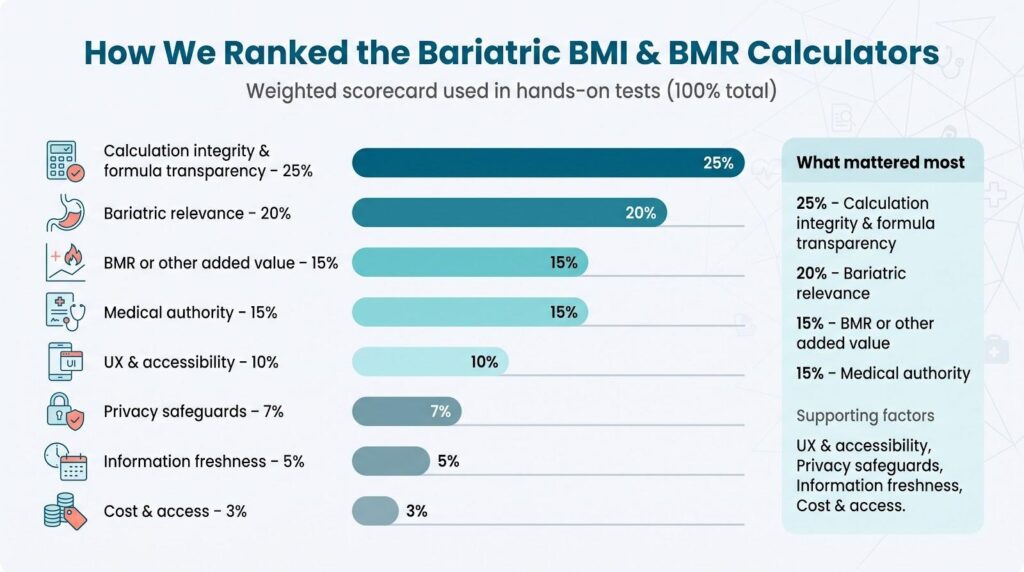
| Criterion | Weight | What we looked for |
| Calculation integrity & formula transparency | 25% | Correct unit handling, visible equations, input validation |
| Bariatric relevance | 20% | Guidance that matches current ASMBS/IFSO indications and common insurance language |
| BMR or other added value | 15% | Accurate resting-calorie estimate, risk curve, or long-term tracking |
| Medical authority | 15% | Named peer review, registry data, or accreditation from an MBSAQIP center |
| UX & accessibility | 10% | Mobile usability, clear labels, error messages, metric/U.S. toggles |
| Privacy safeguards | 7% | Local processing, HIPAA claims, minimal data collection |
| Information freshness | 5% | Visible “last reviewed” date within the past three years |
| Cost & access | 3% | Up-front pricing, geo availability, no email gate |
The scores you saw earlier reflect these weighted components; higher-ranked calculators do more than return a number. They frame decisions and help protect your data.
1. Bariatric and Metabolic Center of Colorado: best all-in-one BMI + BMR suite
Open BMCC’s weight loss calculators page and three tools are laid out for you: BMI, BMR, and target heart rate, each a click away on its own page. The copy speaks directly to people considering metabolic or bariatric surgery, not fad diets, a focus that matters when the number on-screen could end up in an insurance file.
- BMI tool. Enter height in feet and inches and weight in pounds (U.S. units only) and select Submit. A 5 ft 6 in adult at 250 lb, for example, returns a BMI of about 40, which falls in class III obesity.
- BMR tool. Add age and gender; the same profile (age 42, female) yields roughly 1,800 calories per day at rest. The page frames the number as the minimum your body needs to keep functioning, a floor to build a diet plan on rather than a target.
- No sign-ups required. Results appear instantly; the site never asks for email or phone details.
Authority checks. A bariatric surgeon (Joshua Long, MD) is listed as the site’s medical reviewer, and the practice operates at an MBSAQIP-accredited hospital, Parker Adventist. The page does not name its BMI or BMR equations, and its eligibility text still cites the older BMI 40 (or 35 with comorbidities) threshold rather than the 2022 guidelines.
Privacy notes. The calculator runs without a login, but the privacy policy flags advertising cookies and tracking pixels. If you prefer a clean slate, open it in a private window and clear cookies afterward.
Takeaway. BMCC tops our list because it is the only bariatric-specific hub that serves BMI and BMR in one visit. Screenshot your results and ask your care team which equations they rely on; if they match, you have a keeper. Otherwise, treat the output as an estimate and verify with an in-clinic tool.
2. ACS and MBSAQIP risk and benefit calculator: best for evidence-based risk and weight trajectory
Built with records from over 775,000 operations across 955 accredited centers, this American College of Surgeons tool predicts three things in a single report:
- 30-day complication probability
- One-year BMI and weight change
- Remission odds for common comorbidities
How it works. You’ll enter roughly 20 data points, including age, sex, BMI, diabetes status, smoking history, and the procedure you’re considering. Set aside about five minutes and keep recent labs handy; complete inputs tighten the projection.
Who it’s for. The calculator serves adults 18+ with pre-op BMI 30 to 80 kg/m² who are considering a primary sleeve, bypass, band, or BPD/DS. Surgeons value it because the math is peer-reviewed, and the last parameter update was May 2022 (v2.0).
Limitations.
- Filling out the long form is smoother on a laptop than a phone.
- The tool does not provide BMR or calorie guidance.
- Outputs are estimates, not guarantees; real-world factors can raise or lower your personal risk.
Pro tip. Print the summary PDF, jot questions next to any risk above your comfort zone, and bring it to your consult. Used alongside your surgeon, the MBSAQIP model turns raw numbers into a clearer conversation about safety and expected results.
3. Duke Health: best medically reviewed eligibility explainer
Duke’s Are You a Candidate for Weight Loss Surgery? page pairs a simple BMI calculator (feet, inches and pounds; select Calculate Your BMI) with the eligibility language insurers actually use: a BMI of 40 or more, or 35 to 40 with a major complication such as diabetes, cardiovascular disease, high blood pressure, high cholesterol, debilitating joint pain or sleep apnea.
Authority checks. The page carries a named reviewer and date: medically reviewed on May 7, 2025 by Shaina R. Eckhouse, MD, FACS, a weight loss surgeon. That is the freshest review stamp of the seven.
Limits. U.S. units only, no BMR, no comorbidity checkboxes, and the thresholds reflect insurer rules rather than the 2022 ASMBS/IFSO indications.
Best use. Run your number here when you want a hospital-grade explainer of what insurers look for, then move to a bariatric-specific tool for BMR or risk.
4. Baritastic: best mobile tracker for life before and after surgery
Baritastic turns your phone into a bariatric hub that logs BMI, weight trends, food, fluids, vitamins, and even mood. Many U.S. programs issue a clinic code at orientation so your surgeon can review the logs in real time.
Set-up. Enter height, weight, and (optionally) a surgery date; the dashboard plots BMI on a color-coded chart and sends hydration or supplement reminders at user-defined intervals.
Social proof. As of September 2026, the app holds a 4.8/5 rating from roughly 95,000 iOS reviews and a 4.6/5 rating on Google Play (U.S. listings).
Limits.
- No standalone BMR calculator; calorie targets come from your care team.
- International availability is inconsistent, and some users report needing a VPN.
- Common complaints include intermittent wearable sync and occasional barcode errors.
Privacy. Consumer data sit on encrypted servers, and the provider dashboard claims HIPAA compliance. Review the policy before syncing devices or sharing a clinic code.
Bottom line. Pair Baritastic with a formal BMI/BMR calculator for accurate numbers, then let the app handle day-to-day tracking so you and your team can spot trends between visits.
5. Bariatric Bluebook: best quick comorbidity screen
Bluebook feels like a fast intake form. Enter height and weight (imperial or metric), tick any of six conditions, sleep apnea, hypertension, GERD, joint disease, fatty liver or type 2 diabetes, and select Calculate. In about 30 seconds you’ll see:
- Your BMI to one decimal (for example, 40.3 kg/m² at 5 ft 6 in and 250 lb)
- A plain-English candidacy note (“may meet surgical criteria”)
- A short list of procedures that match your profile
Why it helps. Combining BMI with comorbidity logic saves time when you’re preparing an insurance packet or a first consult.
Gaps to note.
- The page cites “NIH and ASMBS criteria” but doesn’t name a medical reviewer or specify which guideline version it follows.
- Neither the BMI formula nor rounding method is disclosed, so edge cases near BMI 35 could be off by a decimal.
- The privacy policy is generic, and analytics scripts aren’t fully listed.
Best use. Treat Bluebook as a fast triage tool, then confirm borderline results against the 2022 ASMBS/IFSO guidelines and your insurer’s written policy. Open it in a private window if you’re sensitive about tracking.
6. CDC adult BMI calculator: best official baseline
Sometimes you just need the raw number before eligibility fine print enters the picture. The CDC Adult BMI Calculator delivers exactly that: enter height and weight, and it returns your BMI to one decimal place (for example, 40.3 kg/m² for a 5 ft 6 in, 250 lb adult) along with the standard adult categories.
Because it is a federal tool, the formula stays fixed, and the privacy policy sits prominently on the page, so your data will not feed an ad network. The most recent content update (2024) followed CDC public-health timelines rather than marketing cycles, keeping the arithmetic locked and the guidance stable.
What it cannot do: interpret results for surgery, list comorbidities, or estimate BMR. That simplicity may feel refreshing or limiting, depending on where you are in the decision process.
When to use it. Pull the CDC number when you need a source no insurer or clinician will dispute, then switch to a bariatric-specific calculator for the “so what” conversation. The tool is free and works smoothly on both desktop and mobile.
7. Calculator.net: best transparent BMR companion
Calculator.net’s BMR page lets you compare three classic equations: Mifflin-St Jeor: about 1,811 kcal/day; Harris-Benedict: about 1,834 kcal/day; and Katch-McArdle, which requires body-fat % before displaying its own value. Switching to the BMI tab provides the standard calculation plus unit converters that accept decimals.
Limits. The site offers no bariatric eligibility logic, comorbidity checklist, or insurance wording. Banner ads appear beside the form, but data remain in the local session and no login is required. The footer carries a 2008 to 2026 copyright line but no review date.
Best use. Treat Calculator.net as a comparison lab: pick an equation, print the result, and review it with your dietitian. Then move to a bariatric-specific calculator for candidacy and risk details.
Detailed comparison: what each calculator shows and hides
Fine-grained differences decide which tool earns a spot in your workflow. The table below tracks nine data points our testers cared about most: formula transparency, comorbidity logic, privacy detail, last review date, and more. Dates reflect the latest version we accessed on September 2, 2026.
| Calculator | BMI formula named | BMR output | Comorbidity / eligibility logic | Risk projection | Platform | Privacy notes* | Last review / update | Medical reviewer listed |
| BMCC | ✘ | ✔︎ | ✘ (eligibility rule stated in page text) | ✘ | Web | Ad cookies disclosed | Unstated | ✔︎ |
| ACS-MBSAQIP | ✔︎ | ✘ | ✔︎ | ✔︎ | Web | No tracking beyond session | May 2022 | ✔︎ |
| Duke Health | ✘ | ✘ | ✔︎ | ✘ | Web | Standard privacy policy | May 7 2025 | ✔︎ |
| Baritastic† | ✔︎ | ✘ | ✔︎ (clinic code) | Weight trend | iOS & Android | HIPAA statement | Weekly app releases | ✔︎ |
| Bariatric Bluebook | ✘ | ✘ | ✔︎ | ✘ | Web | Generic policy | Unstated | ✘ |
| CDC | ✔︎ | ✘ | ✘ | ✘ | Web | Federal privacy | 2024 | ✔︎ |
| Calculator.net | ✔︎ (3 options) | ✔︎ | ✘ | ✘ | Web | Banner ads only | Not stated (copyright 2026) | ✘ |
*Privacy notes come from each site’s published policy; none required an email or login for a basic calculation.
†Baritastic calculates BMI in-app but does not show a standalone BMI or BMR screen.
How to read it:
- Need strict privacy? Choose CDC or ACS.
- Want a BMR without leaving a bariatric site? BMCC. Want the equation spelled out? Calculator.net names three.
- Looking for surgical risk projections? ACS stands alone.
Remember: every legitimate adult BMI calculator uses weight ÷ height², so any “proprietary” spin deserves extra scrutiny. While Harris-Benedict or WHO equations can edge out Mifflin-St Jeor for severe obesity, no single BMR formula is perfect. Treat outputs as estimates, not prescriptions.
How to interpret your result
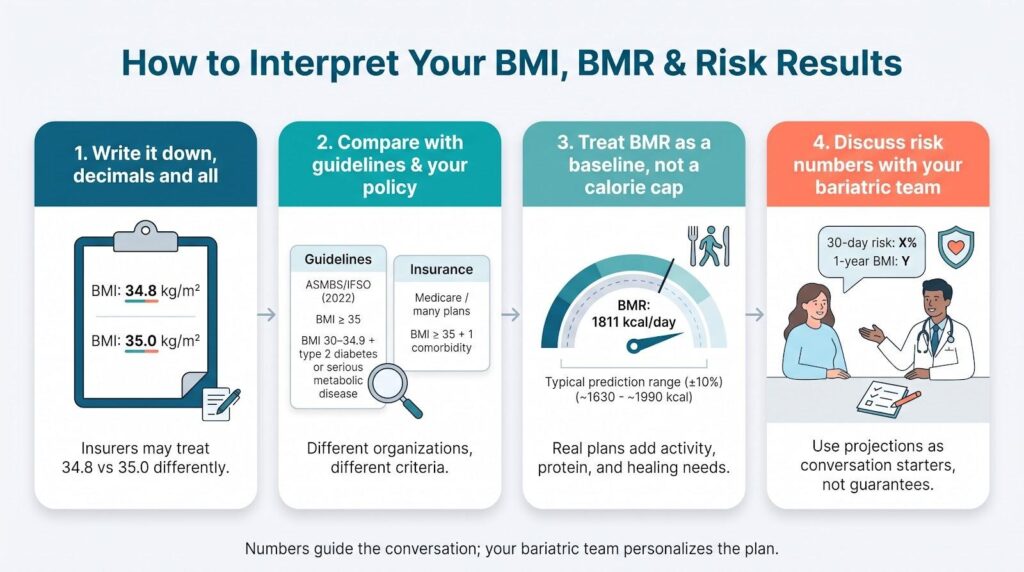
- Write it down, decimals and all. Insurers often rely on the exact figure, so a BMI of 34.8 kg/m² can carry different weight than 35.0 kg/m².
- Compare it with current guidelines. The 2022 ASMBS/IFSO statement calls for evaluation at BMI ≥ 35 and at BMI 30 to 34.9 when type 2 diabetes or another serious metabolic disease is present. Medicare still requires BMI ≥ 35 plus one comorbidity; many private plans mirror that rule, so review your policy’s fine print.
- Treat BMR as a baseline, not a prescription. Predictive equations can differ by ±10 percent from measured resting energy expenditure, especially above BMI 40. Re-calculate after major weight changes and work with your dietitian to add activity, protein, and healing needs.
- Use risk projections as conversation starters. ACS-MBSAQIP percentages reflect population averages, not promises. Ask your surgeon which procedure balances your risks and how you will track progress.
Community FAQ: your top questions answered
1. What BMI usually qualifies someone for surgery?
Clinical guidance (ASMBS/IFSO, 2022) recommends evaluation at BMI ≥ 35 kg/m², or BMI 30 to 34.9 kg/m² with type 2 diabetes or another serious metabolic disease. Many insurers still cite the older BMI 40 or 35 plus a comorbidity rule, so confirm both the medical and policy thresholds.
2. Can losing weight before surgery make me ineligible?
It depends on your plan. Some carriers lock in the BMI documented at referral, while others use surgery-day weight. Ask your coordinator which date counts and keep a log of every official weigh-in.
3. Why does my calculator disagree with my surgeon’s?
Both likely use the CDC formula. Differences usually come from rounding, unit conversion, or when eligibility logic is applied. Verify height and weight, then compare the raw BMI values.
4. Which BMR equation works best above BMI 40?
A 2024 systematic review in severe obesity found Harris-Benedict and WHO equations slightly closer to measured values than Mifflin-St Jeor, but error margins remained wide. Treat any BMR as a starting estimate and adjust with a dietitian.
5. Is BMR the minimum calories I should eat after surgery?
No. BMR reflects resting expenditure only. Post-op plans add activity, protein, and healing needs. Follow the staged schedule from your bariatric team, even if calories dip below the estimated BMR.
6. Which weight matters for insurance: highest, consult, or surgery day?
Most carriers want a documented history of obesity. Save primary-care notes, supervised-diet records, and clinic weigh-ins. When uncertain, submit more evidence rather than less.
7. Are these calculators private?
The CDC widget keeps data local. Other tools may load analytics scripts or ads. If privacy is critical, use a private browser window and clear cookies afterward.
8. What if the “ideal” BMI goal feels impossible?
BMI 25 is a population benchmark, not a personal mandate. Surgeons often target improvements in A1C, sleep apnea, or blood pressure instead. Discuss individualized goals with your team.
Conclusion
Numbers begin the dialogue; your bariatric team turns them into a personal plan. The seven calculators above differ on the one thing that matters after BMI: whether they also give you a BMR you can plan meals around, and whether they flag the risk bands surgeons actually use. Run your figures through two of them, write both results down, and bring them to your consultation. A calculator tells you where you stand today; the program you choose decides where you go from there.