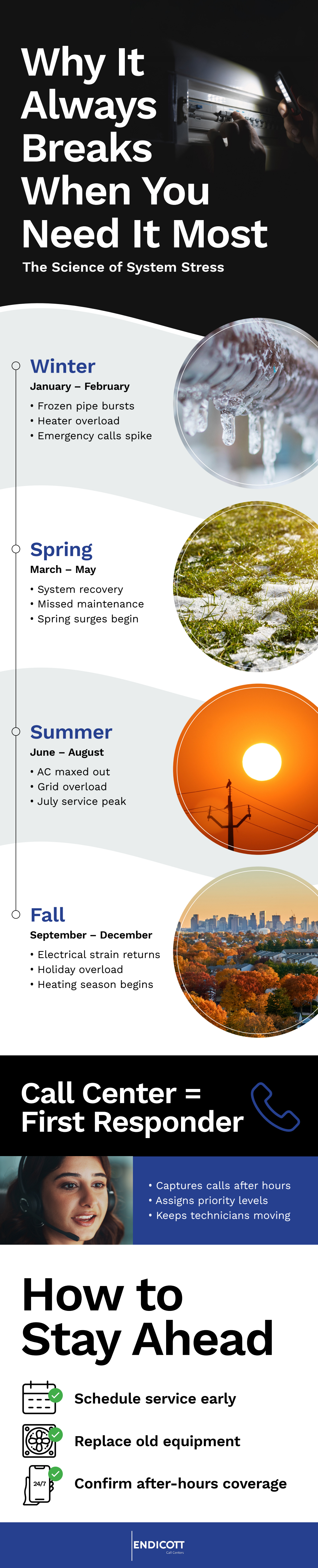
Business leaders often notice a pattern. Systems appear stable during routine operations but fail at the exact moment performance matters most. Product launches, peak sales periods, major announcements, or crisis events reveal hidden weaknesses. This pattern is not a coincidence. System stress follows predictable principles rooted in capacity limits, human behavior, and structural design. Understanding why systems fail under pressure begins with examining how stress accumulates and how organizations prepare for variability.
Capacity Thresholds and Hidden Load
Every system operates within defined capacity limits. These limits may involve server bandwidth, staffing levels, supply chain throughput, or communication flow. During normal conditions, usage fluctuates below maximum thresholds. Problems arise when demand spikes beyond tested boundaries.
High-stakes moments amplify activity. Marketing campaigns increase website traffic. Seasonal demand strains logistics networks. Crisis events drive sudden surges in customer inquiries. If systems are built around average demand rather than peak tolerance, failure becomes more likely.
Hidden load also contributes to breakdown. Technical systems may handle visible transactions efficiently while background processes consume additional resources. Deferred maintenance, outdated infrastructure, and incremental patchwork upgrades gradually weaken performance margins. Under pressure, these latent weaknesses surface.
Human Factors and Cognitive Strain
System stress extends beyond technology. Human decision-making deteriorates under pressure. During urgent situations, leaders compress timelines and reduce deliberation. Communication becomes reactive rather than structured. This accelerates error rates.
Cognitive overload affects teams managing multiple simultaneous tasks. When unexpected problems arise, employees must prioritize rapidly without full context. Small misjudgments can cascade into broader disruptions.
Organizational silos further intensify stress. If departments operate independently without shared visibility, coordination slows during peak demand. Information gaps delay corrective action, increasing the likelihood of system failure.
The Role of Variability and Uncertainty
Variability is a natural feature of business operations. Demand fluctuates, suppliers face disruptions, and external events introduce uncertainty. Systems that lack built-in flexibility struggle to adapt.
Redundancy and buffer capacity are often viewed as inefficiencies during stable periods. However, these buffers provide resilience under strain. Without surplus capacity, even minor deviations can trigger disproportionate consequences.
For example, customer service operations designed for average call volume may experience extended wait times during a product recall or outage. Organizations that incorporate contingency plans, cross-training, or customer care outsourcing solutions may distribute workload more effectively during spikes.
Feedback Loops and Escalation
Failures often escalate because feedback loops are delayed or incomplete. If performance metrics are not monitored in real time, teams may recognize issues only after disruption spreads. Early warning signals such as rising error rates, slower response times, or supply delays must be visible and actionable.
Escalation pathways also influence outcomes. Clear authority structures enable rapid decisions when capacity limits are approached. Without predefined protocols, uncertainty slows intervention.
Testing under simulated stress conditions provides valuable insight. Load testing, crisis simulations, and scenario planning expose weaknesses before they impact customers or stakeholders.
Designing for Resilience
Resilient systems acknowledge that peak demand is inevitable. Planning for extremes rather than averages improves stability. Distributed infrastructure, cross-functional coordination, and documented contingency plans reduce fragility.
Regular maintenance and performance audits strengthen system integrity. Monitoring tools that provide predictive alerts allow teams to intervene before a breakdown occurs. Transparent communication channels improve coordination during high-pressure events.
Cultural factors matter as well. Organizations that encourage proactive risk identification are better prepared to address vulnerabilities early. Psychological safety supports reporting of near misses and potential weak points.
System stress does not cause failure randomly. Breakdowns occur when capacity limits, human strain, and variability converge without sufficient buffers. High-stakes moments simply reveal what already exists beneath the surface. Businesses that design for resilience, monitor performance closely, and maintain flexibility reduce the likelihood that critical systems will fail when they are needed most. Look over the infographic below for more information.