

You run sales calls, cloud backups, and credit-card swipes on your connection. When that link stalls—or when the promo price doubles—revenue can skid to a halt. If you’re a Tennessee firm ready to move on from Comcast Business, this guide compares five stronger options.
We pulled speed-test data, uptime SLAs, support ratings, and true coverage maps from Memphis to Mountain City. Spoiler: WOW! Business, now lighting fresh fiber in Knoxville, makes the cut. The result is a shortlist you can trust—so you can get back to serving customers instead of shopping for internet.
Why Tennessee businesses are re-evaluating Comcast
Comcast still controls plenty of coax across Tennessee, yet more owners and IT leads now ask, “Is this the best we can do?”
Performance is the first sore spot. Because cable lines share bandwidth, lunch-hour video calls crawl when sales teams need them sharp. Upload speeds trail downloads, hampering cloud backups and file transfers.
Bills climb next. Introductory prices disappear after 12 months, and renewal quotes often rise 20–40 percent. Long contracts, sometimes three years, make the deal feel one-sided.
Service hiccups finish the break-up. An outage can trap you in an automated phone tree, and the “business-class” label rings hollow. The story spreads through chambers of commerce and LinkedIn groups, and alternatives gain appeal.
Meanwhile the market has shifted. AT&T and Brightspeed crews are stringing new fiber down rural roads. Municipal utilities in Chattanooga and Knoxville offer multi-gig service. Even 5G routers give pop-up shops a quick, inexpensive backup. Competition now covers the entire state.
To compare offers without drowning in spec sheets, keep these checkpoints close:
- Speed symmetry: equal upload and download.
- Written uptime guarantee: 99.9 percent is the minimum; lower numbers fit home service.
- Contract flexibility: month-to-month beats a three-year lock.
- Local support: nearby crews mean faster truck rolls.
- Total cost per Mbps: include install fees and the end of promos.
In the next section we explain how we used these same factors to score every major alternative.
How we scored and ranked the providers
We use a five-point scorecard that matches the questions you ask before signing any contract.
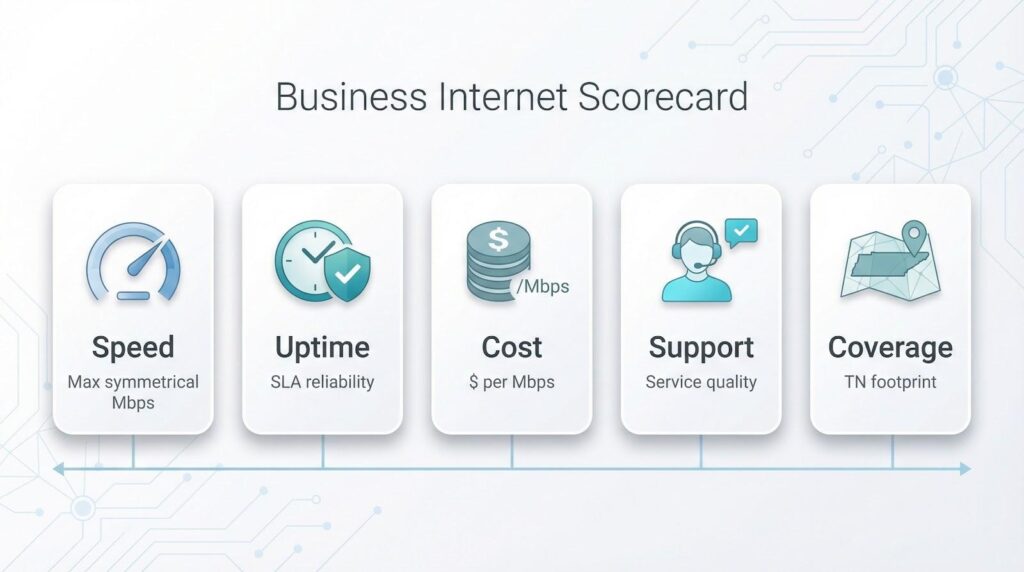
First, we record the top symmetrical speed each provider offers, because performance drives everything from cloud backups to Zoom calls. Next, we check written uptime guarantees and any credit policies; if a promise is missing, the provider loses points.
Third, we measure cost. We divide the monthly price of a 1 Gbps plan by 1,000 Mbps, then add any install or equipment fees. Fourth, we grade support quality using the latest J.D. Power scores and verified customer reviews.
Finally, we plot real Tennessee coverage. A perfect fiber plan available in one ZIP code ranks below a solid performer that serves the whole state. The five providers with the highest combined score appear in the next section.
1. WOW! Business: enterprise-grade internet with a local touch
If your office sits inside WOW!’s Knoxville-area footprint, you’ve found one of Tennessee’s quietest upgrades.
WOW! uses a hybrid network: coax for standard plans and dedicated fiber for heavier workloads. Beyond basic connectivity, WOW!’s enterprise lineup bundles Fiber Internet with Ethernet transport and Dedicated Internet Access, making the company an enterprise business internet provider that can scale as your bandwidth needs grow. Entry speeds start around 100 Mbps and reach 1.2 Gbps on cable, while enterprise circuits climb to 10 Gbps symmetrical. Install teams can pull fiber straight to your suite when consistent uploads are critical for cloud backups or live video.
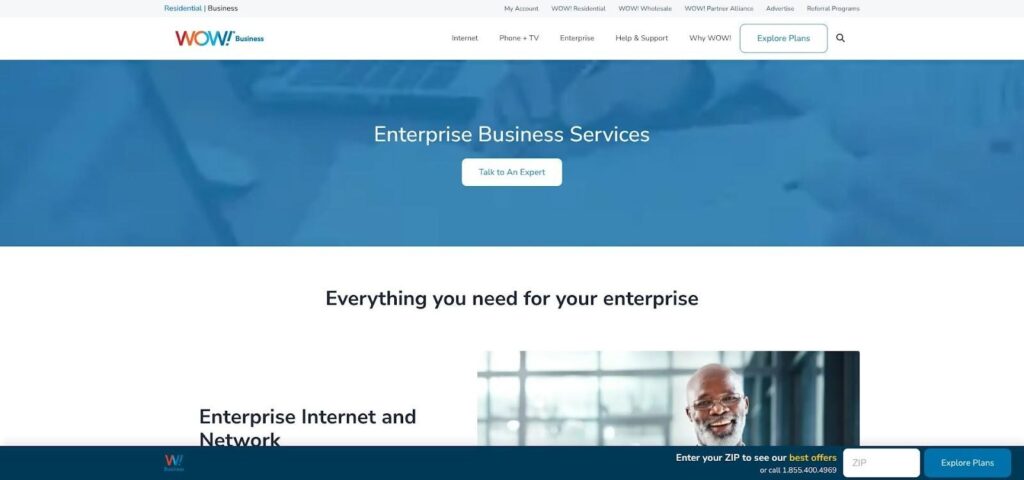
WOW! Business enterprise fiber and hybrid network official webpage screenshot
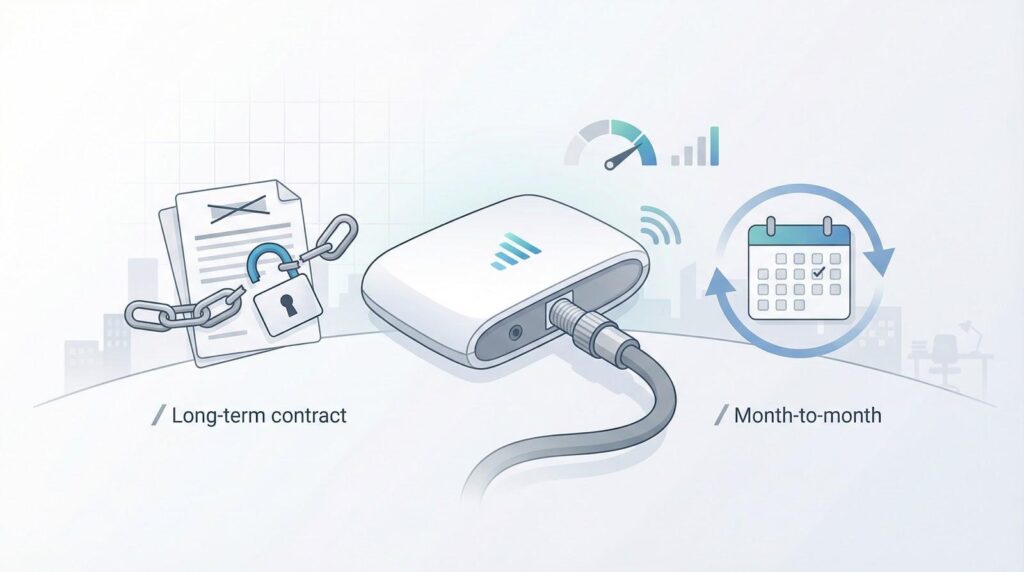
Contracts stay light. Most coax tiers are month-to-month, so you skip the three-year lock common among national carriers. Enterprise fiber pricing remains competitive on a cost-per-Mbps basis, and promotional price locks keep your invoice steady.
Support is a strong point. Business calls reach a regional network operations center, not a distant script reader. Local technicians travel with spare nodes and often solve problems on the first visit, according to customer interviews.
For companies inside its service zone, WOW! pairs multi-gig fiber with flexible terms and responsive support, giving you a fast path away from Comcast without turning to another giant.
2. AT&T Business: fiber reach that blankets the state
If you want a single provider whose truck can reach almost any Tennessee address, AT&T leads the pack. Over the past five years its crews have trenched new fiber through Nashville alleys, Memphis suburbs, and rural county roads. Today AT&T Fiber passes more than 1 million customer locations across more than 90 communities.
Performance is strong. Shared Business Fiber plans range from 300 Mbps to 5 Gbps, all symmetrical, while dedicated links climb higher for data-heavy teams. Low latency keeps cloud apps feeling local.
Reliability is spelled out in writing. Shared fiber carries a 99.9 percent uptime pledge; Dedicated Internet raises that to 99.99 percent with a four-hour restoration goal. That translates to minutes, not hours, of potential downtime each month.
Pricing is premium yet predictable. A 1 Gbps loop often lands near $250 per month with a 12-month term. Month-to-month is available for startups that need flexibility and can absorb a small surcharge.
Support scales with account size. Enterprise customers receive named reps and proactive monitoring. Small offices call a national help desk but still benefit from local field crews who roll quickly when a line is cut.
Add built-in wireless failover, optional static IP blocks, and the chance to bundle mobile plans, and AT&T offers a turnkey path from coax to statewide fiber.
3. Spectrum Business: gig-speed cable without the handcuffs
Comcast’s closest twin is Spectrum Business, yet the experience changes the moment you read the contract: there isn’t one. Standard coax plans are month-to-month, so you can scale or switch without early-termination fees, a policy highlighted by the provider’s top ranking in the 2025 J.D. Power U.S. Business Internet Satisfaction Study.
Speeds reach 1 Gbps down and 35–50 Mbps up, enough for point-of-sale systems and daily video calls. Uploads trail fiber, but download performance stays strong thanks to ongoing node splits and an upcoming DOCSIS 4.0 upgrade.
Reliability is solid for shared cable. Spectrum targets 99.9 percent uptime and offers 24/7 phone support. Field crews stage in most Tennessee counties, so truck rolls arrive quickly when a line is cut.
Pricing is straightforward. A 200 Mbps plan often costs under $80 per month with gear included. Add static IPs for a small fee and you can be online within days—ideal for a fast-moving startup or a retailer opening a new storefront.
If fiber isn’t on your block and you value flexibility over symmetrical uploads, Spectrum provides a clear, contract-free exit from Comcast.
4. Brightspeed Fiber: new glass for formerly forgotten towns
Century-old copper once held back businesses across eastern Tennessee. Brightspeed bought those lines, raised fresh capital, and is now swapping them for gig-ready fiber at record pace. The company says its Tennessee build is 90 percent complete, reaching about 180,000 addresses so far.
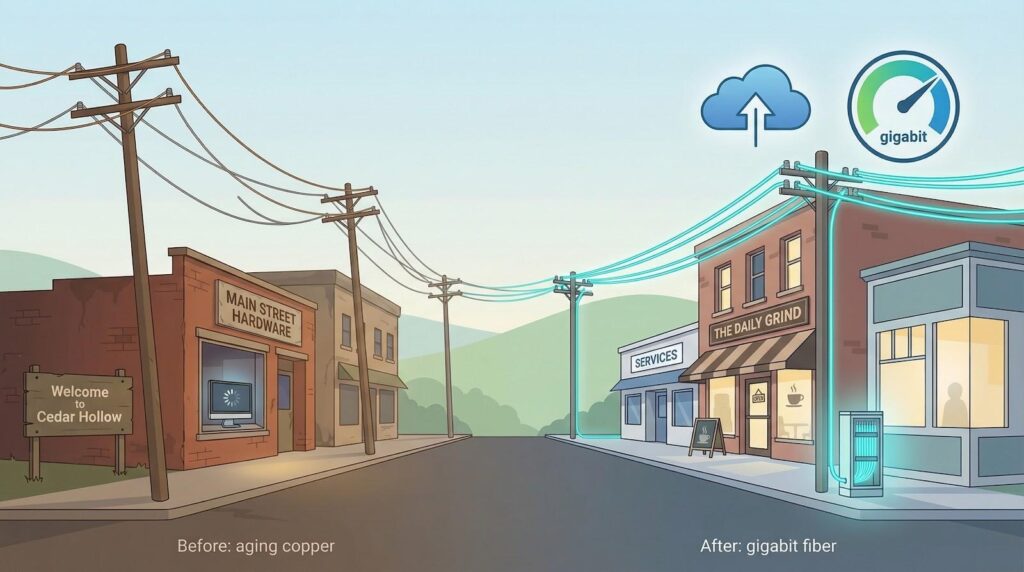
Speed is the main upgrade. Where 25 Mbps DSL crawled last year, you can now order symmetrical 1 Gbps, and in some zones 2 Gbps, without the dedicated-line pricing other carriers charge. Latency drops, video calls sharpen, and cloud backups finish before lunch.
Reliability improves with fiber. Brightspeed’s business plans ride a passive grid that resists rust, storms, and distance limits. A 99.9 percent uptime pledge comes standard, while higher-tier circuits add SLA credits and four-hour restorations.
Pricing stays sharp to attract converts. Residential fiber promos sit near $70. Business customers we interviewed landed gig service for under $140 per month with no installation fee, a figure that undercuts cable in many counties.
Support still shows “new provider” wrinkles. Hold times spiked during the first billing migration, and online reviews average 3.3 out of 5. Field technicians, however, earn praise for quick activations and courteous on-site work. As the network settles and call centers improve, satisfaction appears to be climbing.
If your shop sits in Unicoi, Carter, or another market Comcast skips, Brightspeed Fiber offers the quickest leap from DSL to cloud-ready speeds. Check your address; service may already be available.
5. EPB Fiber: Chattanooga’s 25-gig powerhouse
Chattanooga is home to the fastest commercial internet in the United States. EPB Fiber launched a city-wide gigabit in 2010; today the utility offers symmetrical service up to 25 Gbps, enough bandwidth for movie studios, AI labs, or any small firm that refuses to wait on uploads.
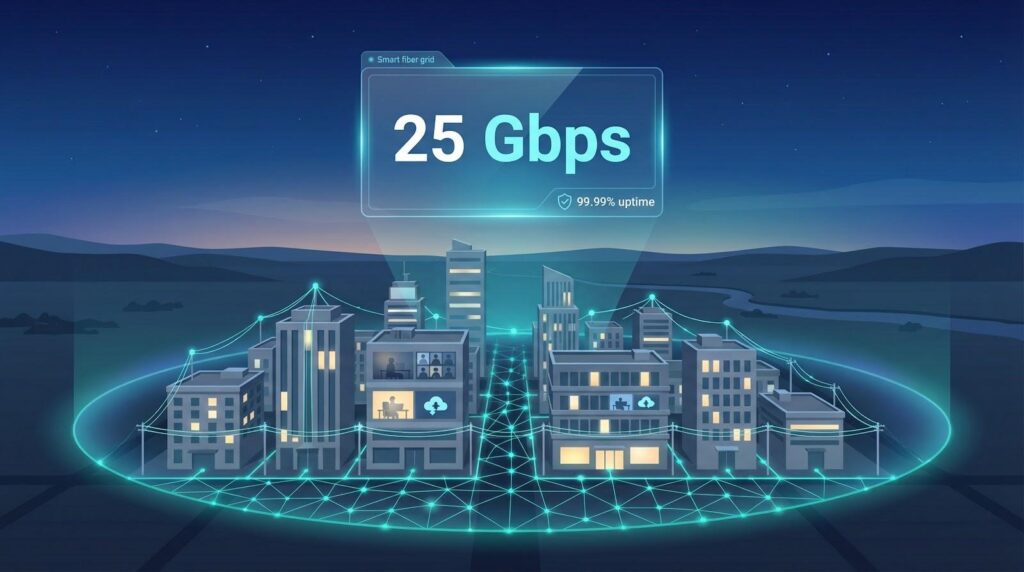
That speed rides on a mesh of underground fiber linked to the city’s smart grid. The network can reroute traffic when a line is cut, and EPB backs it with a 99.99 percent uptime pledge. Many businesses see outages measured in minutes per year. Local crews manage both the electric and broadband plants, so one truck roll usually fixes everything.
Pricing remains reasonable. A 1 Gbps business plan sits near $300 per month, and terms are month-to-month unless custom construction is needed. Static IPs are included, and the utility will supply managed Wi-Fi gear on request.
Geography is the only constraint. State law keeps EPB inside Hamilton County, so a block past the border is out of reach. If you operate inside Chattanooga, however, EPB stands alone as the top choice over any coax alternative.
Comparison table: quick-scan view of the top five
Choosing a provider should not feel like decoding a cell-phone bill. The matrix below trims the essentials—speed, uptime pledge, contract terms, static-IP options, and real coverage—into one glance. Skim it, spot any deal-breakers, then return to the deeper reviews if you need details.
| Provider | Max symmetrical speed | Written uptime guarantee | Contract required? | Static IP offered | Core Tennessee footprint |
| WOW! Business | 10 Gbps (enterprise fiber) / 1.2 Gbps (coax) | 99.9 percent on coax, 99.99 percent on fiber | None on coax; term optional on fiber | Yes (add-on) | Select Knoxville-area ZIP codes |
| AT&T Business | 5 Gbps (shared fiber) / 10 Gbps+ (dedicated) | 99.9 percent shared, 99.99 percent dedicated | 12-month term for best rate | Yes (blocks available) | Statewide; 1 million+ locations |
| Spectrum Business | 1 Gbps down / 35–50 Mbps up | 99.9 percent | No | Yes (fee) | Middle and East TN cities and suburbs |
| Brightspeed Fiber | 1–2 Gbps symmetrical | 99.9 percent | Month-to-month | Yes (fee) | Rural East and Middle TN; 180 k sites |
| EPB Fiber | 25 Gbps symmetrical | 99.99 percent | None | Yes (included) | Chattanooga / Hamilton County |
The numbers confirm two points. First, fiber rules upload performance; EPB and Brightspeed dwarf coax uploads. Second, Spectrum’s contract-free model is the lone exception among large carriers, making it the simplest short-term exit route.
Honorable mentions: strong options in the right ZIP code
A few standout networks miss our top five only because their reach is narrow. If your address falls inside one of these pockets, keep them on your shortlist.
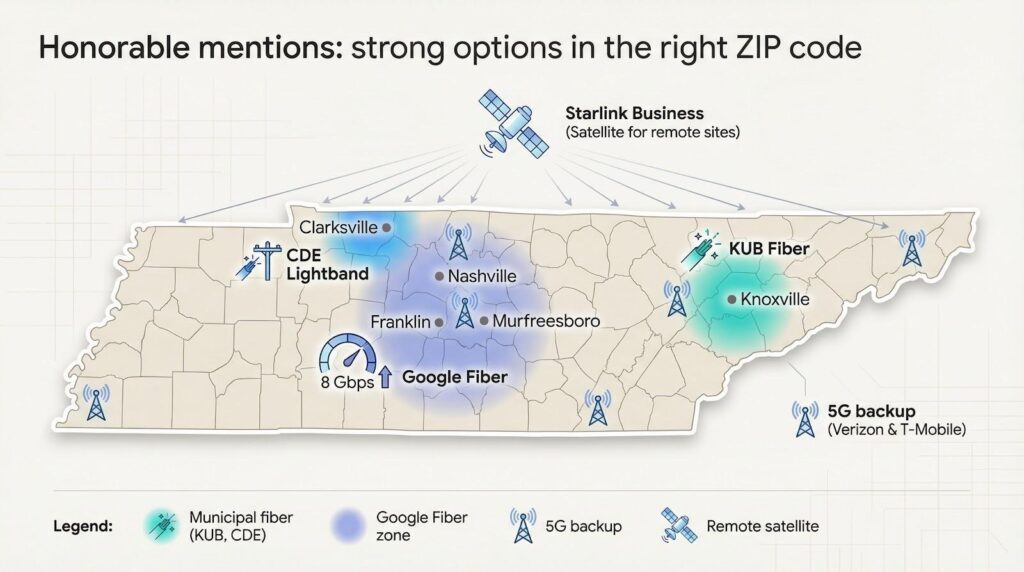
KUB Fiber is lighting Knoxville block by block with symmetrical gig service and nonprofit pricing. Early adopters praise instant local support from the same crews that maintain the electric grid.
CDE Lightband blankets Clarksville with gigabit fiber and utility-grade uptime. For Fort Campbell suppliers or downtown retailers, performance often beats cable on both speed and cost.
Google Fiber serves parts of Nashville, Franklin, and Murfreesboro with up to 8 Gbps symmetrical speeds and no-contract terms. Availability varies widely, so always check the map before ordering.
Verizon and T-Mobile 5G Business Internet offer quick-install backup links. Speeds hover around 150–300 Mbps, enough to keep card readers online during a wired outage.
Starlink Business covers remote mountain lodges and delta farm offices where landlines end. Latency is higher and monthly cost steeper, but for truly isolated sites it keeps the lights—and the data—on.
FAQs: Tennessee business internet questions
Who offers the fastest business internet in Tennessee?
EPB delivers symmetrical plans up to 25 Gbps inside Chattanooga, far ahead of any rival. Google Fiber reaches 8 Gbps in parts of Middle Tennessee, and AT&T offers 5 Gbps fiber tiers with the widest multi-gig footprint statewide.
Do I need a backup connection?
Yes, if a single outage would halt point-of-sale terminals or disconnect remote staff. Many firms pair a primary wired link with 5G fixed-wireless failover, an inexpensive safeguard when a construction crew slices fiber.
Is Comcast Business available everywhere in the state?
No. Comcast serves most of Nashville, Memphis, and parts of Knoxville and Chattanooga, but many Middle and East Tennessee counties fall under Spectrum, Brightspeed, or rural co-ops. Always run an address check before assuming service.
Can I get static IPs from these alternatives?
AT&T, Spectrum, WOW!, Brightspeed, and EPB all sell static IP blocks for a small monthly fee. EPB bundles one at no extra cost. Cellular plans still rely on dynamic addresses that complicate inbound traffic.
What counts as a strong uptime guarantee?
Target 99.9 percent—about 43 minutes of downtime a month—as the minimum. Dedicated fiber or municipal utilities often raise the bar to 99.99 percent, trimming downtime to under five minutes. Anything below 99.9 percent fits home service, not mission-critical workloads.
Conclusion
The result is a shortlist you can trust—so you can get back to serving customers instead of shopping for internet.