
Venture funding for fintechs fell 42 percent to roughly $35 billion in 2023, so every founder now watches burn like a hawk. Yet calendars are still packed: investor decks iterate at midnight, regulators add tasks, and the inbox never sleeps. A sharp personal or executive assistant buys back the hours you need to ship product faster, close rounds sooner, and steady the team.
This guide spotlights six recruiters who understand fintech’s pace, compares their fees, and pinpoints when each partner shines—so you can reclaim your schedule with confidence.
Why fintech assistant recruiting plays by new rules

Venture capital is cautious, but your calendar is not. Global fintech funding collapsed by 42 percent in 2023, sliding to roughly $35 billion, which forced every startup to do more with leaner teams. According to S&P Global Market Intelligence, that squeeze reshapes how we hire support staff.
Founders still need lightning-fast travel plans, board decks scrubbed, and regulatory filings chased. What they do not need is a six-figure overhead mistake.
Three trends now drive every smart PA search.
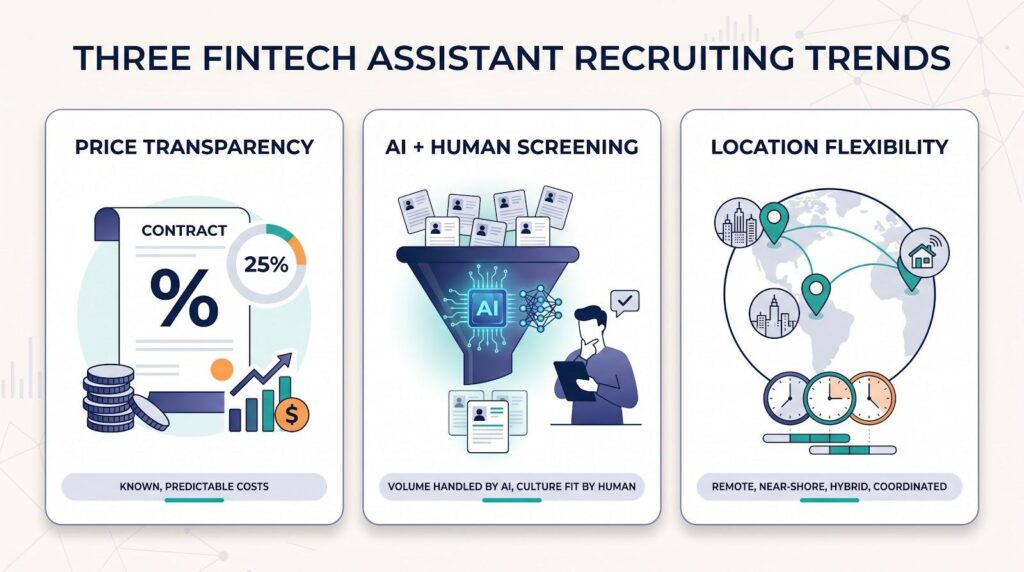
First, price transparency matters. Agency fees once felt murky; today most firms peg contingency searches at about 25 percent of first-year salary, and finance teams ask for that figure up front so they can model ROI before signing, according to staffing firm 4 Corner Resources.
Second, tech is the new gatekeeper. According to a recruiting trends survey by MyPerfectResume, roughly 96 percent of recruiters run résumés through AI screening before a human skims the shortlist. Speed rises, but culture-fit blind spots widen, so the best agencies pair algorithms with multi-round interviews to test soft skills.
Third, location is fluid. Hybrid offices and distributed engineering squads mean a right-hand assistant can sit in Bogotá, Boston, or the spare room down the street. That opens cost-savvy options such as fractional U.S. veterans or full-time near-shore pros working in your time zone.
One example: specialist C-Suite Assistants taps a proprietary database of over 35,000 fully vetted assistants, then narrows each fintech search to a tightly curated shortlist after live schedule-juggle drills. Clients who hire through this process report regaining 10–15 executive hours every week—proof that rigorous human screening beats raw résumé volume.
Put it together, and the brief sounds like this: “Find me an assistant who thinks two steps ahead, works tools like Slack and Notion, flexes across remote and in-person tasks, and does not blow the burn rate.” The six recruiters we profile next meet that challenge head-on.
How we hand-picked (and ranked) the final six
Good lists start with a filter, not a feeling. We mapped more than twenty agencies that place personal or executive assistants in tech or finance circles. From there we applied four hard yes-or-no gates: each firm must place EAs or PAs (not just general admins), show activity after 2023, publish or disclose its fee structure, and list at least one fintech or venture-backed client.
Twelve firms cleared the bar. To separate the standouts, we weighed six factors that mirror the questions founders ask when every hour counts:
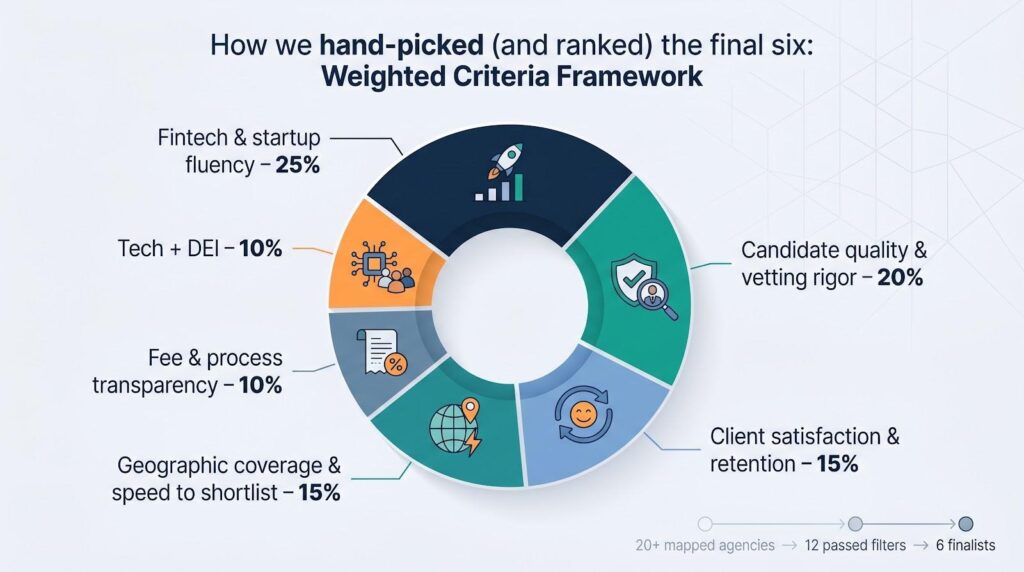
- Fintech and startup fluency (25 percent)
- Candidate quality and vetting rigor (20 percent)
- Client satisfaction and retention signals (15 percent)
- Geographic coverage and speed to shortlist (15 percent)
- Fee and process transparency (10 percent)
- Smart use of tech plus a real DEI plan (10 percent)
These weights push agencies that understand early-stage chaos to the top, without penalizing a boutique for being smaller than a global giant. Where hard metrics were missing, we relied on documented processes, such as multi-round interviews, pass rates below five percent, or replacement guarantees, to infer quality.
Finally, we checked the math with founders who hired through these partners in the past year. Their feedback confirmed the order you will see next: six recruiters that return time, not headaches.
1. C-suite Assistants – elite quality for founders who demand precision
C-Suite Assistants, a specialized personal assistant recruitment agency, does one thing exceptionally well: match top-tier executive and personal assistants with leaders who run at redline speed. Their vetting playbook targets core traits such as strong attention to detail, forward-thinking initiative, and absolute discretion—capabilities the firm highlights as non-negotiable for any personal assistant it places. Launched in New York in 2003, this boutique has spent two decades refining that craft.
Fewer than five percent of applicants survive its multilayer gauntlet of scenario drills, reference deep-dives, and culture-fit interviews, so every résumé that reaches your inbox is already battle-tested.
That rigor pays off when you operate in fintech’s constant pivot. Recruiters here see the difference between an EA who thrives in hierarchical banks and one who can build the plane while you fly it. They screen for grit, rapid context switching, and fluency with tools such as Notion, Slack, and Zapier because those are your daily weapons.
The engagement runs on a straight contingency model, roughly 25 percent of first-year salary, and includes a no-quibble replacement guarantee. Translation: you pay only when the hire sticks, and if chemistry fizzles inside the first three months, they reboot the search on their dime.
Time to shortlist averages three to four weeks. It is not the fastest on our roster, but founders say the first slate feels “hand picked rather than scraped,” which saves more hours than it costs. If you want a partner who can anticipate investor questions before the slide deck is final, start your search here.
2. Maven Recruiting Group: Silicon Valley’s inside track
Maven Recruiting Group feels less like a staffing agency and more like the Bay Area’s secret-handshake network. The women-led firm has spent more than a decade hosting EA roundtables, salary workshops, and a cult-followed podcast, so they often know who is quietly open to new roles long before the job appears on LinkedIn.
That community focus pays off in speed. When your Series B fintech suddenly needs an assistant who can wrangle investor roadshows and build a Notion dashboard, Maven typically produces a shortlist in under two weeks, sometimes in just a few days, because the right candidates are already on text-message terms with their recruiters. Fees land in the 20 to 25 percent contingency band, which is a fair trade for near-instant access to pre-vetted talent.
Quality does not get sacrificed for pace. Recruiters probe for what they call “startup DNA”: grit, ambiguity tolerance, and tech fluency. Candidates run through scenario drills that mirror your daily chaos, such as “the CTO just inserted three new priorities into tomorrow’s board deck; reorder the agenda without blowing up travel plans.”
Geography is another edge. While Maven’s roots are San Francisco, their reach now spans New York, Austin, and remote-first roles. If you need an EA who can toggle between Pacific Time engineering stand-ups and an East Coast investor breakfast, they have the roster.
Choose Maven when culture fit is as urgent as timing. You will trade a bit of search breadth for rapid turnaround and candidates who already speak startup shorthand.
3. Tiger Recruitment: global reach for founders who never stay put
If your roadmap hops from London to Dubai to New York, Tiger Recruitment is built for you. The firm began in London’s private-office scene and now runs desks in New York, Zurich, Dubai, and Dublin, so sourcing a bilingual EA who can arrange visas and switch politely between Gulf etiquette and Silicon Valley Slack threads feels routine here.
The process blends head-hunter discretion with administrative depth. Consultants actively poach passive assistants from top banks and tech giants, then run them through language tests, diplomacy scenarios, and the classic lost-passport-in-Zurich drill. The result is a shortlist of three to five polished candidates in about three weeks, each comfortable moving from investor briefing to private-jet logistics without breaking stride.
Expect premium pricing: contingency fees land in the high twenties percent range, edging toward thirty when the brief demands multiple languages or cross-border employer-of-record support. You pay more, yet you also receive an extended six-month guarantee that smaller boutiques rarely match.
Founders at later-stage fintechs value Tiger for one simple reason: the assistants already understand regulated environments. Many have supported executives at Tier-1 banks, so GDPR, FCA, or MAS paperwork will not rattle them. If your days toggle between licensing meetings and crypto-conference keynotes, Tiger keeps your EA one calendar block ahead.
4. Boldly: fractional firepower without the full-time burn
Some founders need strategic help, just not forty hours a week. Boldly solves that puzzle with a subscription model that feels like SaaS for executive support. You pay a flat monthly fee, usually two to four thousand dollars, for a seasoned U.S.-based assistant dedicated to you for a set block of hours. No payroll, no benefits, no HR overhead.
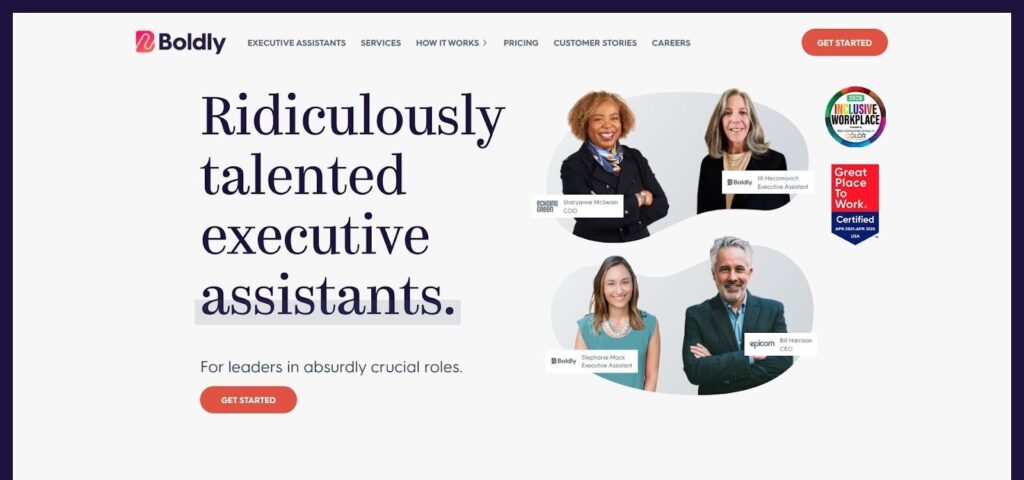
Boldly subscription executive assistant service website snapshot
Quality is the headline. Boldly hires fewer than two percent of applicants, insisting on ten years of prior C-suite experience and fluency in the cloud tools startups rely on. Because those assistants are W-2 employees of Boldly, vacation gaps trigger an instant backup, so investor updates or compliance filings never stall.
Ramp-up is fast. Most clients interview a matched EA on Monday and start delegating by the following week. That speed makes Boldly ideal for Series A leaders who just closed a round and suddenly juggle board prep, town-halls, and product sprints.
Cost control is the other draw. Compare a $3,000 monthly plan to a six-figure salary plus taxes and bonuses, and runway thanks you. Hours scale up or down quarterly, so when launch week hits you can increase coverage, then ratchet back once the dust settles.
Choose Boldly if you want senior-level support without adding permanent headcount. It is the pragmatic middle lane between scrappy virtual assistants and a full-time hire vetted by a head-hunter.
5. HirewithNear: full-time support at near-shore prices
When cash is king, geography becomes a lever. HirewithNear taps deep talent pools in Latin America, including Mexico City, Bogotá, and Buenos Aires, to deliver English-fluent executive assistants who work your U.S. hours at roughly one third of domestic cost.
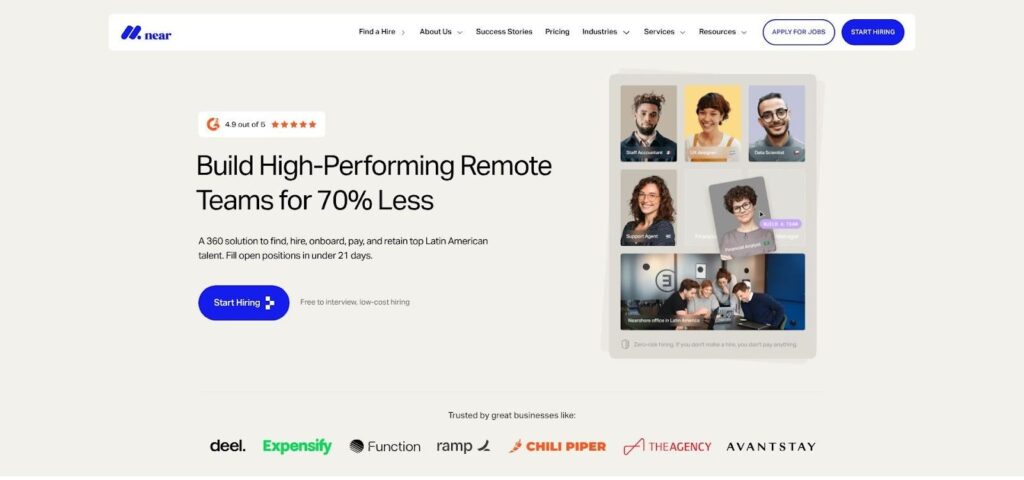
HirewithNear near-shore executive assistant staffing website snapshot
The model is simple. Near sources, vets, and employs the assistant; you pay a flat monthly rate of about 1,300 dollars for a full-time, 40-hour-per-week EA. No surprise fees, no employment-law puzzles, and zero time-zone drag. Because candidates live within GMT-6 to GMT-3, morning stand-ups and late-day investor calls stay in sync.
Quality control zeroes in on two issues fintech founders care about: proactive communication and data security. Applicants complete business-etiquette role-plays and must show reliable broadband plus a private workspace before they ever reach your Zoom. Many come with finance or Big Four backgrounds, so reconciling expense reports or chasing KYC docs will not feel foreign.
Speed is a bonus. Expect a shortlist in seven to ten days, fast enough to plug a sudden gap without overpaying a temp agency. If your startup grows from one EA to three as product lines multiply, Near can add extra hires without reopening contract terms.
Choose Near when runway matters more than in-office presence. You keep real-time collaboration, cut monthly burn, and still gain a dedicated partner who wakes up thinking about your backlog, not six other clients.
6. Robert Half: the “need an EA yesterday” safety net
Sometimes the calendar meltdown has already happened. Your assistant quits two days before earnings week, or due diligence piles up and every deck explodes with last-minute edits. In those moments, you do not want artisanal; you want volume, fast. That is Robert Half’s lane.
With more than 300 offices worldwide and a database that refreshes hourly, Robert Half can drop a stack of qualified résumés into your inbox within 24 to 48 hours. Many candidates arrive skills-tested on Office, Google Workspace, and common fintech CRMs, so you skip the basic screening. If you need a temp to bridge a sudden gap, they can start tomorrow and clock in through Robert Half’s payroll. If direct hire is the goal, the standard contingency fee hovers near the industry norm of about 25 percent, backed by a short replacement guarantee.
Yes, the service feels more transactional than a boutique search. You will wade through more profiles and fine-tune culture fit yourself. But when speed outweighs nuance—product launch next week, board off-site on fire—Robert Half is the reliable firehouse that keeps you from juggling meetings alone.
Think of the firm as your backup generator. You hope the power never goes out; if it does, you will be glad the switch flips instantly.
Compare your options in 60 seconds
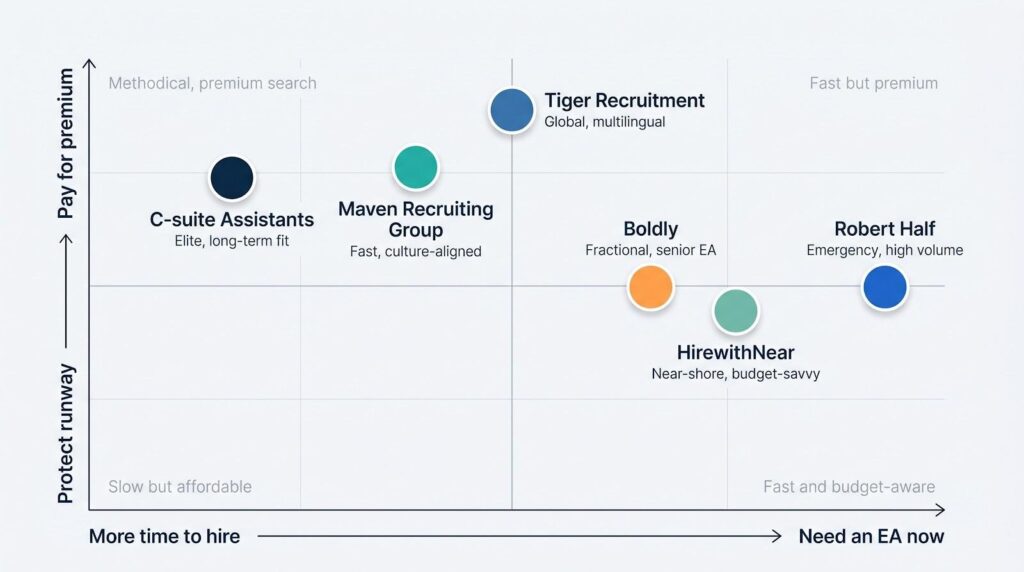
We just covered a lot of detail. The table below lets you zoom out and spot the agency that best matches your urgency, budget, and working style.
| Agency | Core model | Time to first shortlist | Typical cost | Sweet spot |
| C-suite Assistants | Boutique, direct-hire EA focus | 3–4 weeks | about 25 percent contingency | Elite fit for founder-CEOs who prize long-term chemistry |
| Maven Recruiting Group | Bay-Area boutique, deep network | under 2 weeks | 20 to 25 percent contingency | West-Coast startups that need fast, culture-aligned help |
| Tiger Recruitment | Global head-hunter style | 2–3 weeks | 25 to 30 percent contingency | Multilingual or travel-heavy executive roles |
| Boldly | Subscription fractional EAs | about 1 week | 2,000 to 4,000 dollars per month | Senior support without adding headcount |
| HirewithNear | Near-shore remote full-time | 1–2 weeks | about 1,000 to 1,500 dollars per month | Cost-sensitive, remote-first teams in U.S. time zones |
| Robert Half | High-volume temp or perm | 24–48 hours | about 25 percent for perm; hourly markup for temp | Emergency cover or multi-city hires |
Use this grid as a cheat sheet. If speed rules, Robert Half rises. If budget calls the shots, Near wins. For a strategic, can’t-miss hire, C-suite or Tiger justify their higher fee.
Frequently asked questions
1. How desperate is the clock?
If you need résumés in hours, call Robert Half. A one-month buffer? Maven or Near can still deliver. Anything longer opens the door to C-suite or Tiger for deeper vetting.
2. What is your spend ceiling?
Runway tight? Near’s monthly rate of about 1,000 dollars or Boldly’s fractional plans protect cash. Comfortable paying for elite longevity? Budget 25 to 30 percent of salary for C-suite or Tiger, and know you are buying retention.
3. Does location matter?
Hybrid or on-site in New York or San Francisco points to C-suite or Maven. Fully remote and time-zone aligned favors Boldly or Near. Truly global executive life? Tiger wins.
Trends to watch as you hire in 2026
AI runs first pass, humans close the deal.
Roughly 96 percent of recruiting firms now rely on AI résumé screening to cut time-to-hire. That speed is welcome, but algorithms still miss soft-skill nuance, so ask your agency when humans step back in to judge culture fit.
Pay-transparency laws push clarity and discretion.
New York, California, and several EU zones require salary ranges in job posts. Founders who prefer not to broadcast budget often turn to recruiters for discreet searches that still keep them compliant. Confirm how each partner handles postings and internal benchmarking.
Fractional and near-shore models have gone mainstream.
High U.S. salaries plus remote-first culture have led many fintech teams toward part-time senior EAs (Boldly) or full-time near-shore talent (Near). These options are no longer backups; they are primary levers to protect runway without adding permanent headcount.
Conclusion
Fintech founders juggle relentless product sprints, investor demands, and regulatory surprises. The right personal assistant recruiter frees your calendar so you can focus on growth. Whether you crave lightning-fast volume, global multilingual support, or budget-savvy near-shore talent, one of these six partners offers a proven path. Match their strengths to your urgency, budget, and working style, and reclaim the hours that push your startup forward.