

Corporate learning and development teams face an impossible equation: the demand for training content grows every quarter, but the budget and headcount to produce it stays flat. New product launches require training. Regulatory changes demand compliance updates. Organizational restructures call for revised onboarding programs. Each initiative generates a content requirement, and each requirement sits in a queue behind all the others.
The bottleneck is not expertise — L&D teams know what their people need to learn. The bottleneck is production. Creating professional training videos using traditional methods is slow, expensive, and requires skills that most L&D professionals were never trained in. A growing number of forward-thinking organizations are breaking this bottleneck by adopting AI-powered lecture video tools that convert existing training materials into polished, narrated video content at a fraction of the time and cost.
The Training Content Gap
According to LinkedIn’s 2025 Workplace Learning Report, 94% of employees say they would stay at a company longer if it invested in their learning and development. Yet the same report found that only 35% of L&D professionals feel they can keep pace with the content demands of their organization. The gap between demand and capacity is widening, not narrowing.
Part of the problem is structural. Traditional video production requires coordination across multiple teams — subject matter experts, scriptwriters, videographers, editors, and reviewers. Each handoff introduces delays. A training video that conceptually takes a week to produce often stretches to a month or more in practice when you account for scheduling conflicts, revision cycles, and production queue backlogs.
The Consequence of Slow Production
When training content cannot be produced fast enough, organizations make compromises. They rely on text-based materials that employees do not engage with. They extend the shelf life of outdated videos that reference obsolete processes. They skip training for lower-priority initiatives and hope for the best. Each of these compromises has downstream costs: higher error rates, slower onboarding, and lower employee confidence.
How AI Lecture Video Tools Solve the Production Problem
AI lecture video tools, like the AI-powered lecture video creator from Leadde.ai, take existing written content and convert it into professional-quality training videos automatically. The process eliminates most of the traditional production workflow: no camera setup, no recording sessions, no manual editing, no multi-week production timelines.
From Documents to Videos in Minutes
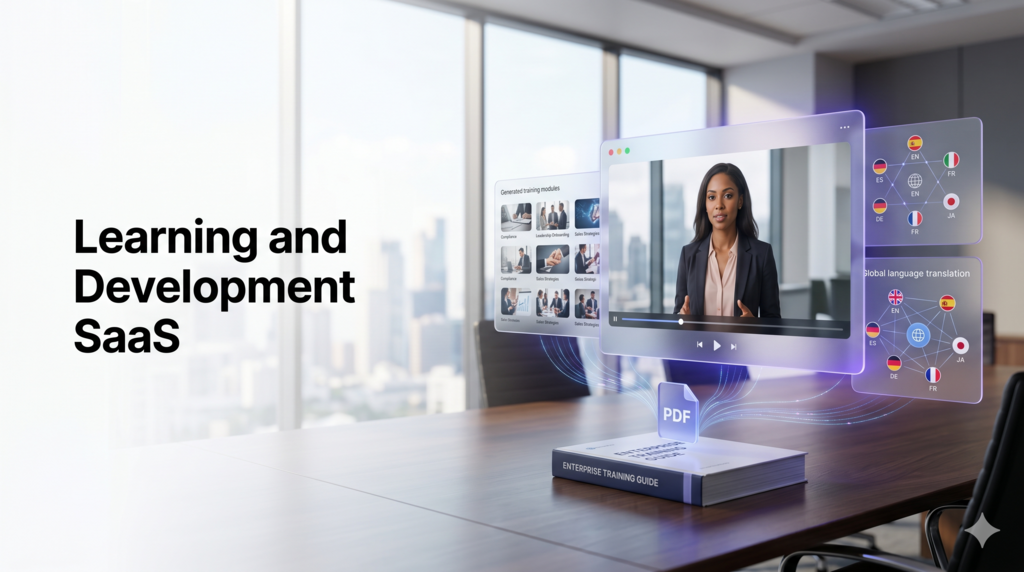
The typical workflow starts with a document that your team has already created — a training manual, a process guide, a set of slides, or even a text outline. The AI analyzes the content, generates a narration script, creates visual scenes with supporting imagery, and adds an AI presenter who delivers the content with natural expression and body language.
The entire process, from document upload to finished video, takes minutes rather than weeks. An L&D specialist can convert a 20-page training guide into a series of short video modules during a single afternoon — work that would have required a dedicated production sprint of several weeks using traditional methods.
Consistency at Scale
One of the underappreciated benefits of AI-generated training video is consistency. When different subject matter experts record their own videos, the quality varies dramatically — different lighting, different audio quality, different presentation styles, different levels of comfort on camera. AI-generated videos maintain a consistent visual style, narration quality, and production polish across every module in the training library. This consistency creates a more professional learning experience and establishes the training program as a credible, authoritative resource.
Building the Business Case
Time Savings
The most immediate and measurable benefit is production time savings. Organizations that have adopted AI lecture video tools report 80-95% reductions in video production time. For a team that previously allocated one full-time employee equivalent to video production, this translates to recovering 80-95% of that capacity for other work — or, more commonly, producing 5-10 times more content with the same resources.
Cost Reduction
Traditional training video production costs typically range from $1,000 to $5,000 per finished minute when you factor in equipment, software, talent, and post-production time. AI-generated video reduces this to a fraction of the cost — often less than $100 per finished minute. For organizations producing dozens of hours of training content annually, the savings are substantial.
Content Currency
Perhaps the most valuable but hardest-to-quantify benefit is content currency. When updating a training video is as simple as editing the script and regenerating the affected scenes, the training library stays current. Processes change, policies evolve, and products get updated — and the corresponding training videos can be updated in hours rather than months. This freshness directly impacts training effectiveness because learners trust content that is visibly current.
Implementation Playbook
Phase 1: Audit Your Existing Content
Start by inventorying your existing training materials. Identify documents that are well-structured, up-to-date, and serve large audiences. These are your best candidates for initial conversion. Common starting points include new hire onboarding materials, compliance and regulatory training, product knowledge bases, and standard operating procedures.
Phase 2: Pilot with High-Impact Content
Convert 5-10 high-impact documents into video format. Deploy them alongside existing training materials and measure engagement differences: completion rates, quiz scores, time-to-completion, and learner satisfaction ratings. This pilot data builds the evidence base for broader rollout.
Phase 3: Integrate into L&D Workflows
Once the pilot validates the approach, integrate AI video conversion into your standard content development workflow. When a new training document is created, a video version should be generated as a routine step. When an existing document is updated, the video should be regenerated. This integration ensures that the video library grows and evolves naturally without requiring a separate production effort.
Phase 4: Leverage Multilingual Capabilities
For global organizations, generate translated versions of training videos for each market. AI translation with localized narration makes multilingual training content economically viable in a way that traditional localization never was. A training module that previously existed only in English can be made available in a dozen languages within hours.
Measuring Program Impact
Track these KPIs to demonstrate the impact of AI-powered training video: production throughput (number of video modules produced per month), content currency (percentage of training videos updated within 30 days of source material changes), learner engagement (completion rates, rewatch rates, interaction metrics), knowledge retention (assessment scores tied to specific training modules), and time-to-competency (how quickly new hires reach productivity benchmarks).
Organizations that track these metrics consistently find that AI-generated training video performs comparably to professionally produced video on engagement and retention metrics, while dramatically outperforming text-based training materials across all measures.
The Strategic Opportunity
The organizations that will build the strongest learning cultures over the next several years are those that treat content production as a scalable capability rather than a fixed constraint. AI lecture video tools make this possible by decoupling content quality from production budget.
The expertise that drives effective training — deep subject matter knowledge, understanding of learner needs, clear communication of complex concepts — has always existed within your organization. What has been missing is a production mechanism that can keep pace with the rate at which this expertise needs to reach learners. AI-powered video creation fills that gap, and the organizations that recognize and act on this opportunity will build a meaningful competitive advantage in talent development.