

Most contractors don’t realize their coverage has gaps until a claim gets denied. Contractor insurance isn’t just a box to check for a job site. It’s the difference between a bad week and a business-ending loss. Figuring out what’s legally required versus what’s just strongly recommended, keeping premiums reasonable without gutting your coverage limits, and bridging the gap between general liability and professional liability for design-build work are real problems that trip up contractors every single day. After reviewing dozens of providers across the construction insurance space, this guide breaks down five companies that actually deliver.
How this ranking was put together
Every option in this list was evaluated by combing through user reviews, official websites, industry directories, and publicly available case data. Only providers with a documented track record of serving construction professionals made the cut. Shortlisted companies were reviewed for consistency in reputation and real-world results.
→ See the full research breakdown
- Affordable Contractors Insurance – Best for small to mid-sized contractors needing fast, trade-specific coverage
- Thimble – Best for small construction businesses needing flexible, short-term insurance coverage
- AmTrust Insurance – Best for small commercial construction businesses and low-to-medium hazard construction operations
- Nationwide – Best for large-scale commercial and business insurance
- Zurich – Best for commercial construction insurance and complex business risk coverage
Why Contractor Insurance Is Worth a Closer Look
Picking the wrong policy isn’t just a financial risk. It can cost you the contract entirely. Plenty of contractors get burned by coverage that looks solid on paper but falls apart the moment a client demands proof of adequate limits or a specific endorsement.
The challenge is real. Working out which coverage types your state or municipality actually requires versus what’s just good practice takes time, most contractors simply don’t have. And cutting premiums to save a few bucks often means finding out too late that your limits fall short of what the project contract demands.
Specialized knowledge in this space pays off. Providers who actually understand trade-specific risks price policies more accurately and process certificates of insurance faster. That turnaround speed matters a lot when you’re sitting on a cert waiting to break ground. The right provider can also mean noticeably shorter claims settlement times and a better fit between your cost per $1M in general liability coverage and what your contracts actually require.
Comparing the 5 Best Contractor Insurance
Note: All data in this table is sourced from review platforms and the official websites of the listed companies.
| Company Name | Years Operating | Headquartered In |
| Affordable Contractors Insurance | Since 2011 | United States |
| Thimble | Since 2015 | New York City |
| AmTrust Insurance | Since 1998 | New York City |
| Nationwide | Since 1925 | Columbus, Ohio |
| Zurich | Since 1872 | Schaumburg, Illinois |
- Affordable Contractors Insurance – Best for Fast, Trade-Specific Coverage
What Services Does Affordable Contractors Insurance Offer?
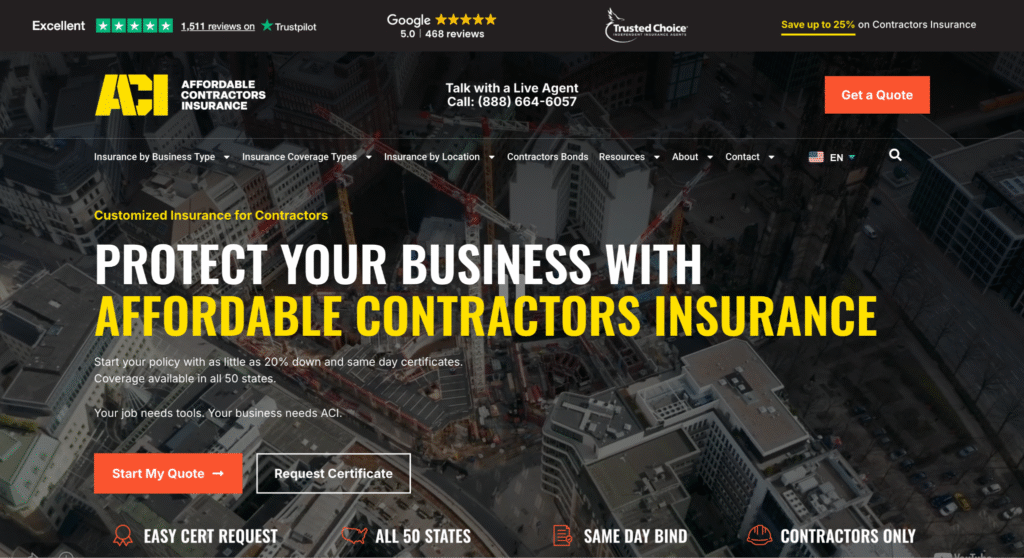
Affordable Contractors Insurance is a U.S.-based brokerage that has focused exclusively on construction and contractor insurance since 2011. They cover general liability, workers’ compensation, commercial auto, builder’s risk, tools and equipment, and umbrella liability. What sets them apart is same-day policy binding and fast delivery of certificates of insurance (which is genuinely rare in this space). Their focus remains on trade professionals, including roofers, electricians, plumbers, and HVAC contractors, with payment options tailored to the budgets of smaller construction businesses.
Why Does Affordable Contractors Insurance Stand Out for Contractor Insurance?
Contractors under deadline pressure lose jobs when insurance paperwork moves slowly. That’s exactly the problem Affordable Contractors Insurance is built to solve. Their same-day binding and cert turnaround directly address the needs that most small to mid-sized construction businesses face on real job sites.
What Users Are Actually Saying:
From what the reviews show, contractors respond well to the speed and simplicity of working with a team that actually knows the trades. The feedback points to quick cert delivery and responsive service as the two things clients mention most. That kind of consistency across reviews builds trust pretty fast.
- Thimble – Best for Flexible, Short-Term Insurance Coverage
What Services Does Thimble Offer?
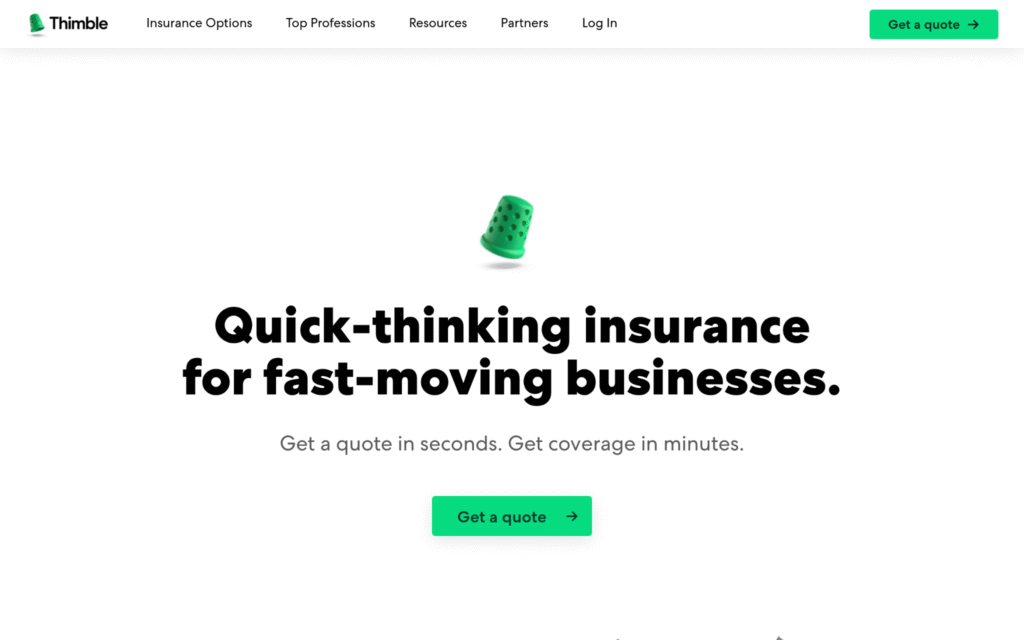
Thimble runs an on-demand insurance platform where small construction businesses can grab coverage by the job, month, or year directly through an app, website, or phone. They cover over 300 professions across eight insurance products, including general liability, professional liability, workers’ comp, and cyber insurance. The interesting thing about Thimble is that they pioneered hourly general liability coverage (starting as low as $9 to $15), which makes short-term project coverage genuinely accessible for solo contractors and small crews.
Why Does Thimble Stand Out for Contractor Insurance?
A lot of small contractors get stuck paying for full annual policies when they only work seasonally or on individual projects. Thimble solves that by letting them buy coverage that fits the actual job timeline. And honestly, the combination of Fortune 500-backed underwriting and on-demand flexibility is hard to match for contractors who don’t need a 12-month commitment.
What Users Are Actually Saying:
Thimble holds 621-plus reviews on Trustpilot with 86% sitting at five stars, which speaks for itself. From what the reviews show, users consistently point to fast quote-to-policy turnaround and ease of use as the standout strengths. That kind of feedback across that many reviews suggests the platform genuinely delivers on its speed promise.
- AmTrust Insurance – Best for Workers’ Compensation and Low-to-Medium Hazard Construction
What Services Does AmTrust Insurance Offer?
AmTrust Financial Services has been operating since 1998 and ranks as the third-largest workers’ compensation provider in the country. They cover workers’ comp, general liability, business owners’ policies, cyber liability, and EPLI. Their platform, AmTrust Genius, uses AI to speed up quote generation, which makes the underwriting process faster for construction businesses with niche or lower-hazard risk profiles. With over 500,000 small commercial policies in force, the scale here is real.
Why Does AmTrust Insurance Stand Out for Contractor Insurance?
Small construction businesses often struggle to get accurately priced workers’ comp because general insurers don’t understand trade-specific risk factors. AmTrust’s niche focus directly addresses that gap. Their AM Best “A minus” rating and 2025 Claims Excellence Award back up what their policy volume already suggests: they’re built to handle this kind of work consistently.
What Users Are Actually Saying:
The industry recognition tells a clear story here. From what the data shows, AmTrust has earned repeat recognition for claims handling and digital experience, which tracks with what construction businesses actually need when a worker gets hurt on site. The feedback pattern points to reliability and speed in claims resolution as the consistent strengths.
- Nationwide – Best for Large-Scale Commercial Construction Insurance
What Services Does Nationwide Offer?
Nationwide has been in the insurance business since 1925 and currently sits at No. 72 on the 2025 Fortune 500 list. They offer a full range of commercial insurance products, including property and casualty coverage, excess and surplus lines, and business insurance relevant to construction operations. With roughly 24,000 employees and an A-plus rating from Standard and Poor’s, the financial backing is strong. For larger construction businesses that need a carrier with serious operational scale, Nationwide fits the profile.
Why Does Nationwide Stand Out for Contractor Insurance?
Large construction operations often need a carrier that can handle complex, multi-line commercial policies without missing a beat. Nationwide’s size and financial strength position them well for exactly that. The depth of their commercial product range means a general contractor managing multiple coverage types can consolidate more of that work with a single, stable carrier.
What Users Are Actually Saying:
Nationwide’s strongest recognition tends to cluster around customer experience consistency over time. From what the data shows, their Retirement Solutions division has earned the DALBAR Customer Experience Excellence Award for six consecutive years, which points to a company culture that prioritizes long-term service reliability. That reputation for staying consistent matters when you’re renewing policies year after year.
- Zurich – Best for Complex Commercial Construction Risk

What Services Does Zurich Offer?
Zurich North America has operated in the U.S. and Canada since 1912 and covers commercial property and casualty insurance, life insurance, accident and health products, and crop insurance. They serve mid-sized to Fortune 500 businesses and work across industries where construction risk gets complex fast. What’s impressive about Zurich is its documented history of major projects, including the Hoover Dam, Madison Square Garden, and the Confederation Bridge. They cover 90% of the Fortune 500 (not a small operation by any measure).
Why Does Zurich Stand Out for Contractor Insurance?
Complex construction projects carry risk profiles that most insurance providers simply aren’t equipped to assess accurately. Zurich’s 150-plus-year track record on exactly those kinds of projects is hard to argue with. Their Transactional Net Promoter Score of 82 in Q4 2021 sits well above the insurance industry average of 36, which suggests their claims and service experience hold up even when the stakes are high.
What Users Are Actually Saying:
That gap between Zurich’s score and the industry average is pretty striking. From what the data shows, customers consistently report satisfaction with claims service and the quality of risk guidance, which lines up with what you’d expect from a carrier that built its construction reputation on projects of serious scale. That kind of service culture is hard to fake over 150 years.
Methodology Behind These Picks
Gathering and Organizing Your Data Sources
The research started by building a broad list of insurance providers actively serving the construction industry. Sources included insurance review platforms, contractor-focused industry directories, company websites, and publicly available case studies tied to construction operations. Each provider was identified based on visible market presence and evidence of construction-specific coverage options. The goal at this stage was breadth, pulling in enough options to make sure no strong candidates were missed before narrowing down.
The Shortlist Cut
Once the initial list was assembled, providers without verifiable records in the construction space were removed. Review patterns were analyzed across multiple platforms to check for consistency in feedback. Companies showing isolated or unverifiable positive reviews were flagged and excluded. The shortlist was kept to providers where the review volume and patterns told a clear, coherent story about how they actually perform for contractors and construction businesses.
Fact-Checking the Picks
Claims made on company websites were cross-referenced against external reviews, third-party ratings, and publicly available industry data. Where a company positioned itself as a specialist, that claim was checked against the types of policies they offer, the trades they serve, and whether real-world feedback confirmed the positioning. Any gaps between what a company claimed and what customers actually reported were noted and factored into the final evaluation.
Authority Signals and Industry Standing
Industry recognition, carrier ratings from organizations like AM Best and Standard and Poor’s, and mentions in relevant trade publications were all considered. Awards for claims excellence, customer experience, and financial strength were treated as supporting signals rather than the only proof of quality. A company holding a strong financial rating alongside consistent service recognition carries more weight than a rating alone. These signals were evaluated as a group, not in isolation.
Contractor Insurance Track Record
Each provider was assessed for their history in the contractor insurance space. This included looking at dedicated coverage pages for construction trades, verified reviews from contractors and construction business owners, and any publicly available case studies showing real construction projects or trade-specific outcomes. Providers who treated construction as a specialty rather than an add-on scored higher here. The depth of trade-specific coverage options and the speed of certificate of insurance delivery were treated as strong practical indicators of genuine construction knowledge.
Picking the Right Contractor Insurance for You
Choosing the right contractor insurance provider comes down to more than finding the lowest premium. The right fit depends on your trade, your project size, your state’s requirements, and how fast you need documentation delivered. Here are the factors worth weighing before you decide.
- Industry and Domain Experience: Look for providers who specialize in contractor and construction coverage, not just general commercial insurance. Trade-specific knowledge directly affects how accurately your policy is priced and how well exclusions are explained upfront.
- Features and Coverage Options: Check that the provider covers the specific policy types your contracts and state licensing require. General liability is a starting point, but workers’ comp, commercial auto, and builder’s risk may all be necessary depending on your work.
- Pricing Structure: Compare the cost per $1M in general liability coverage across providers. Flexible payment options matter for smaller contractors managing cash flow across multiple active projects.
- Results Measurement: Ask about average claims settlement timelines and certificate of insurance turnaround times. These numbers tell you more about day-to-day performance than a marketing page ever will.
- Industry Knowledge and Compliance: Your provider should understand state insurance regulations, OSHA requirements, and contractor licensing laws in the states where you operate. Coverage that meets one state’s requirements may fall short in another.
The Verdict
The construction insurance market has solid options across the board, but the right fit depends on your business size and trade type. Smaller contractors benefit most from providers like Affordable Contractors Insurance and Thimble, where speed and flexibility are built into the model. Larger or more complex operations tend to need the depth that Nationwide or Zurich brings. AmTrust fills a useful middle ground for workers’ comp-heavy businesses. As project contract requirements grow stricter, having the right coverage in place before you need it matters more than ever.