
Finding the radiology suite should not feel like a scavenger hunt. Hospitals are among the most navigationally complex environments people encounter, and when a department moves or construction reroutes a corridor the physical signage lags the change by weeks or months, so the map on the wall is wrong and the patient is late. Navigation confusion is a leading barrier at multi-building campuses, where the average no-show rate already runs around 18 percent. We reviewed the top five hospital concierge services in California, full-stack teams that blend valet, check-in escorts, shuttles, and real-time wayfinding, to show you how a coordinated arrival can turn those first 100 yards into a calm, on-time welcome.
What counts as a hospital concierge service?
A hospital concierge service is an end-to-end arrival network that begins at the windshield and ends at the clinic door. One cross-trained team parks the car, summons a wheelchair, guides the patient through registration, and escorts them to imaging. There are zero hand-offs and no guesswork.
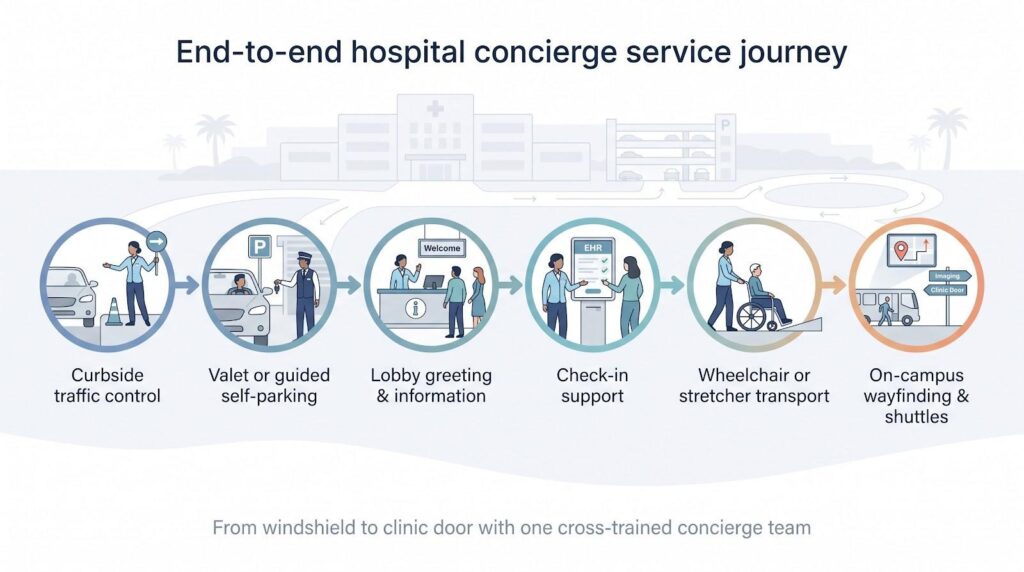
A complete program touches six points every time:
- Curbside traffic control
- Valet or guided self-parking
- Lobby greeting and information
- Check-in support (kiosks or full EHR registration)
- Wheelchair or stretcher transport
- On-campus wayfinding, with shuttles for remote lots when needed
Anything less is a single task, not a concierge system. When you vet vendors, pin down where greeting stops and registration starts, confirm that escorts are certified for patient lifts, and ask how their digital maps route back to a live human. Clear definitions now mean fewer scope-creep headaches and far fewer late arrivals later.
How we chose the five providers
We reviewed vendor sites, job postings, case studies, LinkedIn head counts, trade news, and California hospital pages, then asked one blunt question: Can this company run the full arrival gauntlet for a Golden State hospital right now?
We weighed each candidate across six factors:
- Service breadth, 25 percent
- California footprint, 20 percent
- Technology, 15 percent
- Documented results, 15 percent
- Compliance and training, 15 percent
- Pricing transparency, 10 percent
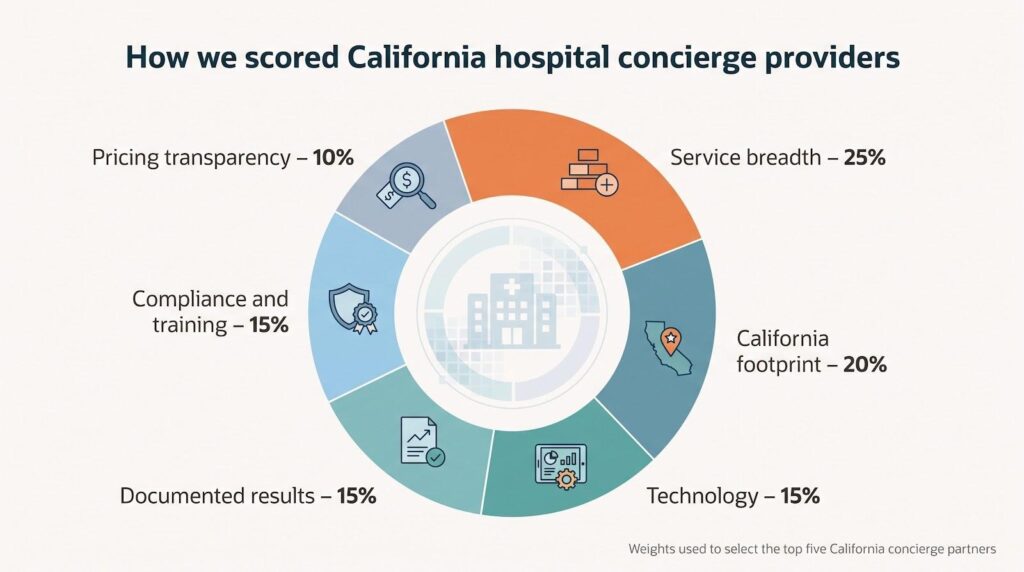
Breadth mattered most because one accountable partner means fewer hand-offs and fewer headaches for your team. California presence came next; national kudos do not help if a vendor cannot staff a San Diego ER entrance on a holiday weekend. Technology, results, and compliance filled the middle of the scale, and we looked for proof of ticket-free valet, real-time dispatch, and wheelchair response times, not glossy promises. Finally, we rewarded any vendor that at least explains its fee logic, even if no one publishes a rate card.
Only five firms cleared the bar. The pages that follow label each one for the scenario where it shines.
Quick-look scorecard
A side-by-side glance saves time. Use this grid to match each vendor’s strengths to your own arrival gaps before diving into the full profiles.
| Provider | Best for | California proof | Check-in assist | Wheelchair / transport | Valet and shuttles | Digital tools | Public metric | Pricing visibility | Evidence confidence* |
| FC Parking | Bundled check-in and wayfinding | VA Central California case study | Yes | Yes | Yes | Valet tech | 38 percent increase in valet capacity (vendor-reported) | Custom quote | Medium: one published California case study |
| Towne Health | Enterprise systems and transport | CHOC, Mission Hospital | Yes | Yes | Yes | Dispatch analytics | None published; ask for before-and-after data | Custom quote | Medium: two California hospitals confirmed |
| LAZ Parking | Mobility centers and deep California roster | Statewide healthcare roster; request current list | Yes | Yes | Yes | Hand-held admission tools | None published; request the survey method | Custom quote | Low: roster and results are vendor-stated |
| SP+ Healthcare | Multi-site parking and shuttle scale | Multiple California campuses; request roster | Limited | Yes | Yes | Metropolis platform | More than 300 healthcare sites | Custom quote | Medium: national site count published |
| Propark Mobility | Sutter-linked parking and shuttles | Sutter Health hospitals | Limited | Yes | Yes | Gateless payment tech | More than 1,000 locations in more than 250 cities | Custom quote | High: partnership and site counts published |
*Rather than publish a single composite score, we show how much of each vendor’s claim you can verify today from public sources. The six weighted factors above (service breadth, California presence, technology, documented results, compliance and training, and pricing transparency) shaped the shortlist; the confidence column tells you where the evidence is thin.
FC Parking, best for bundled check-in, wheelchair escort, and on-the-ground wayfinding
FC Parking’s healthcare concierge services bundle every arrival task under one roof. Greeters park the car and hand back a digital valet ticket the guest can redeem from a phone with no app to download. Inside, the same contract covers the six things FC publishes as its concierge scope: patient check-in, wheelchair transport, clerical assistance, wayfinding, hospital tours, and organizing pet visits. One vendor, one training standard, and no gap between the person who took the keys and the person who knows where imaging moved to. No wandering, no guesswork.
California proof matters. At the VA Central California Health Care System in Fresno, the program delivered a vendor-reported 38 percent increase in valet capacity. FC published that result in 2018 and reports parking complaints “at an all time low” on the same account. Treat it as what it is, a valet-capacity outcome at one federal campus, and ask FC for a reference where the full concierge scope, check-in through wayfinding, was running.
Staffing standards do the work here rather than software. FC trains on a “patient-centered healthcare and hospitality training curriculum that meets HIPAA, The Joint Commission and five-star hospitality practice standards.” On the technology side FC publishes GPS-verified time and attendance tracking and real-time performance insights, which is what lets a facilities team confirm the crew it paid for was actually on post. Ask for a sample of that report before you sign.
Sweet spot: midsize to large facilities that want white-glove service without mega-operator red tape. Pricing is custom and FC publishes no rate card, so put the itemization you want into the request for proposal yourself: wage assumptions by role, relief and call-out coverage, and any technology fees, each as a separate line.
Towne Health, best for enterprise systems that need high-volume patient transport
Towne Health runs like a logistics firm in hospitality uniforms. The company says it holds more than 300 hospital contracts nationwide, and its teams speak the language of peri-operative flow, nurse-call metrics, and capacity dashboards.
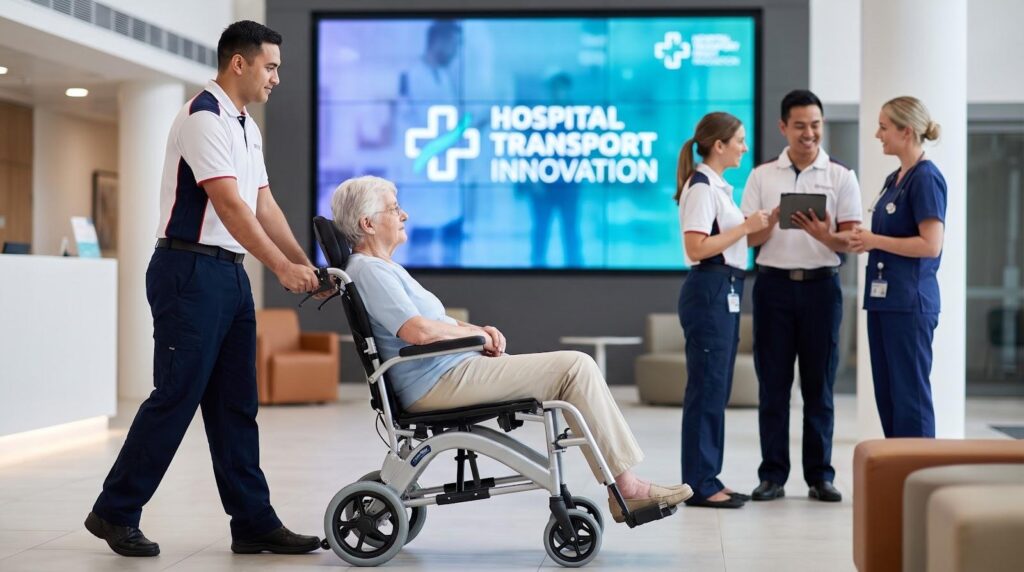
Towne Health hospital valet and patient transport services webpage screenshot
In California you will spot Towne associates at CHOC and Mission Hospital. They juggle valet lanes, shuttle loops, lobby greeters, and a wheelchair fleet while a proprietary dispatch platform tracks every transport in real time and reroutes staff as volumes spike.
That technology is the pitch. Towne’s case for itself rests on transport throughput, so make it prove the claim on your campus: ask for before-and-after retrieval times and monthly transport volumes from a hospital of your size, with the measurement method attached, and treat any number that arrives without one as a starting position rather than a result.
The training stack is equally rigorous: motor-vehicle checks, de-escalation tactics, ADA mobility protocols, and optional CPR or sitter modules. Cross-training lets supervisors slide staff between parking, lobby, and patient escort as each day’s census shifts.
Towne fits multi-hospital networks that want uniform service-level agreements and data-rich scorecards. Proposals are custom and bundle base wages, shift premiums, and relief coverage into one hourly rate, with clear clauses for California wage escalators.
LAZ Parking Healthcare, best for mobility support and deep California references
LAZ started as a parking powerhouse; today its healthcare arm operates like a mobility command center that covers valet, greeters, patient companions, wheelchair stations, and even scooters for guests who need more than a push.
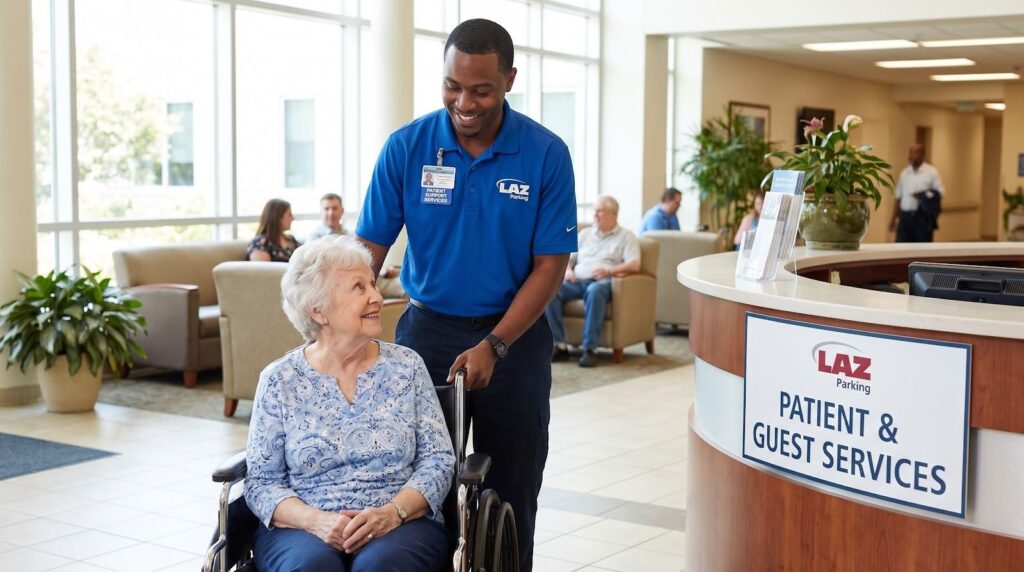
LAZ Parking healthcare patient support services webpage screenshot
California hospitals are on LAZ’s healthcare roster across the state. Ask LAZ for its current California hospital reference list in writing and call two of them, because a vendor’s regional depth is the one claim that is cheap to state and easy to check. A vendor’s own satisfaction and on-time figures are worth having, but they are worth far more with the survey instrument and the sample size attached, so request both.
The secret sauce is detailed route planning. LAZ maps every curb cut, ramp grade, and elevator bank before the first car is parked. Hand-held apps guide staff through pre-admission tasks, patient escorts, and equipment inventory, while wheelchair counts, battery levels, and scooter locations appear on a live dashboard.
Training leans hard on empathy. Associates complete hospital-level safety modules and can add CPR, AED, or evacuation courses for extra confidence.
LAZ shines on sprawling campuses with diverse mobility needs. If your population skews older, rehab-heavy, or multilingual, the companion model keeps guests moving. Pricing is quote-only, but proposals spell out staffing ratios, fleet costs, and technology fees. Confirm how the platform syncs with Epic MyChart before you sign.
SP+ Healthcare, best for multi-site parking and shuttle scale
SP+ is a transportation engine first. Since its acquisition by mobility-tech firm Metropolis, that engine now pairs curbside cameras with smart-payment tools to keep lanes clear and revenue transparent.
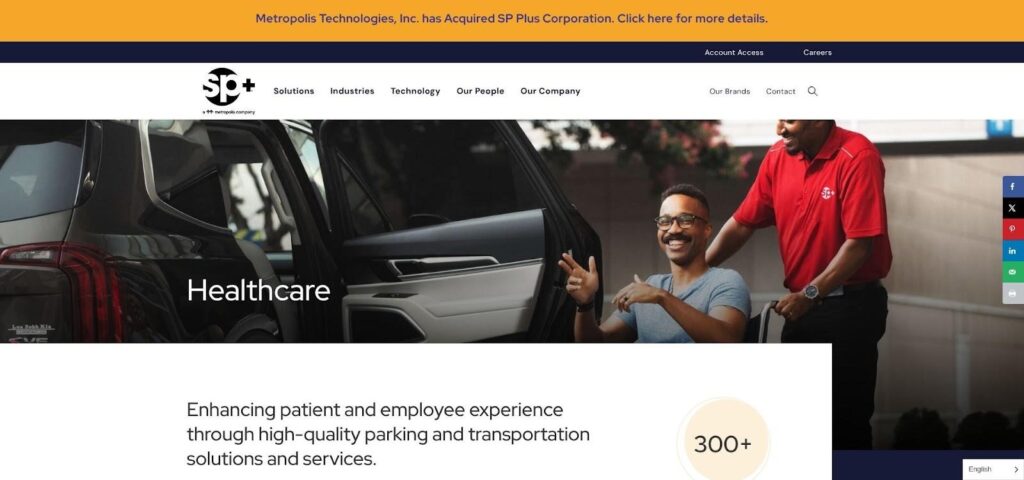
SP+ Healthcare parking and shuttle services webpage screenshot
Hospitals call SP+ when parking headaches spread across multiple campuses. The company supports more than 300 healthcare sites nationwide, and California locations include large academic and community systems (ask for a current roster). Associates handle valet, wheelchair transport, entrance ambassadors, and adaptive screening that flexes during infectious-disease surges or mass-casualty drills.
Shuttle and ambulatory rides set SP+ apart. Fleet managers watch live GPS pings, seat counts, and ADA-lift cycles, adjusting loops before visitors complain. Those data feed executive dashboards so facilities teams spot demand spikes well before budget season.
Metropolis supplies the back end, giving finance teams one source of truth for tickets, validations, claims, and refunds, which means fewer audit surprises and fewer gray-area fees.
SP+ fits health systems that prize technology and need consistent service across dozens of properties. Verify California references, ask how the Metropolis help desk integrates with yours, and confirm privacy safeguards for plate-recognition cameras. Pricing is proposal-only, but bids include detailed volume assumptions that make negotiations straightforward.
Propark Mobility, best for Sutter-aligned campuses that rely on shuttles
Propark is woven into Northern California’s hospital fabric through a long-running partnership with Sutter Health. The team manages valet lanes, multilevel garages, and fixed-route shuttles that move visitors between clinics, parking structures, and nearby transit stops.
Propark Mobility healthcare parking management webpage screenshot
Throughput comes first. Greeters ease choke points, and gateless payment technology speeds exits while feeding live occupancy dashboards. Inside, dispatchers track GPS pings to tighten shuttle headways and reroute vehicles when imaging or infusion centers surge.
Local leadership is Propark’s edge. Regional managers recruit from the same labor pools as their hospitals, then cross-train staff for valet, wheelchair escort, and patient-sitter roles, creating bench depth that keeps entrances covered even when flu season spikes absenteeism.
Electrification is underway. Propark manages more than 1,000 locations in more than 250 cities nationwide and handles charging infrastructure, driver certification, and range analytics so facilities teams skip the electric-vehicle learning curve.
Front-desk check-in remains less mature than parking and transport, so note that need in any request for proposal. For campuses where parking flow, shuttle frequency, and local governance outrank national scale, Propark offers a California-savvy solution with proposal drafts ready in days and transparent cost assumptions.
How to choose the right concierge partner for your hospital
- Define the scope. Decide whether you only need curbside greeters and valet, or if you expect full EHR check-in, wheelchair escorts, and evening discharge support. Spell that out in the request for proposal so every bidder prices the same playbook.
- Insist on hard numbers. Ask for average valet retrieval time, wheelchair response time, shuttle on-time performance, complaint counts per 1,000 encounters, and staffing fill rate or turnover. Real metrics reveal operational discipline.
- Factor in California labor law. Make sure proposals include wage escalators tied to Senate Bill 525, overtime triggers, and paid-break relief coverage. Transparent rate tables today prevent invoice arguments tomorrow.
- Test the tech. Request a live demo of ticket-free valet payments, dispatch dashboards, and visitor-feedback portals. If you rely on Epic MyChart, press vendors on whether their wayfinding or check-in tools sync with it.
- Probe service recovery. What happens when keys vanish, a vehicle is scratched, or a patient misses an appointment because the shuttle ran late? Look for written service-level agreements that define response times, claims handling, and credits.
- Ask what happens when the campus changes. California hospitals are rebuilding on a statutory deadline, so entrances move, lots become staging areas and departments relocate mid-year. Signage does not keep up. Ask each bidder how it retrains front-door staff when a route changes, how fast, and who tells the greeters, because for the weeks your map is wrong the person at the door is your wayfinding system.
Treat these six checkpoints as non-negotiable and your shortlist will sort itself.
Emerging trends shaping California arrival programs
Digital front doors keep widening. Map engines such as Cartogram guide patients from driveway to department before they ever ask for help, and the better ones integrate with the electronic health record so directions arrive with the appointment reminder. Ask any vendor to confirm in writing which systems it connects to. Yet app-free text messages and voice prompts remain critical for older visitors and anyone who skips hospital apps entirely.
Hybrid staffing is rising. Vendors now deploy flex teams who slide between valet, lobby screening, and wheelchair duty as real-time dashboards flag demand spikes. The model trims idle time during clinic lulls and cushions peak waves without inflating budgets.
Accessibility is moving beyond ramps. Modern wayfinding platforms plot wheelchair-friendly routes and surface elevation changes, while LAZ-style mobility centers stock scooters, walkers, and bariatric wheelchairs so no guest waits for equipment.
Green fleets are rolling in. ACE Parking runs an all-electric shuttle fleet at San Diego International Airport that has now covered more than a million zero-emission miles, while Propark manages electrification across more than 1,000 sites nationwide, pairing chargers with telematics that track battery health and route efficiency. As the state tightens emissions rules, expect future requests for proposal to require an electrification roadmap rather than a promise.
Conclusion
The thread through every trend is clear: technology augments people; it does not replace them. Hospitals that combine smart software with empathetic concierges will stay ahead of those chasing an all-digital shortcut.
Frequently asked questions
What is the difference between hospital concierge services and concierge medicine?
Hospital concierge services cover non-clinical arrival support such as valet, greeters, wheelchair escorts, wayfinding, and shuttles that improve the visit itself. Concierge medicine is a paid, one-to-one relationship with a physician for ongoing clinical care. Same word, different worlds.
Can an outsourced concierge team handle patient check-in?
Yes, when you define it precisely. Some vendors only greet and guide; others assist with kiosks; a few obtain electronic health record credentials to complete full registration. Spell out the level of access, training, and HIPAA safeguards you expect.
How much do concierge and valet services cost?
Pricing is quote-only. Recent California hospital valet postings have run roughly 21 to 24 dollars an hour for attendants, with supervisory and overnight lead roles above that, and California’s health care worker minimum wage sets a floor that varies by facility class. Pull the rate for your own facility class and market rather than a statewide range, then check that every bid you receive is built on the same number. Total program cost also reflects entrance count, vehicle volume, shuttle miles, technology fees, and insurance limits.
Do these providers integrate with Epic MyChart?
Most staffed vendors focus on parking and transport technology, not deep electronic health record links. If MyChart navigation is crucial, pair a physical vendor with a platform such as Cartogram or Gozio and outline data-sharing boundaries in a joint statement of work.
What key performance indicators should we track after go-live?
- Valet retrieval time (target under 10 minutes)
- Wheelchair response time (under 5 minutes)
- Shuttle on-time rate (95 percent or higher)
- Complaints per 1,000 encounters
- Staffing fill rate and turnover
Tie incentives or penalties to these numbers rather than vague satisfaction claims.
Is valet parking alone enough to fix the arrival experience?
Rarely. Families still need clear directions, accessible routes, and a human who can bridge confusing kiosks or language barriers. The best programs weave parking, mobility aids, digital maps, and empathetic concierges into one seamless path.