
It’s 2 a.m. A VIP’s €4,000 withdrawal is stuck and the chatbot keeps looping the same answer. Frustration spills onto Reddit, chargebacks follow, and regulators take notes. Since 2 August 2026, the EU AI Act requires every chatbot to explicitly identify itself as an AI to users, while the U.K. Gambling Commission made one operator pay £1.4 million in March 2025 for, among other failures, missing a safer-gambling interaction with a player who lost £6,000 in 48 hours. This comparison of seven live-chat platforms for iGaming reveals which tools automate routine questions yet hand risky conversations to a real person fast.
How we selected and scored each platform

We started with a US-English Google sweep and logged 30 unique URLs that mention live-chat software for iGaming. Roughly 50 percent were vendor pages, 20 percent general “best-of” blogs, and the balance mixed forums, service providers, or regulatory PDFs. That noise called for an objective filter.
First cut: we kept only products that combine always-on AI with a built-in path to a human agent. Outsourced call centers, one-way widgets, and casino-platform plug-ins were excluded. Seven tools remained: Comm100, Zendesk, Intercom, Salesforce Agentforce Service, LiveChat, Freshchat and Tugi Tark.
We then applied a seven-factor scorecard:
- Security & regulatory controls: 25 percent (chat transcripts can hold KYC data and card details)
- Bot-to-human handoff: 20 percent
- 24/7 automation depth: 15 percent
- iGaming-specific integrations: 15 percent
- Multilingual & omnichannel reach: 10 percent
- Pricing transparency & total cost: 10 percent
- Independent evidence: 5 percent
All scores draw on publicly available documents dated 2 September 2026. We ignored any claim without a verifiable source and ran no proprietary load tests.
At-a-glance comparison
Short on time? The table below shows where each platform excels, its published entry cost, and our editorial handoff score (1 means poor escalation, 5 means instant, context-rich escalation).
| Rank | Platform | Best for | Handoff score¹ | Published entry price² | Notable compliance evidence | Overall score |
| 1 | Comm100 | Regulated, multi-channel operations | 4.5 | From $39/agent/mo | SOC 2 Type II, ISO 27001, PCI-DSS | 91.3 |
| 2 | Zendesk | Named casino case studies | 4.7 | From $55/agent/mo | Advanced Data Privacy add-on, audit logs | 91.0 |
| 3 | Intercom | AI-first chat and fast escalation | 4.6 | $0.99 per AI outcome + seat | SOC 2 Type II, ISO 42001 | 87.4 |
| 4 | Salesforce Agentforce | Teams already on Salesforce | 4.7 | From $125/agent/mo | Salesforce Shield, regional hosting | 85.8 |
| 5 | LiveChat | Quick rollout, clear pricing | 4.2 | From $19/agent/mo | GDPR guidance, HIPAA setup guide | 82.6 |
| 6 | Freshchat | Budget-friendly multilingual CX | 4.4 | Free tier to $79/agent/mo (Enterprise) | IP restrictions, Trust Center docs | 82.2 |
| 7 | Tugi Tark | iGaming-native AI challenger | 4.6 | EUR 99/agent/mo + about EUR 0.15 per AI ticket | No certifications published; GDPR terms | 76.1 |
¹ Handoff score is our editorial metric based on publicly documented trigger controls, transcript transfer, and routing options. Five represents the best possible escalation.
² Prices captured 2 September 2026; seat tiers, AI usage fees and privacy add-ons vary. Always request an itemised quote.
Comm100: best for regulated omnichannel support and deployment control
Comm100’s live chat software platform for igaming operators unifies live chat, ticketing, social messaging and AI within a single console so player context follows across channels. You can run it in Comm100’s cloud or deploy it on-premises behind your own firewall, a critical option when regulators require local data residency.
Security first. Comm100 lists SOC 2 Type II, ISO 27001 and PCI-DSS certificates and lets you mask card data or auto-delete transcripts after a set period. The AI Agent answers only from your own verified knowledge sources, and a full on-premises option keeps VIP history on your servers.
Automation with audit trails. The AI Suite pairs an AI Agent for routine queries with Copilot suggestions and AI-driven QA scoring. Comm100 cites up to 80 percent AI resolution platform-wide and a 60 to 80 percent band in iGaming (vendor reported, so verify in your own handoff test). Because AI and live chat share one workspace, context follows the player when a human steps in.
Pricing snapshot. Core live chat starts at $39 per agent per month; the full AI Suite is quote-only, so include it in your RFP. One console carries chat, email, SMS, social and messaging conversations, with the full transcript attached on every handoff, which keeps multi-channel operations audit-ready.
Zendesk: best for proven iGaming adoption and mature workflows
Real-world evidence sets Zendesk apart. After moving to Zendesk AI, sportsbook operator Superbet cut first-response time by 74 percent and reached a 37 percent no-touch resolution rate, according to a Zendesk case study. Faster answers mean fewer abandoned withdrawals and fewer public complaints, a win for both retention and compliance.
The suite combines chat, messaging, voice, knowledge, workforce management and QA in one agent console. AI agents deflect routine account checks, then route higher-risk topics such as KYC issues, large-stake disputes or self-exclusion requests directly to the right human queue with the full transcript and account data intact.
Security and privacy. Zendesk offers role-based access, audit-ready logs and an Advanced Data Privacy add-on that masks personally identifiable information. Core services hold SOC 2 Type II certification and support regional data hosting, details you can verify in the Zendesk Trust Center.
Cost signals. Entry pricing starts at $55 per agent per month (Suite Team). You can add AI resolutions, Copilot, workforce management and Advanced Data Privacy à la carte; each line item is usage-based, so model monthly ticket and automation volumes before you commit.
If you need battle-tested workflows, extensive integrations and named iGaming successes, Zendesk delivers, but budget both time and dollars to configure it to your regulators’ exact expectations.
Intercom: best for AI-first conversational support
Intercom puts its Fin AI Agent in front, then hands control to a human the moment things get risky. Fin speaks dozens of languages (Intercom does not publish an exact count on its product pages) and can trigger an instant transfer when a player types “live agent,” repeats a query or hits keywords such as KYC, withdrawal or self-exclusion. You set the threshold, so compliance teams decide exactly when automation must stop.
Because Fin and the Inbox share one workspace, every transcript, intent tag and sentiment score follows the chat. VIPs avoid repetition and supervisors get a complete audit trail.
Outcome-based pricing. Fin costs $0.99 per AI outcome on top of agent seats. A “procedure handoff” still counts as a paid outcome, so model busy Saturdays before signing. Usage caps can be enabled to prevent bill shock during World Cup-level spikes.
Security and governance. Intercom lists SOC 2 Type II, ISO 27001 and ISO 42001 (AI management) certifications in its Trust Center. Fin’s data-handling policies mirror the core help desk, giving operators one set of audit controls.
There’s no published casino case study yet, but fintech and SaaS brands already trust Fin with payment and personal data, promising signals for iGaming.
Salesforce Agentforce Service: best for stacks already living in Salesforce
When your CRM, marketing cloud and player-wallet data already sit inside Salesforce, Agentforce Service keeps support in the same pane of glass. An agent can check a deposit limit, log a risk flag and trigger a KYC reminder without switching tabs, a big win for speed and audit accuracy.
Agentforce bots read live account fields, launch approval flows and hand chats to tier-two teams with every object intact. Because the AI lives on the same data model, you skip brittle APIs and shadow copies.
Pricing signals. Salesforce lists Agentforce add-ons at $125 per user per month, plus $2 per AI conversation or Flex Credits at $500 per 100,000. Add-ons such as Service Cloud licences, Shield encryption and Success Plans raise total cost quickly, so build a full quote.
Security and governance. Agentforce inherits Salesforce’s SOC 2 Type II and ISO 27001 certifications and offers regional hosting plus Salesforce Shield for field-level encryption, which your compliance team may already use.
Implementation trade-off. You’ll need certified admins to map escalation rules, permission sets and jurisdictional workflows. For multi-brand operators deeply embedded in Salesforce, that effort pays off. Lean teams, however, may find the platform heavier than they need.
LiveChat: best for speed of deployment and transparent seat pricing
Need a chat widget online before tonight’s Champions League kick-off? LiveChat lets you copy one JavaScript snippet and go live in minutes. The widget supports 48 languages, and a mobile SDK mirrors the experience inside your iOS or Android app.
Automation comes from the sister product ChatBot.com. The bot handles FAQs, fetches basic account data over API, then hands the thread to a human group (VIP, payments or responsible gambling) without breaking the transcript. Agents can also jump in proactively when they spot a high-roller typing a frustrated message.
Pricing clarity. LiveChat seats start at $19 per agent per month, and ChatBot.com starts at $19 per user per month on an annual plan. No minimum AI commitment, no hidden overage tiers. That predictability suits mid-tier operators who can’t justify enterprise budgets on day one.
Compliance basics. LiveChat publishes GDPR guidance and credit-card masking; ask where your data would be hosted. While it lacks the deep certification roster of an enterprise suite, LiveChat says more than 2,000 iGaming companies use it, and SOFTSWISS reports it has eliminated missed chats since ChatBot.com began handling the first phase of each conversation.
If you need to launch fast, keep costs predictable and still provide a human fallback, LiveChat checks the essential boxes.
Freshchat: best for value-driven multilingual automation
Freshchat sits between free help-desk tools and heavyweight customer-experience suites. Even the Free tier covers web, mobile and social channels, while the Enterprise plan costs $79 per agent per month and unlocks Freddy AI, advanced routing and support in more than 45 languages.
What Freddy AI adds. Beyond simple FAQ replies, Freddy translates chats in real time, summarises long threads and hands a fully tagged ticket to the right human team. Triggers can be set for low confidence, repeated queries or keywords like “self-exclude.” Agents receive the player’s question, Freddy’s draft answer and account metadata, avoiding awkward restarts.
Predictable billing. Freddy is metered per AI session: Enterprise includes 500 sessions; after that you pay $49 per additional 100 sessions. Sessions cover 24 hours of messages, keeping costs steadier than per-outcome pricing.
Compliance signals. Freshworks lists IP-restriction controls, role-based access, SOC 2 Type II certification and an EU data-center option in its Trust Center. There’s no public casino case study yet, so run a sandbox demo that covers payment disputes and self-exclusion flows before launch.
For operators that need omnichannel coverage, real-time translation and transparent session-based AI pricing, Freshchat offers a pragmatic middle lane.
Tugi Tark: best iGaming-native specialist challenger
Most support suites start in e-commerce and retrofit gambling terms later. Tugi Tark reverses that path. The Estonian startup says its AI is trained on 10 million-plus historical casino and sportsbook tickets, so it already understands wagering requirements, pending withdrawals and bonus abuse.
Responsible-gambling first. A built-in RG module routes messages such as “I need a break” or a loss-limit trigger straight to a human and cannot be disabled, a design choice regulators may welcome.
Real-time translation. Tugi advertises support for 249 languages with on-the-fly translation. Ambitious? Yes, so run regional-slang tests before committing.
Evidence gaps to investigate.
- Pricing: public. EUR 99 per agent per month on an annual plan plus a prepaid AI balance at about EUR 0.15 per AI-handled ticket; translation draws from the same balance.
- Certifications: none published, so ask for the audit timetable before real money enters the chat.
- Performance: the vendor claims about 80 percent auto-resolution, but this is self-reported; verify in a pilot.
If you can run a full security review and handoff stress test, Tugi offers a focused, gambling-native alternative to generalist CX suites.
Which platform fits your operation?
Match each tool’s standout trait to the headache that keeps you up at night:
- Need airtight compliance? Choose Comm100 for on-premises hosting and AI that answers only from your own knowledge base.
- Want proven iGaming workflows? Zendesk offers named casino case studies and an extensive integration marketplace.
- Chasing conversational AI without enterprise sticker shock? Intercom charges $0.99 per AI outcome, flexible if you model peak-event traffic first.
- Already run your business on Salesforce? Agentforce Service keeps support inside the same object model, but budget for licences, Shield and admin time.
- Launching fast on a tight budget? LiveChat goes live with one snippet and starts at $19 per agent; add ChatBot only when you’re ready.
- Need multilingual automation at a sensible price? Freshchat includes Freddy AI and more than 45 languages on the $79 Enterprise plan; AI is billed by session, not outcome.
- Prioritising responsible-gambling escalation? Tugi Tark hard-codes RG handoff and claims real-time translation in 249 languages; run a security and accuracy pilot.
Shortlist two or three candidates, run the same bot-to-human stress test and plug every fee (seats, AI usage, add-ons, seasonal surges) into a total-cost worksheet. The platform that escalates fastest, secures data and stays predictable at peak volume earns the contract.
The bot-to-human handoff stress test every operator should run
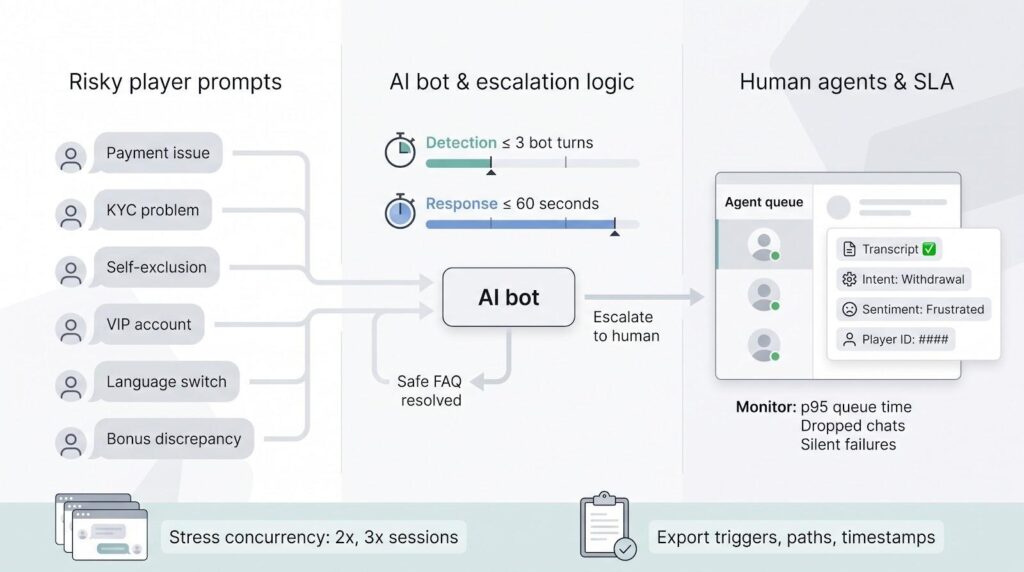
1. Use 10 tension prompts
- “I want to speak to a human.”
- Repeat the same low-confidence question twice.
- “Where is my €4,000 withdrawal?”
- “My KYC failed, why?”
- “Explain this wagering requirement again.”
- Switch languages halfway through.
- “I need to self-exclude.”
- “Remove my deposit limit.”
- “My VIP account is locked.”
- Ping the bot when no agent is online.
2. Measure two timers
- Detection: time from the first risky message to bot-triggered escalation.
- Response: time from escalation to human greeting.
Target: no more than three bot turns and no more than 60 seconds during staffed hours; flag anything slower.
3. Inspect the agent view
Confirm the console shows the full transcript, intent tag, sentiment, player ID, account status and escalation reason. If agents must re-ask basics, the handoff failed.
4. Stress concurrency
Double and then triple live sessions. Watch p95 queue time, dropped chats and silent failures. Verify the SLA covers peak traffic and that outages fall back to tickets or messaging automatically.
5. Log and repeat
Export a report with trigger, path and timestamps. Hand it to compliance before launch, and rerun the drill after every major update or model change. Turning a promise into a metric is the only way to keep regulators and players happy.
Pricing and total cost: read the fine print, not the homepage
1. Map every fee bucket
| Cost bucket | Typical metric | Gotcha questions |
| Human seats | $/agent/month | Are part-time users billed as full seats? |
| AI usage | $/resolution or $/session | Does a bot greeting + handoff count as a paid outcome (yes in Intercom, session-only in Freshchat)? |
| Voice & messaging | cents/min or $/SMS | Are inbound and outbound rates different? |
| Privacy / security | $/add-on | Zendesk Advanced Data Privacy, Salesforce Shield, etc. |
| Overages | percent of list or tier jump | What happens at World Cup-level volume? |
2. Hunt for line items
- Comm100: Core chat $39/agent, but the full AI Suite is quote-only.
- Zendesk: AI resolutions, workforce management, QA and privacy sold à la carte.
- Salesforce: Add Shield encryption, Flex Credits and Success Plans, each on its own SKU.
3. Model peaks and cap risk
World Cup finals or Super Bowl Sunday can double AI calls and human chats. Get a volume-tiered quote and an auto-cap that pauses AI once it hits a spend ceiling. Otherwise, your CFO may be stunned by the invoice.
4. Build a simple TCO worksheet
Annual TCO = (Seat cost × agents) + (AI fee × monthly volume × 12) + voice/SMS + privacy add-ons + implementation
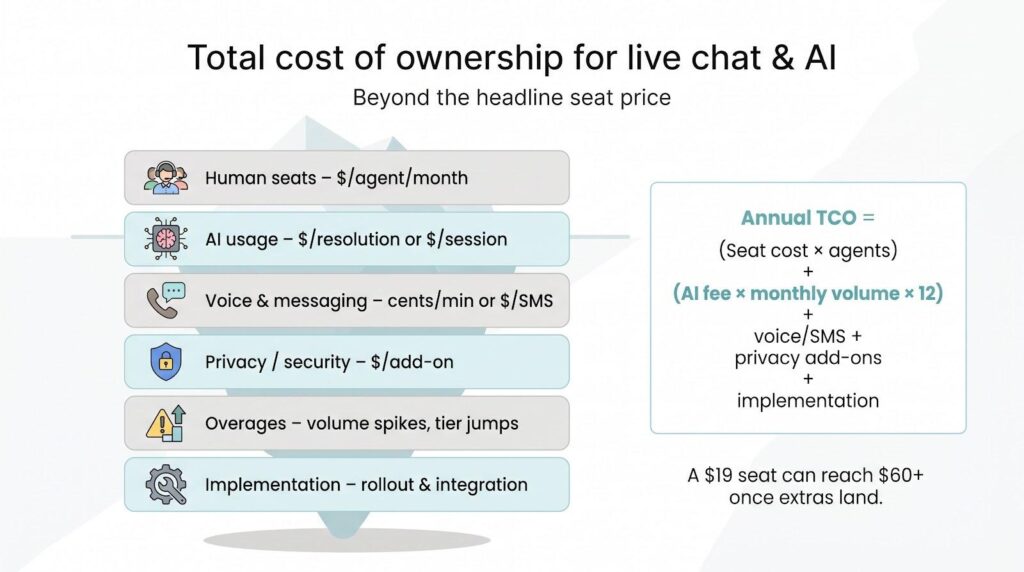
Plug real traffic numbers into that formula before you fall in love with the demo.
Compliance checklist for your RFP
Regulators ignore slide-deck promises; they audit logs, retention rules and data flows. Build those same checkpoints into your RFP.
1. Certifications
- Which product and hosting region hold SOC 2 Type II, ISO 27001, PCI-DSS?
- Does the certificate cover the AI module or only a legacy feature?
2. Data handling
- Card-number masking in chat?
- Transcript retention configurable by brand and jurisdiction?
- Full export for regulators without exposing VIP balances to front-line agents?
3. AI governance
- Is customer data used to train shared or third-party models?
- List every sub-processor that sees chat content.
- Can generative AI be disabled for RG queues but stay on for password resets?
4. Resilience
- If the AI provider fails at 10 p.m. on a Saturday, what is the automatic fallback: ticket, email or silence?
- SLA: maximum outage minutes per month and penalty credits?
The future of iGaming player support
- AI copilots, not replacements. Bots will draft answers, surface account history and flag sentiment so agents start each chat in context, cutting average handle time without losing the audit trail.
- Mandatory transparency. Since 2 August 2026, Article 50 of the EU AI Act requires chatbots to tell users they are AI. Similar bills are in committee in the U.K. and several U.S. states; white-label avatars that pretend to be human are running out of runway.
- From language counts to legal accuracy. Operators will test whether a Spanish bot distinguishes between límite de depósito and límite de pérdidas, not just whether it can say “hola.” Expect certification or third-party audits of multilingual intent libraries.
- Chat and voice converge. “Click-to-call” buttons will start an encrypted voice session inside the same transcript, keeping every word in one compliance record and eliminating channel-hop context loss.
- Proactive safety nets. AI will analyse play patterns in real time and, with a human on standby, reach out before a complaint or self-exclusion request arrives. Support shifts from cost center to risk-mitigation layer, something boards and regulators alike will track.
Securiti’s guide to the EU AI Act transparency code of practice
In short, tomorrow’s winning platform will be the one that makes humans faster, keeps logs intact and treats transparency as a feature, not a checkbox.
Frequently asked questions
Below are answers to some of the most common questions operators ask about live-chat software in iGaming.
What’s the “best” live-chat platform for iGaming?
It depends on your non-negotiable need. Looking for on-premises hosting and AI grounded in your own content? Choose Comm100. Want named casino case studies and a vast marketplace? Zendesk fits. Prefer outcome-based AI pricing at startup speed? Intercom works well. List your must-haves, then run the handoff stress test on two or three finalists.
Can a chatbot provide true 24-hour casino support?
Yes, for first response. Bots can greet players and solve common password or bonus questions at 3 a.m., but KYC failures, large withdrawals or self-exclusion cues still need a human. Your escalation trigger should fire within no more than three bot turns and no more than 60 seconds during staffed hours.
When should the bot hand the chat to a human?
Immediately after any human request, repeated low-confidence answer, payment dispute, VIP flag or responsible-gambling keyword. Top platforms let you script these triggers and log each event for audit.
Does live-chat software fix KYC and AML pain?
It streamlines them, collecting documents, checking verification status and opening cases, but it doesn’t replace regulated identity checks or human approval.
Is live-chat software automatically PCI-DSS compliant?
Not by default. Many tools offer card-masking and encrypted transport, but the certificate scope may cover only the vendor’s data centers. Always verify and run tokenised test payments.
How much will it cost in total?
Combine seat licences, AI usage (per outcome or session), privacy add-ons, voice/SMS minutes, surge overages and implementation. A $19 seat can reach $60 or more once extras land, so demand an itemised, volume-tiered quote.
How do we test multilingual quality?
Use real player prompts with betting slang, switch languages mid-chat and include a responsible-gambling request. Have native speakers grade accuracy, tone and legal phrasing; language count alone is meaningless.
Does the EU AI Act apply to casino chatbots?
Yes. Since 2 August 2026, Article 50 requires every interactive AI in the EU to tell users it is an AI. Build those disclosures into your widget copy and agent greetings from day one.
Conclusion
The convergence of airtight compliance, rapid escalation and transparent pricing will separate winners from also-rans in iGaming customer support. Evaluate each platform’s certifications, handoff speed and total cost of ownership, then stress-test the shortlist under peak traffic before signing. The solution that protects players, satisfies regulators and keeps costs predictable is the one to deploy.