

We usually write about ultraviolet light as something to defend your skin against. Inside the eye, the same wavelengths have been put to work. Sunlight flashing off the Peace River blurs a putt, a café menu shimmers into halos, and the cause is a cataract, the slow clouding of the lens you were born with. Surgery removes that lens and replaces it with an implant, and a standard implant fixes your prescription the moment it goes in. The Light Adjustable Lens does not. Its material stays photoreactive, so after the eye heals, targeted UV light can change its power while it sits in place. That chemistry is worth understanding before you choose it.
Who Leads Each Stage of Care
An ophthalmologist (M.D.) removes the cataract and places the new lens. An optometrist (O.D.) measures vision, writes prescriptions, and tracks healing.
At Snead Eye Group, board-certified surgeon Dr. Brad Snead performs every cataract operation, while a dedicated optometry team captures the postoperative data that guides each Light Adjustable Lens adjustment. Confirm which provider you will see at every visit so expectations stay clear from day one.
How Travel and Follow-Up Fit Into the Decision
Snead Eye Group’s closest surgery centers are about 28 miles (45 km) south in Fort Myers and roughly 35 to 40 miles to Cape Coral. In normal traffic, the drive on I-75 takes 45 to 55 minutes. Surgery, adjustments, and lock-in all occur at these locations, so expect several round trips while your pupils are dilated.
Before you book, confirm which office handles each step: consultation, surgery, postoperative measurements, adjustments, and final lock-ins. A clear schedule now keeps the focus on your vision, not the odometer. Compare drive times, parking and accessibility for each office at www.sneadeye.com.
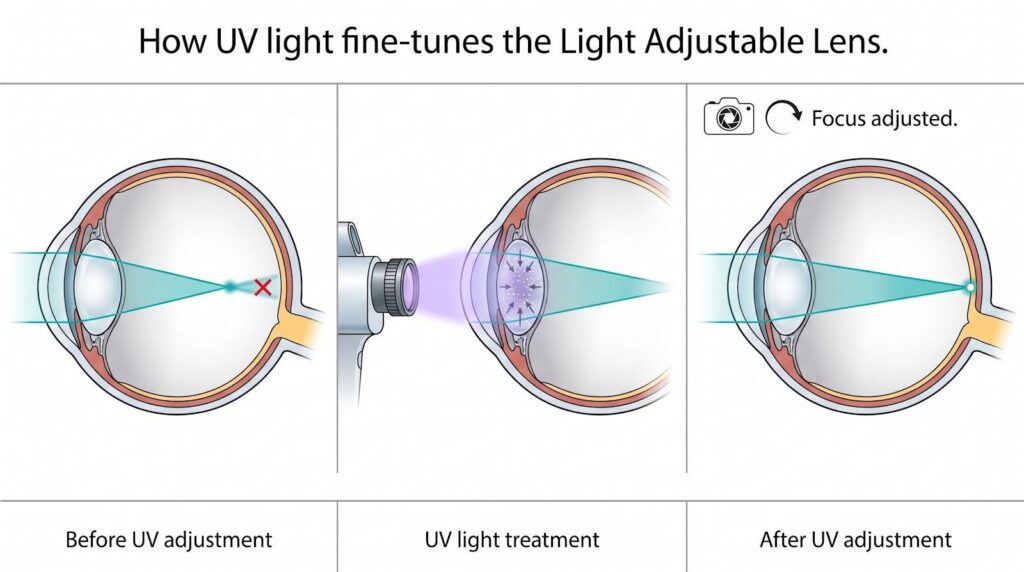
Light Adjustable Lens being fine-tuned with targeted UV light.
Eye imaging and biometry before lens replacement surgery.
Why Measurement Quality Matters
A Light Adjustable Lens can only be tuned to data you trust. That calls for high-resolution scans of the cornea, lens capsule, and retina, plus repeatable refraction on a stable tear film.
Snead Eye Group uses a USD 1 million multimodal system (optical biometry and OCT) that captures micron-level detail in milliseconds. Technology produces value only when paired with conversation: the team explains every reading, asks how you use vision each day, and notes clues such as dusk glare or couch-tablet distance.
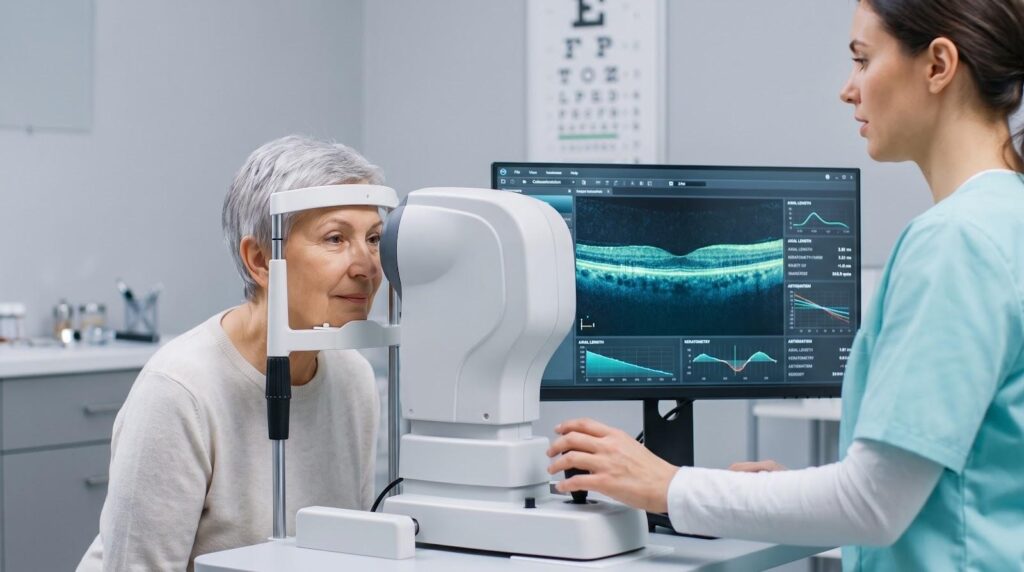
When data and dialogue align, the lens acts like a custom instrument rather than a generic upgrade.
How Cataracts and Replacement Lenses Change Focus
What a Cataract Does to Everyday Vision
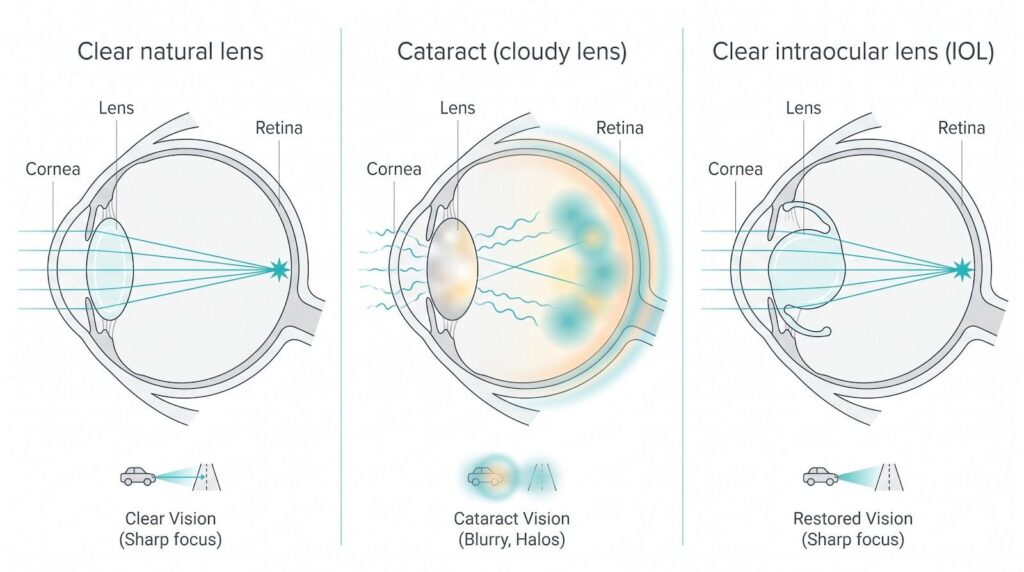
According to the National Eye Institute, by age 80 more than half of Americans either have a cataract or have had cataract surgery. When the clear lens turns opaque, colors fade, print looks foggy, and headlights burst into halos. The scene itself stays sharp, yet light no longer reaches the retina cleanly.
Standard and Premium IOLs in Plain Language
- Standard monofocal IOL: fixed at one distance, like a single-focus camera.
- Toric IOL: built-in cylinder power that neutralizes corneal astigmatism.
- Multifocal or extended-depth IOL: concentric rings or stretched optics that cover near through far, with more halo risk for some users.
- Light Adjustable Lens (LAL): starts as a high-quality monofocal, then lets you fine-tune its power with office-based UV light after healing.
The “best” choice depends on eye health, driving and reading priorities, tolerance for glare, and willingness to attend extra visits.
What Makes the Light Adjustable Lens Different
A Prescription That Is Not Final on Surgery Day
A Light Adjustable Lens (LAL) is a photosensitive silicone IOL that can be fine-tuned after cataract surgery. Standard implants lock your prescription in the operating room. With an LAL, the surgeon places the lens, lets the eye heal, then measures how you really see: driving at noon, reading at dusk, scrolling in bed. Those real-world numbers guide the next step instead of relying only on pre-op predictions.
How Targeted UV Light Changes Lens Power
During an office visit, a gentle ultraviolet beam from the Light Delivery Device (LDD) treats a selected zone. Exposed molecules polymerize, unexposed ones migrate, and the lens curvature shifts by fractions of a diopter, similar to turning a camera’s focus ring. Each session lasts a few minutes; most patients need one to three adjustments to reach their goal, with vision checked between visits (per current RxSight patient material).
What Lock-in Means
When your vision feels right, two final UV “lock-in” treatments polymerize the remaining molecules and freeze the lens shape. After lock-in, the LAL behaves like any other IOL, stable and inert, though future age-related changes in the eye can still alter vision. The tweak window closes for good, turning a flexible lens into a permanent custom fit.
Who May Be a Good Candidate
Vision Goals and Eye Histories That May Favor Adjustability
A Light Adjustable Lens candidate is an adult with a cataract and at least 0.75 diopter of corneal astigmatism whose macula is healthy enough for crisp optics. If you want sharp distance for the Peace River bridge yet hope to read a café menu without readers (or to test mini-monovision before deciding), postoperative adjustability delivers that freedom.
Eyes that have undergone LASIK or PRK often benefit, because measurements taken after healing can correct the unpredictability those surgeries introduce.
Reasons the Light Adjustable Lens May Not Fit
Success depends on one to three adjustment visits plus two lock-ins over roughly four to six weeks. Skipping an appointment or the required UV-blocking glasses can let the lens drift. You may be guided toward another IOL if you:
- cannot commit to every visit,
- struggle to wear the glasses during waking hours,
- take medications that increase UV sensitivity or threaten the retina,
- have active inflammation, severe dry eye, herpes scars, poor dilation, or macular disease (current FDA exclusion).
Step One: Cataract Removal and IOL Placement
Surgery takes about 10 to 15 minutes. After numbing drops and a light sedative, Dr. Snead removes the cloudy lens through a ≤3 mm micro-incision. The Light Adjustable Lens folds into the capsule, unfolds, and centers itself. A clear shield goes on, you rest briefly, then ride home with a driver and a bag of drops. Vision is hazy that day, but discomfort is usually mild, and most people resume normal tasks within 24 hours.
Step Two: Healing Before the First Adjustment
The Light Adjustable Lens cannot be tuned until the eye is quiet. Most patients need about three weeks (17 to 21 days per current RxSight guidance) for swelling to ease and refraction to steady. Vision sharpens gradually; mild blur or dryness is normal.
Use your drops, wear sunglasses, and avoid judging each morning’s clarity. The surgeon watches for stability, not speed. You’ll return for pressure checks and refractions. Only when the cornea, capsule, and tear film stop shifting do we schedule the first UV session. Treating any lingering dry eye or inflammation first keeps the adjustment target from moving.
Step Three: Testing Vision in Daily Life
Ditch the shield, step into sunlight, and put the new lens through real-world tests. Drive at dusk to judge headlights, read a paperback at arm’s length, tap your phone in dim AC light, then watch TV across the room. Note what feels crisp and what doesn’t; those daily-life observations, paired with eye-chart numbers, guide the first fine-tune session.
Step Four: Fine-Tuning with One to Three Adjustments
During each office visit, your pupil is dilated and you sit under the Light Delivery Device. A controlled UV beam treats the lens for about 30 seconds to 2½ minutes while you fixate on a target. Most patients need one to three adjustments, typically spaced three to five days apart, to land on their ideal prescription. Every round uses fresh measurements plus the everyday feedback you bring back from the road, the book, or the back nine.
Step Five: Completing the Lock-in Treatments
When your everyday vision feels right, two final UV sessions “lock in” the prescription by polymerizing all remaining light-reactive molecules. Each treatment lasts roughly 30 seconds to 2½ minutes and feels like the earlier adjustments, but its job is to make the lens power permanent.
Keep the RxSight UV-blocking glasses on for 24 hours after the second lock-in. Then the glasses can retire to a drawer, the lens is no longer adjustable, and your cataract journey shifts from active project to daily life.
Why UV-Protective Glasses Matter in Southwest Florida
How to Manage Outdoor Life and Everyday Tasks
Port Charlotte life is sunny (pickleball at Gilchrist Park, boating on Peace River, errands under a cloudless sky), so keep the glasses on. Use tinted lenses for midday glare, clear lenses indoors, and clip-on readers for tiny print. Stash a spare pair in the car and another by the porch door to stay protected through the four- to five-week adjustment phase without missing a beat.
What Results Are Realistic
What Recent Evidence Shows
A recent FDA post-approval study found that 93.1 percent of LAL eyes landed within 0.50 diopter of the intended prescription, and 92.5 percent hit the same level of astigmatism control six months after surgery (n = 332 eyes). By comparison, only about 76 percent of eyes with standard toric lenses reached that cylinder accuracy in similar studies. In plain language, most LAL patients saw the focus they planned, with fewer “surprise” glasses prescriptions.
Recovery, Side Effects, and Risks to Discuss
What Patients Commonly Notice During Healing
In the first few days vision can feel like looking through a freshly washed window that still carries a faint fog. It often sharpens, blurs slightly, then clears again as swelling and surface dryness settle. You may notice halos at night, mild scratchiness, or extra-vivid colors for a day or two after each UV session. Lubricating and anti-inflammatory drops calm these changes. Most irritation is minor and fades within a week; subtle focus shifts may continue until the final lock-in.
Potential Risks of Surgery and UV Treatment
Modern cataract surgery reports a serious-complication rate below 0.5 percent in large U.S. studies, yet no procedure is risk-free. Possible issues include infection, swelling, retinal detachment, or a pressure spike. The Light Adjustable Lens adds precision demands: centered UV beams, completion of both lock-ins, and constant UV-glasses use. Skipping steps can let the lens drift, tint vision, or, very rarely, reactivate ocular herpes.
The FDA post-approval study met every safety benchmark, and complications were uncommon, yet safety is a team effort. Report sudden pain, flashes, or a dark curtain right away and keep every follow-up so small problems stay small.
What the Quoted Price Leaves Out
Covered Cataract Care Versus the Premium Upgrade
Medicare Part B typically pays 80 percent of the approved amount for standard cataract surgery and a monofocal IOL after you meet the deductible. Surgeon, facility, and anesthesia fees sit inside that umbrella. Everything unique to the Light Adjustable Lens (premium lens fee, extra imaging, each UV adjustment and lock-in, and the RxSight UV-protective glasses) remains a patient-paid upgrade. Check your baseline benefits first by skimming Medicare’s cataract coverage page.
Questions to Ask About an Itemized Quote
- Does the fee include pre-op scans, all adjustments and both lock-ins, UV eyewear, and routine follow-ups for the first year?
- Are surgeon, facility, and anesthesia charges bundled or separate?
- Will dry-eye treatment or additional refractions add cost?
- Is a second eye discounted or quoted separately?
Get the answers in writing and file the sheet with your insurance papers to prevent “but we assumed” surprises.
Frequently Asked Questions
Is the Light Adjustable Lens a multifocal lens?
No. The Light Adjustable Lens (LAL) is a single-focus, or monofocal, implant that can be customized after surgery. UV light shifts that single focus point to distance, near, or a blended compromise. Multifocal and extended-depth lenses split light into multiple zones at once, which is why some users notice halos or reduced contrast.
How many light treatments are usually needed?
Most patients need one to three adjustment sessions, each lasting about 30 seconds to 2½ minutes, followed by two lock-ins. The exact count depends on how fast the eye stabilizes and how close the first tweak lands to your target.
How long must I wear the UV-protective glasses?
Expect four to five weeks of daytime use, ending 24 hours after the second lock-in. Your surgeon will confirm when you can retire the glasses.
Can the lens be adjusted again years later?
No. Lock-in consumes the remaining light-reactive material and makes the power permanent. Future prescription changes would require glasses, corneal laser, or another surgical option.
Will I still need reading glasses?
Possibly. Locking in sharp distance for both eyes may still leave tiny print challenging. Some people choose mini-monovision, tuning one eye a notch toward near, to reduce dependence on readers.
Does Medicare cover the Light Adjustable Lens upgrade?
Medicare Part B generally covers 80 percent of standard cataract surgery costs after the deductible, but the LAL upgrade (lens fee, imaging, adjustments, lock-ins, and UV eyewear) is patient-paid. Check the Medicare cataract page and request a written estimate to see what your plan and any supplemental policy will cover.
Can I choose the Light Adjustable Lens after LASIK?
Yes. Previous LASIK, PRK, or RK does not disqualify you. Postoperative adjustability can offset the calculation uncertainties that come with a reshaped cornea, provided the cornea and retina are healthy and you can follow every post-op rule.
Conclusion
The Light Adjustable Lens moves the final decision about your vision out of the operating room and into the weeks that follow it. That flexibility comes with obligations: UV-protective glasses worn every day until lock-in, several visits for testing and adjustment, and a patient-paid upgrade on top of the part of cataract surgery that insurance covers. For readers in Port Charlotte it also means planning the drive south to the Fort Myers or Cape Coral office for each of those visits. If your eyes are healthy, your visual goals are specific and you can keep every follow-up appointment, adjustability is worth discussing. No single lens works for everyone. Balance follow-up commitment, potential side effects, and your day-to-day visual goals with your surgeon before deciding.