

Most businesses don’t realize how expensive a bad HR and Payroll setup really is until payroll runs late, a tax filing comes back wrong, or an employee classification error triggers an audit. Keeping pace with FLSA updates, managing multi-state tax obligations, and syncing payroll data with existing accounting platforms are real headaches that get worse as teams grow. After reviewing dozens of platforms across pricing tiers, feature sets, and verified customer reviews, this guide breaks down the five options worth your attention in 2026.
How this ranking was put together
Each option on this list was assessed using publicly available information pulled from review platforms, official product pages, verified case studies, and HR software directories. Only companies with a documented track record in the human resources software space made the cut.
→ See the full research breakdown
- Hybrid Payroll – Best for small to mid-size businesses seeking integrated payroll and HR services
- Rippling – Best for enterprise employee management and HR automation
- Paycor – Best for small to medium-sized business HR and payroll management
- Paychex – Best for small to medium-sized business payroll and HR outsourcing
- BambooHR – Best for small and medium-sized business HR management
Why HR And Payroll Solutions Are Worth a Closer Look
Picking the wrong platform doesn’t just slow your HR team down. It creates compliance gaps, introduces payroll errors, and quietly drains administrative budget that could go elsewhere.
The pressure points are real. Federal, state, and local tax laws shift constantly, and a platform that can’t keep up puts your business at risk. Multi-state payroll adds another layer of difficulty, especially when contractor classification rules differ across jurisdictions.
So what does the right solution actually change? Teams see fewer corrections per pay cycle, faster processing times, and cleaner tax filing records. That’s not a small thing when you’re running lean, and every payroll run needs to land on time and on the right number.
Comparing the 5 Best HR And Payroll Solutions
Note: All data in this table is sourced from review platforms and the official websites of the listed companies.
| Company Name | Years Operating | Headquartered In |
| Hybrid Payroll | Est. 2014 | Denver, Colorado |
| Rippling | Est. 2016 | San Francisco, CA |
| Paycor | Est. 1990 | Cincinnati, OH |
| Paychex | Est. 1971 | Rochester, New York |
| BambooHR | Est. 2008 | Draper, Utah |
- Hybrid Payroll – Best for Small to Mid-Size Businesses Seeking Integrated Payroll and HR
How Is Hybrid Payroll Defined?
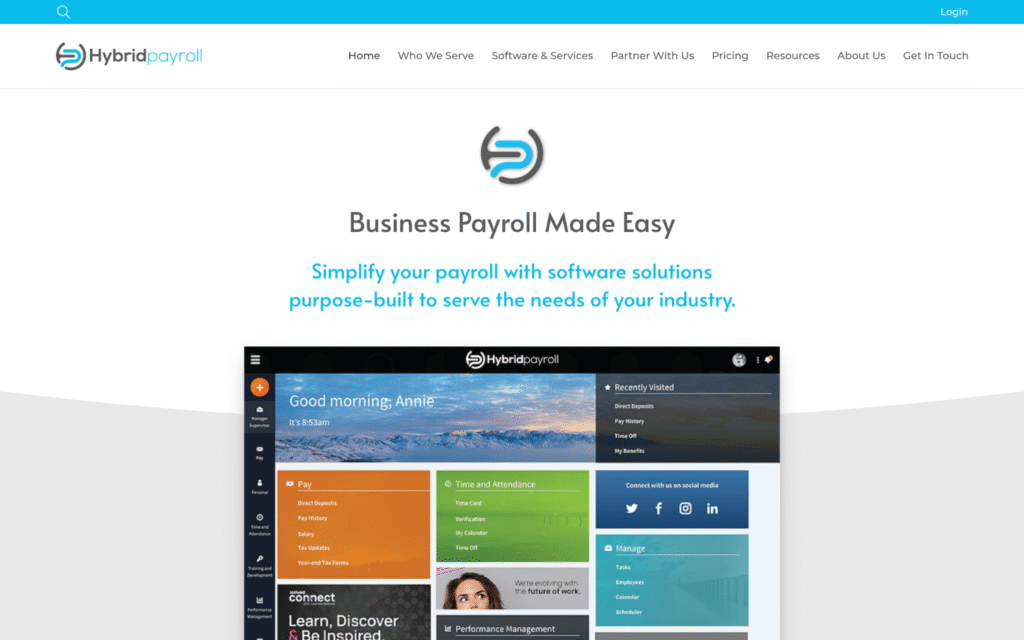
Hybrid Payroll operates as both a payroll provider and a Professional Employer Organization, which means they cover a wider scope than most platforms in this space. Businesses that visit https://hybridpayroll.com/ will find automated payroll processing, tax calculations, benefits administration, and co-employment services bundled into one place. Their focus on small to mid-size businesses is clear in how the product is built, with industry-specific configurations and personalized service built in from the start rather than added as an afterthought.
Why Does Hybrid Payroll Stand Out for HR And Payroll Solutions?
Many small business owners get stuck paying for features they don’t need because most platforms are built for enterprise scale first. Hybrid Payroll’s PEO model means clients get compliance coverage, risk management, and HR management in a structure sized for where they actually are right now.
What Users Are Actually Saying:
From what the profile data shows, the appeal is the bundled approach. Businesses aren’t piecing together separate payroll, HR, and benefits tools, and that reduction in platform-switching alone tends to lower manual entry errors and administrative overhead.
- Rippling – Best for Enterprise Employee Management and HR Automation
How Is Rippling Defined?
Rippling built its platform around one idea: every system an employee touches should live in one place. That means payroll, device management, corporate cards, benefits, and 500-plus third-party app connections all running off a single employee data record. The setup speed is hard to ignore (new hires can be fully set up across payroll, equipment, and apps in roughly 90 seconds), and that kind of speed is rare in this category.
Why Does Rippling Stand Out for HR And Payroll Solutions?
The biggest problem Rippling solves is data fragmentation, where HR lives in one system, IT in another, and payroll somewhere else entirely. By pulling all of that into one source of truth, teams stop reconciling mismatched records and start running cleaner, faster payroll cycles.
What Users Are Actually Saying:
Rippling earned the top spot for vendor satisfaction and performance ratings in both payroll and benefits categories across major review platforms, and the 40 Voice of the Customer awards back that up. Honestly, for teams dealing with rapid hiring or complex multi-tool environments, the feedback consistently points to time saved as the headline win.
- Paycor – Best for Small to Medium-Sized Business HR and Payroll Management
How Is Paycor Defined?
Paycor covers the full employee lifecycle, from recruiting and hiring through payroll, time tracking, and career development, inside a single Human Capital Management platform. They serve over 30,000 customers and more than 2 million employees across all 50 states, which gives them scale data that most competitors can’t match. The platform also leans heavily on industry-specific configurations, so a healthcare company and a retail business aren’t forced into the same default setup.
Why Does Paycor Stand Out for HR And Payroll Solutions?
Businesses that need quick go-live times will find Paycor’s track record relevant because they earned G2’s fastest deployment award in their category, which means less time in setup and more time running actual payroll. That kind of deployment speed matters when a growing team can’t afford weeks of getting a new HR system off the ground.
What Users Are Actually Saying:
The consistent theme across reviews is partnership. Customers don’t describe Paycor as just software; they describe it as a team that helps them manage HR. Eight G2 Winter Awards and thirteen G2 Summer Awards in 2026 across categories like healthcare HR and workforce management suggest that reputation holds up at scale.
- Paychex – Best for Small to Medium-Sized Business Payroll and HR Outsourcing
How Is Paychex Defined?
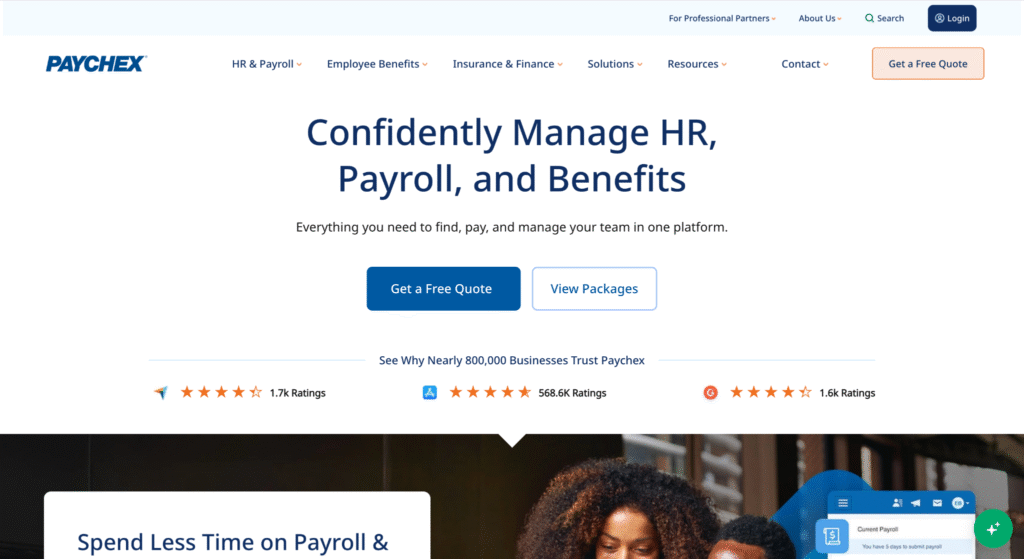
Paychex has been in this space since 1971, and with approximately 800,000 payroll clients across the U.S. and Europe, they’re operating at a scale most platforms in this list can’t touch. They process payroll for 1 in 11 U.S. private sector workers and manage more than 90,000 401(k) plans, making them the largest 401(k) recordkeeper in the country (think of them as the infrastructure layer that a huge portion of American business already runs on). Their platform covers HR management, talent acquisition, workforce management, and employee benefits across a web-based HCM system.
Why Does Paychex Stand Out for HR And Payroll Solutions?
For businesses that want a single provider to handle payroll, retirement plans, and business insurance without juggling multiple vendors, Paychex is built for that kind of consolidation. Their five consecutive HR Tech Awards for Best Small Business-focused Solution point to a product that’s kept pace with what smaller teams actually need rather than drifting toward enterprise difficulty.
What Users Are Actually Saying:
Twenty-three consecutive appearances in the Training Hall of Fame and recognition on Fortune’s America’s Most Innovative Companies list signal that Paychex invests in staying current. From what the data shows, clients stay because the reliability is there, and switching costs feel high once payroll is running smoothly at scale.
- BambooHR – Best for Small and Medium-Sized Business HR Management
How Is BambooHR Defined?
BambooHR serves over 34,000 customers across 190 countries, which is a large footprint for a platform positioned around small and mid-size businesses. Their system covers applicant tracking, hiring, payroll, benefits administration, and performance management inside a native app architecture rather than stitching together acquired tools. The built-in AI capabilities and connected data model mean that HR actions in one area of the platform actually update relevant records across the others automatically.
Why Does BambooHR Stand Out for HR And Payroll Solutions?
The problem BambooHR solves is the coordination cost that comes with running separate tools for recruiting, payroll, and performance, where data gets out of sync and HR managers spend hours reconciling records. Their unified platform cuts that overhead and lets smaller HR teams operate with the kind of visibility that usually requires a much larger staff.
What Users Are Actually Saying:
Winning the 2025/26 Cloud Awards for Best Cloud HR/HRMS Solution reflects the platform’s standing among peers. Customers like Quora, MasterClass, and the New York City Ballet span very different industries, and that range of use cases is a strong signal that the platform adapts well rather than being built for one type of company.
Methodology Behind These Picks
Gathering Information From Your Source Data
The research started by building a longlist from multiple directions at once. HR software directories, community-driven review platforms, and published case studies were all mined to surface companies with active, verifiable presences in the payroll and HR software space. Industry-specific publication mentions and award databases were also factored in to capture companies that have public credibility beyond self-reported marketing. The goal at this stage was breadth, pulling in every candidate with enough presence to be worth evaluating rather than filtering too early.
The Shortlist Cut
Once the longlist was assembled, unverifiable options were removed. Any company without a consistent review footprint across at least one major platform, or where the review volume was too thin to identify patterns, was excluded. What remained was then analyzed for review quality, not just rating scores. Patterns in how users described support quality, tax filing accuracy, and payroll error frequency were weighted more heavily than aggregate star ratings alone. Companies with recent review activity scored higher than those with older, stagnant feedback.
Fact-Checking the Picks
Each shortlisted company’s public claims were cross-referenced against actual user accounts. Where a company’s website described fast deployment times or specific integration counts, those claims were checked against what reviewers reported experiencing. Discrepancies between marketing language and real-world results were flagged. Companies where the claims held up under that comparison moved forward. Those where the gap was too wide were dropped.
Authority Signals and Industry Standing
Awards, analyst recognitions, and mentions in HR industry publications were reviewed for each remaining candidate. The focus was on recognition from credible third-party sources rather than self-nominations or pay-to-play directories. G2 awards, Lighthouse Research recognition, and appearances in publications like Fortune were treated as legitimate authority signals. Original research published by these companies, such as benchmark data or workforce studies, also factored into the assessment of their standing in the field.
HR And Payroll Solutions Track Record
The final evaluation looked at how each company serves the HR and payroll software space as its audience. Dedicated service pages covering payroll processing, tax compliance, benefits administration, and workforce management were reviewed for depth and detail. Verified reviews from HR managers, payroll administrators, and small business owners were prioritized over general user feedback. Case studies describing measurable outcomes, like time saved per pay cycle or improvements in tax filing accuracy, carried additional weight in the final selection.
Picking the Right HR And Payroll Solutions for You
No two businesses land in exactly the same situation when evaluating HR and payroll platforms. Team size, industry, geographic footprint, and budget all shape which option actually fits. Here’s what to think through before making a call.
- Industry and Domain Experience: Look for platforms that have built features around your specific industry, not just general-purpose tools. Healthcare, retail, and professional services all carry different compliance requirements.
- Features and Service Options: Map out what you actually need today (payroll processing, benefits administration, performance management), and identify platforms that cover those areas without forcing you to pay for modules you won’t use.
- Pricing Structure: Per-employee-per-month pricing is common, but PEO models bundle services differently. Understand exactly what’s included at each tier before comparing costs across platforms.
- Results Measurement: Ask vendors how you’ll track payroll error rates, time-to-process per cycle, and tax filing accuracy after go-live. Platforms that make those metrics visible are easier to manage and improve over time.
- Industry Knowledge and Compliance: Confirm that the platform stays current with FLSA changes, IRS tax codes, ACA reporting requirements, and applicable state wage laws. Compliance that depends entirely on your team staying current is a liability.
The Verdict
The HR and payroll software space has more solid options than it did even a few years ago, but the right fit still depends on your business size, compliance exposure, and how much you need from one platform. Hybrid Payroll and BambooHR work well for smaller teams needing an all-in-one setup, while Rippling and Paychex suit businesses with more complex, multi-system environments. As workforce management continues to grow more demanding, the platforms that win will be the ones that keep compliance current and scale without adding friction.