
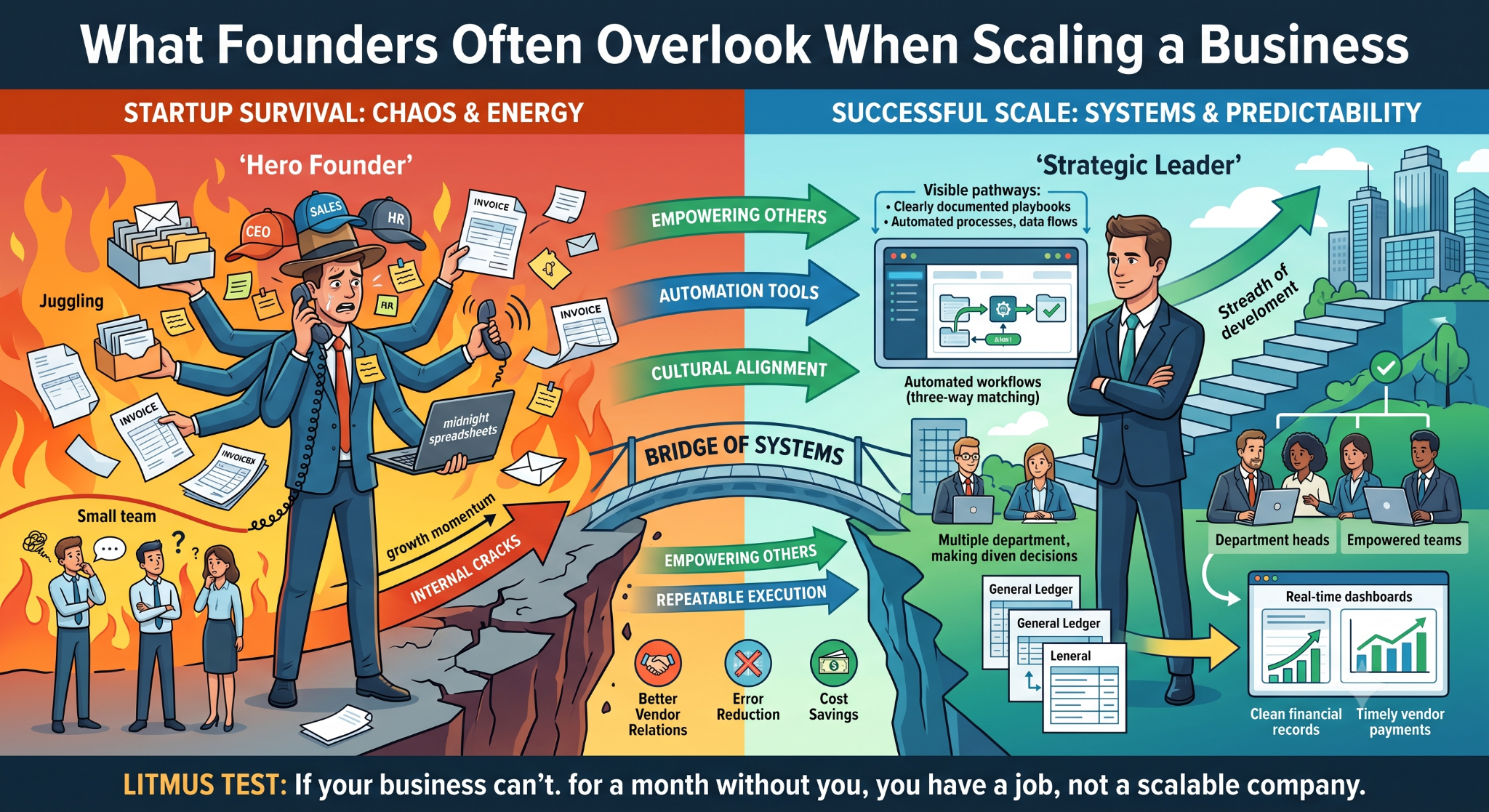
Building a business from scratch is an exhilarating act of pure will. In the early days, survival depends almost entirely on your personal energy. You wear every hat, answer every email, and celebrate every small victory. It’s a chaotic, thrilling phase where speed beats structure every single time. But a strange thing happens when that initial momentum turns into real growth. The very habits that kept your company alive in the beginning start to become the exact things holding it back.
Have you ever looked at your growing team and realized you don’t actually know what everyone is working on today? Honestly, it is a terrifying realization. You sit there under the hum of the laptop at midnight, looking at a spreadsheet, and it hitches in your chest. You realize you can’t carry it all anymore.
Scaling a business isn’t just about doing more of what you’ve always done. It requires a complete shift in how your organization functions.
Too often, founders focus entirely on outward metrics like customer acquisition, top-line revenue, and market expansion. While these numbers are incredibly exciting, they only tell half the story. The real challenges of scaling happen deep within the unglamorous underbelly of your operations. When a company grows quickly without upgrading its internal foundation, things begin to crack. And that’s the point where most of us start to panic.
The Trap of the Hero Founder
Perhaps the most difficult hurdle for any growing company is the founder’s own inability to let go. In the startup phase, you’re the ultimate bottleneck, but it works because the volume is low. You approve every piece of copy, join every sales call, and make every final decision. This hands-on approach creates a tight, unified vision. But it’s completely unsustainable at scale.
When you double or triple your team, you just can’t be in every room anymore. If every decision still has to pass through your desk, progress slows down to a crawl. Employees become hesitant to take initiative because they’re waiting for your green light.
And that is how growth stalls.
To scale successfully, a founder has to transition from a hands-on operator into a strategic leader. This means building systems that empower other people to make decisions without you. It requires clear documentation, well-defined guardrails, and a willingness to let your team make mistakes. I guess it comes down to trust, you know? If the business can’t run for a month without your direct involvement, you haven’t built a scalable company. You’ve simply built a very demanding job for yourself.
Financial Infrastructure Breaks Long Before Sales Do
When revenue is climbing, it’s easy to assume that everything is going perfectly. This financial optimism is incredibly dangerous. Fast growth requires huge amounts of cash. You have to hire people before they become productive, buy inventory before it sells, and expand your infrastructure before you see the returns. Without a rock-solid grasp on your numbers, a business can easily grow itself right into bankruptcy.
But how do you track the true cost of momentum when everything is moving so fast?
Many founders overlook their accounting systems until it’s far too late. They rely on basic cash flow tracking or look at their bank balance at the end of the week to guess how they’re doing.
As transactions multiply, that casual approach falls apart completely. You need to know your exact margins, your customer acquisition cost, and your lifetime value. More importantly, your backend systems must be able to categorize and track every single cent automatically. If you look at a standard example of a general ledger, you’ll realize how complex business transactions become when scaled. Every single credit and debit needs to map back to a clear financial narrative. Maybe it sounds incredibly dry, but if your bookkeeping is messy, you’ll end up making critical strategic decisions based on flawed, outdated information.
Losing the Cultural Glue
In the early days, culture happens completely by osmosis. You sit in the same small room with your first five employees. Everyone hears every conversation, understands the mission instinctively, and knows exactly what the company stands for. You don’t need a mission statement or a handbook because the culture is living and breathing right next to you.
But what happens when your team expands across multiple floors, cities, or time zones?
When you scale, that natural connection vanishes. Suddenly, you have employees who’ve only spoken to you a handful of times. You have departments that operate in complete silos.
So you have to become intentional. If you don’t design your culture, a vacuum forms, and it’ll quickly fill with confusion or politics. Founders often overlook the need to over-communicate their values as they grow. You know, you have to explicitly define how your company treats customers, how conflicts are resolved, and what success actually looks like. Without this cultural alignment, a larger team will pull the business in ten different directions at once, destroying the very magic that made your startup successful in the first place.
The Hidden Cost of Technical and Process Debt
When you’re small, you use whatever tools and processes are fast and cheap. You track projects on a basic spreadsheet. You use temporary workarounds to patch up software bugs. You store vital company knowledge entirely inside the heads of a few key team members. This is called operational debt, and it’s perfectly fine when you’re just trying to survive.
But just like financial debt, operational debt accumulates interest.
When you try to run a high-volume business on top of fragile, makeshift processes, everything becomes incredibly brittle. A spreadsheet that worked beautifully for ten clients becomes a total nightmare when you have a thousand. A lack of formal onboarding means new hires take months to become effective instead of weeks. Founders often delay investing in robust systems because they feel too busy or because the upfront cost seems high. But the reality is that clean, automated processes are the literal tracks that allow your growth engine to run without derailing.
Shifting Focus to Long-Term Predictability
Scaling successfully is ultimately an exercise in turning chaos into predictability. It’s about moving away from the dramatic, exhausting breakthroughs of the early days and moving toward steady, repeatable execution. This transition can feel incredibly boring to a natural entrepreneur who loves the thrill of the chase.
However, the companies that survive the jump from small startup to major market player are the ones that learn to value the invisible details. They protect their cash flow fiercely, empower their leadership teams completely, and build systems that can withstand the weight of their own ambition. Growth is a wonderful goal, but only if you build a foundation strong enough to support it.