

Finding safe, effective bioidentical hormone replacement therapy in Naples takes more than skimming a few ads. Pellets release hormones for months, and once they’re under your skin the dose can’t be dialed back—so a clinic’s dose-control plan matters more than décor.
In February 2026 the FDA relaxed boxed warnings on six factory-made menopausal drugs, yet that change never applied to the custom-compounded pellets many Naples offices implant.
This public-disclosure ranking scores 6 local providers on dose control, clinical credentials, pricing clarity, and follow-up support, helping you ask sharper questions before you book.
What “Dose Control” Really Means
Dose control isn’t a fancy calculator or an endless lab panel. It’s a six-point safety check:
- Risk screen. Did the clinician review your history and rule out cardiovascular, cancer, or clot red flags before prescribing?
- Dose logic. Can the prescriber explain, without jargon, why your very first pellet strength fits you?
- Reversibility. Were faster-adjusting routes such as patches, creams, or injections discussed before a months-long implant?
- Early review. Are symptoms and appropriate labs rechecked within around four to six weeks, when overshoots usually surface?
- Side-effect plan. Is there a written protocol for acne, hair changes, bleeding, or other signs of supra-physiologic levels?
- Lot traceability. Does your chart list the compounding pharmacy, exact milligrams, and lot number for every pellet?
This checklist mirrors the American College of Obstetricians and Gynecologists’ 2026 consensus to favor FDA-approved formulations, monitor thoughtfully, and tread carefully with compounded pellets. Clinics that tick every box score highest; blanks cost points.
Weighted Methodology
We ranked each clinic against five evidence-based criteria:
| Criterion | Weight | What we looked for |
| Dose control & safety | 40% | Candidate screening, starting-dose logic, early follow-up, side-effect plan, pharmacy/lot traceability |
| Clinical expertise | 25% | Board certification, years in practice, direct prescriber involvement |
| Patient outcomes | 15% | Independent, dose-specific reviews or published symptom-tracking data |
| Affordability | 10% | Transparent first-year cost, HSA/FSA, or financing options |
| Convenience | 10% | Telehealth, multiple routes, snowbird, or hurricane continuity |
Undisclosed items earned zero points (not to punish a clinic, but to remind readers that clear answers matter).
All scores reflect publicly available data collected September 1, 2026. Verify details before you book; prices and policies can change overnight.
Quick-Glance Comparison
Verify every figure before you book; clinics can revise prices or policies without notice.
| Rank | Lead clinician | Serves | Routes offered | First follow-up stated | Base price (insertion*) | Stand-out edge |
| 1 | Richard L. Bloy, MD, FACOG | Women and men | Pellets | Labs + visit at 4–6 weeks† | Women ≈ $425<br>Men ≈ $750 | Physician depth and posted pricing |
| 2 | Lisa Sikorski, APRN-BC | Women and men | Pellets, patches, creams, gels, injections | “Several-week” check | ND | Route flexibility and early adjustment plan |
| 3 | Tracye Zlobl, MD | Women only | Pellets + traditional Rx | Visit and labs stated; timing ND | ND | Menopause-centered gynecology |
| 4 | Chaturani Ranasinghe, MD | Women and men | Pellets, creams, injections, patches | ND | ND | Two physician-led locations |
| 5 | Robert Rubin, MD | Women and men | Personalized (verify pellets) | ND | ND | Internal/geriatric focus with lifestyle lens |
| 6 | Diane Brzezinski, DO, FACOI | Women and men | BioTE pellets | ND | ND | Long-standing internal-medicine practice |
*Insertion fee only; labs, medication, and follow-ups add cost.
†Per client briefing; confirm at booking.
ND = Not disclosed.
Contemporary Health Center – Rank 1
Why it leads the list: more than 40 years of OB-GYN experience plus publicly posted prices.
Dr. Richard L. Bloy performs the consult, insertion, and follow-up himself, and the clinic’s bioidentical hormone replacement therapy guide notes that each pellet releases hormone for roughly 3-4 months in women and 4-6 months in men after baseline labs establish the starting dose. That single-clinician chain of custody matters when a pellet’s dose cannot be tweaked once implanted. The Naples office lists insertion fees up front: about $425 for women and $750 for men (labs extra, September 1, 2026). HSA, FSA, CareCredit, and Cherry financing ease the self-pay hit.
Beyond hormones, the clinic offers weight programs, peptide therapy, IV nutrition, and aesthetics, so you can manage energy, metabolism, and skin in one visit. Internal surveys mention sharper focus and steadier mood, but these are anecdotal; ask for objective outcome data.
Request three items in writing:
- The dose-calculation formula.
- The four- to six-week follow-up schedule.
- The compounding pharmacy name and pellet lot-tracking procedure.
Locking those points down turns a transparent price into a truly accountable program.
Coastal Wellness of Naples – Rank 2
Coastal Wellness stands out for route flexibility. Nurse practitioner Lisa Sikorski lays out a clear workflow on the clinic site: comprehensive labs → individualized plan → pellet insertion → a check-in within several weeks to fine-tune dosing. Early review matters; a 2025 Cureus study found that testosterone or estradiol pellets can spike above physiologic ranges in the first month.

Coastal Wellness of Naples hormone therapy services website screenshot
Unlike pellet-only centers, Coastal Wellness also offers patches, gels, creams, and injections—essential escape hatches if a pellet dose proves too strong. The site mentions potential telehealth follow-ups, a bonus for snowbirds who split time between Naples and other states. Confirm that virtual visits cover Schedule III testosterone refills under Florida’s rules (in effect through December 31, 2026).
What’s still unclear?
- Cost. No public pricing or insurance details.
- Oversight. The NP’s collaborating physician and prescription sign-off process aren’t stated.
- Compounding pharmacy. The EvexiPEL supplier isn’t named.
Add those questions to your consult list and Coastal Wellness could edge to the top of your personal ranking, especially if you want the option to start with a reversible patch before committing to a months-long pellet.
Wellness for Women of Naples – Rank 3
Why it ranks: menopause-focused gynecology plus route flexibility.
Board-certified gynecologist Tracye Zlobl reviews symptoms, family history, physical findings, and targeted hormone labs before recommending therapy. Women value a setting where libido, bone density, and pelvic health share the same chart.
If a compounded pellet is not ideal, Dr. Zlobl can prescribe FDA-approved patches, rings, or oral options, echoing ACOG’s 2026 guidance to start with reversible routes when possible. That flexibility earns dose-control credit.
Ask before you book
- Cost: The site says Medicare, TRICARE, and CHAMPVA are not accepted, and self-pay pricing is not posted. Request a first-year cost worksheet.
- Follow-up cadence: Nail down when labs and symptom checks occur after insertion.
- Endometrial protection: Clarify how unexpected bleeding is managed if systemic estrogen is used.
- Telehealth: Confirm whether virtual visits cover prescription renewals for traveling patients.
Locking down those details turns a menopause-centered office into a whole-woman care hub, without surprise bills or unanswered safety questions.
Timeless – Rank 4
Why it ranks: every hormone visit is physician-led by Chaturani Ranasinghe, MD, and patients can choose among pellets, creams, injections, or patches, which matters when a dose needs mid-course adjustment.
The practice operates in two locations (Naples and Marco Island) and advertises extended appointment hours, helpful for shift workers and seasonal residents.
Transparency gaps
- Cost: No public pricing for insertion, labs, or follow-ups.
- Safety plan: Baseline panel, first follow-up date, and written side-effect protocol are not posted.
- Continuity: The site does not state who covers care during hurricanes or holiday closures.
Ask before you commit
- What labs are checked before and 4–6 weeks after insertion?
- Who manages urgent side effects if Dr. Ranasinghe is unavailable?
- What is the full first-year out-of-pocket cost, including labs and unplanned visits?
- Does the clinic offer telehealth for snowbirds once Schedule III tele-prescribing remains legal through December 31, 2026?
If those answers align with your budget and safety bar, Timeless delivers the reassurance of direct physician care without locking you into a single delivery route.
BodyLogicMD of Naples – Rank 5
Why it ranks: integrative, physician-run program that folds hormones into a broader healthy-aging plan.
Internist and geriatrician Robert Rubin combines hormone care with lifestyle coaching on sleep, nutrition, exercise, and stress. New patients complete a symptom and lifestyle review; laboratory results then guide an individualized plan. BodyLogicMD’s national network often offers pellets, but you will need to confirm Naples-stocked routes—the local page sometimes lags behind real-time inventory.
The corporate site advertises packages that start around $79 per month for perimenopause care, yet the Naples office lists no local insertion fee, lab schedule, or membership structure. Independent reviews website Birdeye lists 11 reviews, so ask:
- Which routes (pellet, patch, cream, injection) are available today in Naples?
- How soon are labs and symptoms rechecked—within the critical 4–6-week window?
- Does telehealth satisfy Florida’s Schedule III rules through December 31, 2026?
- What is the full first-year cost once supplements, labs, and follow-ups are in the cart?
Choose BodyLogicMD if you want hormone therapy wrapped inside a data-driven longevity plan—just pin down the practical numbers before you swipe a card.
Dr. Diane Brzezinski – Rank 6
Why she ranks: long-running internal-medicine practice plus BioTE pellet experience.
With more than 30 years in medicine, Diane Brzezinski, DO, offers BioTE-branded pellets for women and men. The BioTE calculator proposes an initial implant strength, but ask how Dr. Brzezinski adjusts that default when personal risk, prior response, or lab values call for caution.
Due-diligence checklist
- Follow-up cadence: When are labs and symptoms reviewed, ideally within 4–6 weeks?
- Adjustment triggers: What numbers or side effects lower the next dose?
- Route options: Are patches or injections available if a pellet overshoots?
- Cost clarity: Request an itemized quote for baseline labs, insertion, follow-up labs, and any corrective visit.
- Insurance: Confirm whether commercial plans reimburse labs even if pellets remain self-pay.
Testimonials on the public page mention better sleep and sharper focus, but they are not dose-specific research. Lock down the objective details above, and this long-established office can pair BioTE convenience with a physician who already knows the local medical landscape.
Start with the Patient, Not a Universal Target
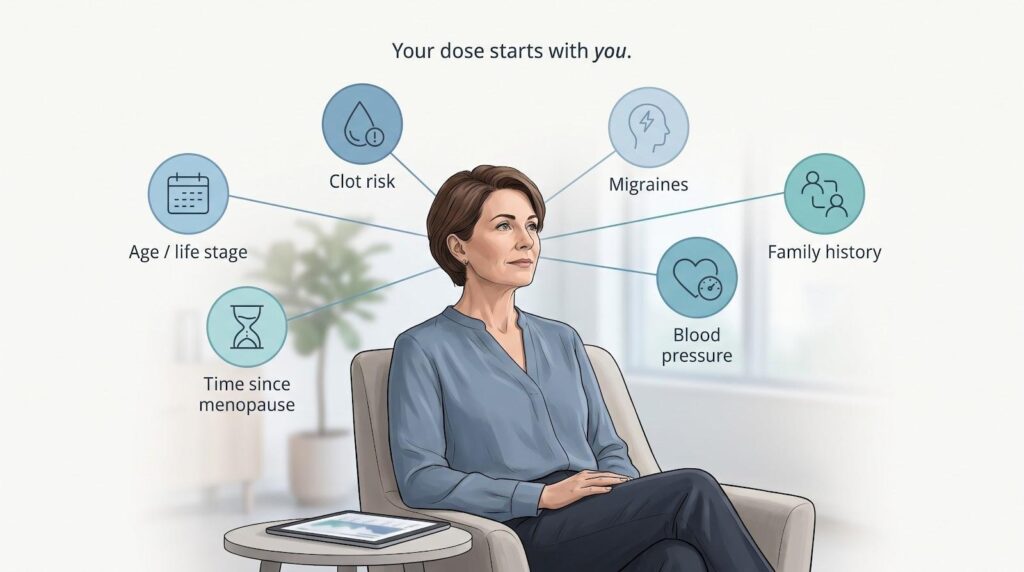
Effective dosing begins with you: medical history, symptoms, and goals. Age, time since menopause or hypogonadism, blood pressure, family history, migraines, and clot risk all tilt the risk–benefit balance before one tube of blood is drawn.
Pellets raise the stakes. A 2025 narrative review found that women’s testosterone levels often reached supraphysiologic early peaks (>100–250 ng/dL) during the first four weeks after insertion and varied widely even when milligram loads were identical. Starting conservatively and rechecking early—ideally at 4–6 weeks—helps prevent months of runaway levels.
Bottom line: choose a clinician who maps your symptoms, risks, and lifestyle before prescribing milligrams. Skip that step, and the rest of the dose-control chain wobbles from the start.
Why Pellets Require a Stricter Conversation
Patches, gels, or weekly injections can be paused within days. A pellet, however, keeps releasing hormone for about 12–13 weeks for women and up to 22 weeks for men, no matter how you feel. That permanence leaves almost no room for dosing error. The American College of Obstetricians and Gynecologists (ACOG) 2026 consensus classifies pellets as harder to adjust and recommends them only when patients understand the trade-off and have a plan for high levels.
Before anyone numbs your hip and reaches for a trocar, ask:
- Early-warning signs: Which symptoms or lab thresholds signal the dose is too high?
- Mid-course fixes: How will side effects be managed in month two if removal is not practical?
- Trial first: Could a patch or injection trial predict my response more safely?
You are not being difficult; you are safeguarding months of endocrine balance. A careful clinic will welcome the dialogue and walk you through every scenario.
Monitoring Should Change Decisions
Blood work matters only if it guides the next dose.
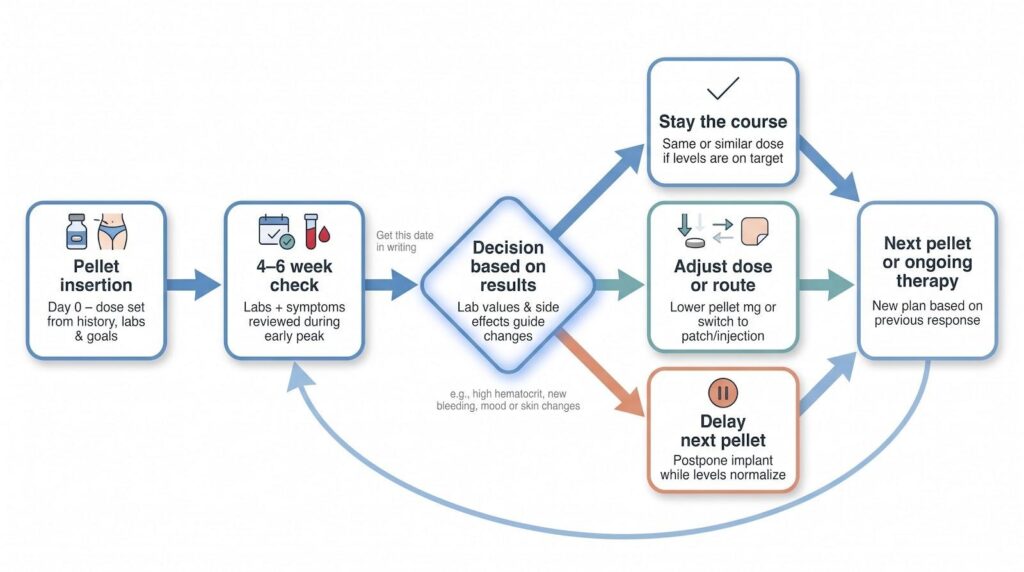
Ask your clinic two specifics: 1) the exact date, often 4–6 weeks after insertion, when labs and symptoms are rechecked, and 2) how those data change the next implant. For example, a hemoglobin or hematocrit above TRT guidelines (≥54%) can prompt a lower pellet strength or a switch to weekly injections. For women on systemic estrogen, new bleeding should trigger an ultrasound or the addition of a progestin for endometrial protection.
Symptoms tell the same story:
- Acne or scalp hair shedding
- Mood swings or irritability
- Breast tenderness or unexpected bleeding
A thoughtful provider logs these clues next to lab trends and may delay, lower, or skip the next implant instead of following a preset reinsertion schedule.
Monitoring is not busywork; it is the feedback loop that turns personalized from marketing copy into real-time course correction. If a clinic cannot walk you through that loop step by step, keep shopping.
Compounding Quality Is Part of Dose Control
Even the best dose plan fails if the pellet itself is sub-standard.
Custom pellets are not FDA-approved drugs; their safety depends on the outsourcing pharmacy’s sterility checks, potency assays, and lot tracking. In April 2025 the FDA issued a warning letter to Empower Pharma, and five months later a Form 483 to FarmaKeio Outsourcing for cleaning, labeling, and potency lapses. Quality can slip when no one is looking.
Protect yourself by asking:
- Which pharmacy makes the pellet?
- Certificates: Does each batch ship with sterility and potency reports?
- Lot tracking: Will the pharmacy name, strength, and lot number appear in your chart?
If the clinic cannot answer all three, consider that a red flag. Months of hormone release ride on one tiny cylinder, so complete paperwork equals peace of mind.
Seven Questions to Ask Before You Book
A two-minute Q & A now can spare months of dosing regret. Bring these questions to your consultation and wait for crisp, confident answers:

- Dose authority. Who calculates and signs off on my starting pellet dose, and what factors could lower it?
- Reversible options. If I start with a patch, cream, or injection, how quickly can you adjust the dose?
- Early check-in. What date, typically 4–6 weeks after insertion, will my first follow-up visit and labs occur, and what results would delay the next pellet?
- Side-effect plan. How will acne, hair shedding, mood changes, or bleeding be managed while the pellet is active?
- Pharmacy traceability. Which outsourcing pharmacy supplies the pellet, and will my chart list the strength and lot number?
- Total cost. What is the complete first-year price, including labs, office visits, medication, and any unplanned corrective care?
- Continuity of care. Do you offer telehealth (permitted for Schedule III prescriptions in Florida through December 31, 2026) or shared-care options if I travel or if a hurricane closes the office?
A clinic that answers all seven without pause is far more likely to deliver personalized, accountable care. If any reply feels vague, keep shopping until clarity is the norm.
FAQs
Are bioidentical hormone pellets FDA-approved?
No. The FDA approves factory-made estradiol, progesterone, and testosterone products, but custom-compounded pellets sit outside that system. The February 12, 2026 label update removed boxed warnings from six approved menopausal drugs; it did not grant blanket approval to compounded pellets.
How does a Naples clinic decide the “right” pellet dose?
A responsible prescriber merges symptoms, medical history, and targeted labs, then chooses the lowest practical strength. Age, time since menopause, blood pressure, breast density, and migraine history all influence that number.
How soon should labs be rechecked after insertion?
Dose-conscious clinics draw blood at 4–6 weeks, when early peaks can still be caught and corrected. Get that date in writing before the pellet goes in.
Can a hormone pellet be adjusted or removed if the dose is too high?
Removal is invasive and uncommon. Because a pellet cannot be dialed back like a patch, conservative starts and early monitoring are key. If levels soar, options include symptom management, aromatase or 5-alpha-reductase inhibitors, and delaying reinsertion.
What does BHRT cost in Naples, and does insurance help?
As of September 1, 2026, consult plus pellet insertion runs about $425–$750; baseline labs add $150–$350; follow-up labs can match that. Most commercial plans do not cover compounded pellets, but HSA/FSA funds, CareCredit, or Cherry financing often apply.
Can testosterone or estrogen be prescribed by telehealth in Florida?
Yes. Federal policy currently allows Schedule III–V prescribing via telehealth through December 31, 2026, provided the clinician meets Florida standards and checks the prescription drug-monitoring program. Confirm that your clinic offers virtual follow-ups before you rely on it.
Conclusion
Pellet therapy can simplify dosing schedules, but its long-acting nature raises the stakes for safety and follow-up. Use the rankings, ask the seven key questions, and insist on early monitoring to ensure your Naples BHRT plan stays both effective and reversible when needed.