

Most Amazon sellers don’t realize their fulfillment partner is costing them sales until a late shipment rate warning lands in Seller Central. Picking from the best Amazon fulfillment companies means balancing storage fees, FBA prep requirements, and Prime-level shipping speed, all at once. After reviewing dozens of 3PL providers against real performance data, the companies that consistently rise to the top share a few common traits. This guide breaks down five standout fulfillment options, what each one does well, and who they’re actually built for.
The shortlist methodology
Public information was gathered from user reviews, case studies, feature breakdowns, and official company websites. Review platforms and logistics directories shaped the initial pool. Only providers with a documented track record in ecommerce fulfillment made the final cut.
→ See the full research breakdown
- Rush Order – Best for ecommerce fulfillment and logistics scaling
- ShipMonk – Best for DTC and ecommerce order fulfillment
- Fidelitone – Best for enterprise ecommerce logistics and third-party fulfillment
- Speed Commerce – Best for e-commerce order fulfillment and logistics
- Fulfyld – Best for e-commerce fulfillment and third-party logistics
The Stakes Behind Choosing Amazon Fulfillment Companies
Picking the wrong fulfillment partner doesn’t just slow down shipping. It chips away at your Amazon seller ratings, drains margin through unnecessary storage fees, and puts you on the wrong side of constantly shifting FBA prep guidelines.
Amazon sellers face a narrow window where inventory levels, prep accuracy, and shipment timing all have to line up. Miss any one of them, and you’re looking at stockouts, suppressed listings, or long-term storage charges quietly eating into profit.
The providers that actually make a difference for Amazon sellers are the ones built around order accuracy and carrier compliance, not just warehouse square footage. When your fulfillment partner keeps your Order Defect Rate low and your on-time shipment rate high, the cost per fulfilled unit starts making sense. That’s the outcome worth choosing for.
5 Amazon Fulfillment Companies Compared
Note: All data in this table is sourced from review platforms and the official websites of the listed companies.
| Company Name | Years Operating | Team Size | Headquartered In |
| Rush Order | Est. 1989 | 201-500 employees | Gilroy, CA |
| ShipMonk | Est. 2014 | 2,000+ | Fort Lauderdale, FL |
| Fidelitone | Est. 1929 | 501-1,000 | Wauconda, IL |
| Speed Commerce | Est. 1983 | 1,609 | Las Vegas, NV |
| Fulfyld | Est. 2016 | N/A | Huntsville, AL |
- Rush Order – Best for Ecommerce Fulfillment and Logistics Scaling
Which Services Does Rush Order Provide?
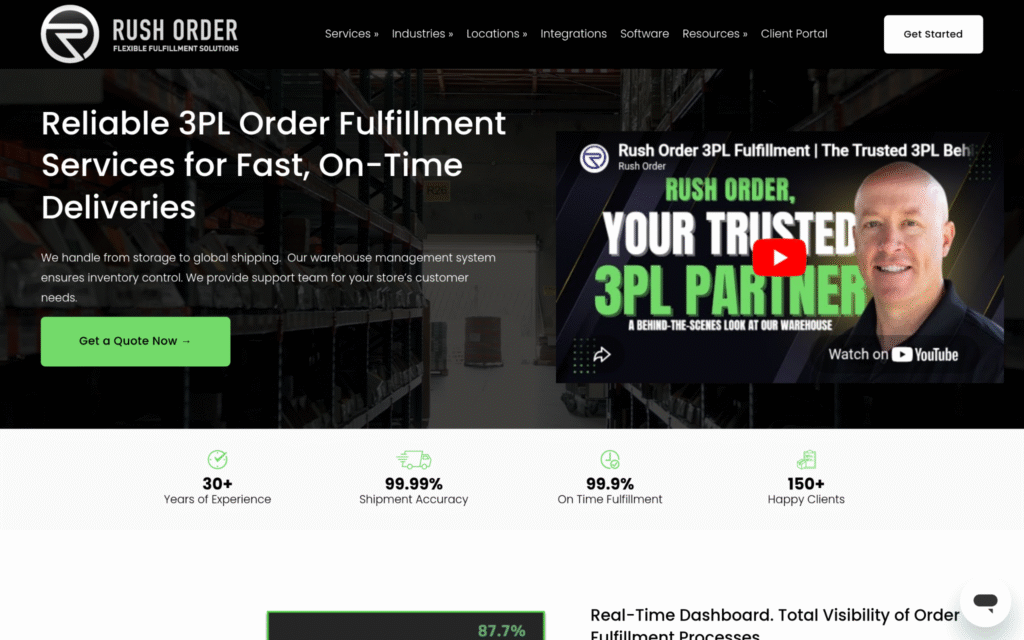
Rush Order has been running logistics operations since 1989, and that depth of experience shows in how they’ve built their current tech stack. Their Amazon order fulfillment services connect directly with Shopify, WooCommerce, NetSuite, and Amazon, giving sellers a single view across every sales channel. They cover B2C fulfillment, retailer EDI, customer support, and turnkey back-office work across 13 locations in North America, Europe, Asia, and Australia. The multi-checkpoint barcode verification system is what keeps order accuracy tight, and same-day shipping for orders placed before 2 pm is a real differentiator for time-sensitive merchants.
Where Does Rush Order Win for Amazon Fulfillment Companies?
Sellers who need to scale fast without rebuilding their internal ops from scratch tend to find the most value here. That combination of real-time dashboard visibility and multi-location coverage is hard to match at this experience level.
What the Reviews Show:
Client feedback points to a consistent theme: sellers can grow without adding internal headcount. The Vogmask case during the pandemic stands out, where the company handled a sudden demand surge without missing a beat. The reliability under pressure is what keeps clients around long-term, based on what the reviews show.
- ShipMonk – Best for DTC and Ecommerce Order Fulfillment
Which Services Does ShipMonk Provide?
ShipMonk runs 12 facilities across the US, Canada, Mexico, and Europe and serves roughly 1,000 customers with a reported 99.9% order accuracy rate. They cover order fulfillment, inventory management, shipping management, and warehouse management for DTC, B2B, and retail brands shipping 500 or more orders per month. Their Virtual Carrier Network routes shipments through the best available carrier option automatically. For high-SKU operations that need reliable shipping capacity at scale, ShipMonk’s infrastructure is well-matched.
Where Does ShipMonk Win for Amazon Fulfillment Companies?
Brands dealing with complex inventory across multiple channels often find their multi-country network removes a lot of coordination headaches. Consistent industry recognition from Gartner Digital Markets and Deloitte signals they’re not just growing fast, they’re actually executing at a high level.
What the Reviews Show:
Five consecutive years on the Inc. 5000 list and four “Company of the Year” wins from the Business Intelligence Group tell a story about sustained execution, not just growth. Clients point to the technology and shipping rate access as the two things that keep them from switching. That kind of track record across multiple award categories is rare.
- Fidelitone – Best for Enterprise Ecommerce Logistics and Third-Party Fulfillment
Which Services Does Fidelitone Provide?
Founded in 1929, Fidelitone brings close to a century of supply chain experience to a modern logistics operation. They cover inbound logistics, order fulfillment, last-mile delivery, and service parts management across 64 locations, with fill rates that consistently land between 95% and 99%. Their Partner Portal gives clients real-time visibility into shipments and inventory, which matters a lot for Amazon sellers tracking inbound lead times and sellable inventory windows. The breadth of their last-mile network is particularly useful for oversized or high-value products that FBA doesn’t handle cleanly.
Where Does Fidelitone Win for Amazon Fulfillment Companies?
Enterprise brands with wide geographic distribution needs tend to benefit most from the 64-location footprint Fidelitone maintains. First-time repair rates above 90% and consistent top-3PL recognition from Multichannel Merchant suggest their service quality stays steady even at scale.
What the Reviews Show:
Being named Home Delivery Carrier of the Year by DHL in 2019 carries weight, and repeat appearances on Multichannel Merchant’s top 3PL lists for 2021 and 2022 back that up. Clients in complex, multi-channel environments value the combination of long-standing stability and current technology, based on what the reviews show. That kind of longevity, paired with documented results, builds real trust.
- Speed Commerce – Best for E-Commerce Order Fulfillment and Logistics
Which Services Does Speed Commerce Provide?
Speed Commerce has been operating since 1983 and serves retailers and manufacturers across the US and Canada with a broad service set. They cover web platform development, order management, fulfillment, logistics, and 24/7/365 customer service, which makes them one of the more end-to-end options on this list. What sets them apart is owning and maintaining their own software platforms (not white-labeled tools), so customization is actually possible rather than just marketed. They work across Shopify, Magento, and WooCommerce and run fulfillment centers in four states with automation built in.
Where Does Speed Commerce Win for Amazon Fulfillment Companies?
Merchants who need a fulfillment partner that can also support their storefront and customer service without adding more vendors tend to find Speed Commerce a natural fit. Over 40 years of operational experience combined with proprietary tech means their tools are built from real-world trial and error, not templates.
What the Reviews Show:
Public review data for Speed Commerce is limited, which can make evaluation tricky for new prospects. What the company’s tenure and service breadth do suggest is that clients who stay tend to stay long. That kind of retention usually comes from a provider that adapts to client needs rather than forcing clients into a fixed workflow.
- Fulfyld – Best for E-Commerce Fulfillment and Third-Party Logistics
Which Services Does Fulfyld Provide?
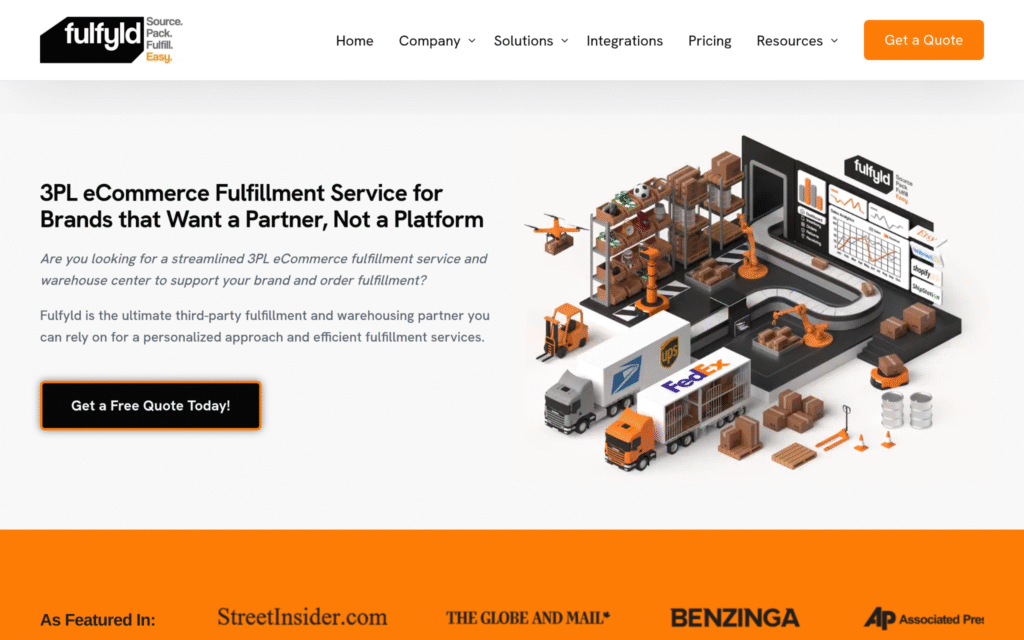
Fulfyld operates out of a 130,000 square foot warehouse in Madison, Alabama, and focuses entirely on e-commerce fulfillment for the US and Canada. They offer product sourcing, packaging design, order fulfillment, and door-to-door shipment, supported by InVia Robotics automation for picking accuracy. Their software connects with over 100 shopping carts and online marketplaces, which removes the typical connection friction smaller sellers deal with. The flat-rate pricing model without minimum order volumes is what makes them accessible to brands that aren’t yet shipping at high volume.
Where Does Fulfyld Win for Amazon Fulfillment Companies?
Sellers who want automation-backed accuracy without committing to a large minimum spend tend to get strong value here, especially in the early growth stages. Dedicated account managers for each customer is a detail that sounds small but actually makes setup and day-to-day problem-solving much smoother.
What the Reviews Show:
Fulfyld doesn’t have a large public review footprint yet, given they launched in 2016. The combination of robotics investment and flat-rate pricing attracts growing brands that want predictability, based on what the data shows. That focus on accessibility and automation together is a positioning approach not many 3PLs are doing at this scale.
Evaluation Criteria and Research Approach
Building a shortlist of the best Amazon fulfillment companies required more than a quick scan of provider websites. The research started from scratch, pulling from multiple public sources before any company was considered for inclusion.
What Gets Collected at the Beginning
The initial pool was assembled from logistics directories, third-party review platforms, industry publications, and case study repositories. Each provider’s official website was reviewed for service scope, geographic coverage, and platform integrations. The goal at this stage was breadth, capturing as many credible 3PL options as possible before any filtering began.
Filtering Candidates for Viability
Once the longlist was in place, providers without verifiable operational history in ecommerce fulfillment were removed. Review patterns were analyzed to identify consistency: one-off positive reviews carry less weight than a steady stream of feedback pointing to the same strengths over time. Providers with gaps in documentation, unclear service scope, or no traceable client outcomes were filtered out at this stage.
Cross-Checking Sources and Data Points
Claims made on company websites were compared against what clients and industry observers reported elsewhere. Where a provider described specific accuracy rates or fulfillment capabilities, those claims were checked against available case studies and external commentary. Real-world results, not marketing language, shaped which companies stayed in consideration.
The Authority Layer
Industry recognition, award history, and mentions in trade publications were reviewed as supporting signals. Appearing on lists like the Inc. 5000, receiving carrier-specific awards, or being cited by logistics publications adds context to a company’s standing in the market. These signals don’t replace performance data, but they do help confirm that a provider’s reputation extends beyond their own messaging.
Amazon Fulfillment Companies Case Files
Each shortlisted company was evaluated for specific evidence tied to Amazon fulfillment. This included dedicated service pages for Amazon-related logistics, verified client reviews from ecommerce merchants, and case studies showing real fulfillment outcomes. Providers that demonstrated specific knowledge of Amazon Seller Central requirements, FBA prep standards, and carrier compliance standards were prioritized over those with only general warehousing experience.
Finding the Right Amazon Fulfillment Companies for Your Needs
Choosing a fulfillment partner isn’t just about price per unit. The right fit depends on where your operation is today, where it’s headed, and how much your current team can actually manage. Here are five factors worth evaluating before you commit:
- Industry/Domain Experience: Look for providers with documented experience in Amazon-specific fulfillment, not just general warehousing. FBA prep standards and Seller Central requirements are specific enough that general logistics knowledge isn’t always enough.
- Features and Services: Match the service set to your actual needs. If you’re shipping high-SKU products, inventory management depth matters. If you’re in early growth, flat-rate pricing and easy connections matter more.
- Pricing Structure: Understand the full cost per fulfilled unit, including receiving, storage, pick and pack, and any returns processing fees. Transparent pricing without hidden minimums saves a lot of friction later.
- Results Measurement: Ask how each provider tracks order accuracy rate, on-time shipment rate, and the impact of late shipment rate. Providers that surface this data proactively take accountability seriously.
- Industry Knowledge and Compliance: Confirm they understand Amazon Seller Central requirements, FBA prep guidelines, and carrier compliance standards. Sellers in restricted product categories such as hazmat or oversized items need to be especially specific here.
Final Words
The right Amazon fulfillment partner protects your seller metrics, keeps costs predictable, and scales with your growth without requiring constant manual oversight. From established operators like Rush Order and Fidelitone to tech-forward providers like ShipMonk and Fulfyld, the options here cover a real range of operational sizes and needs. As Amazon’s fulfillment expectations keep rising, the sellers who build strong 3PL partnerships early will be the ones best positioned to compete.